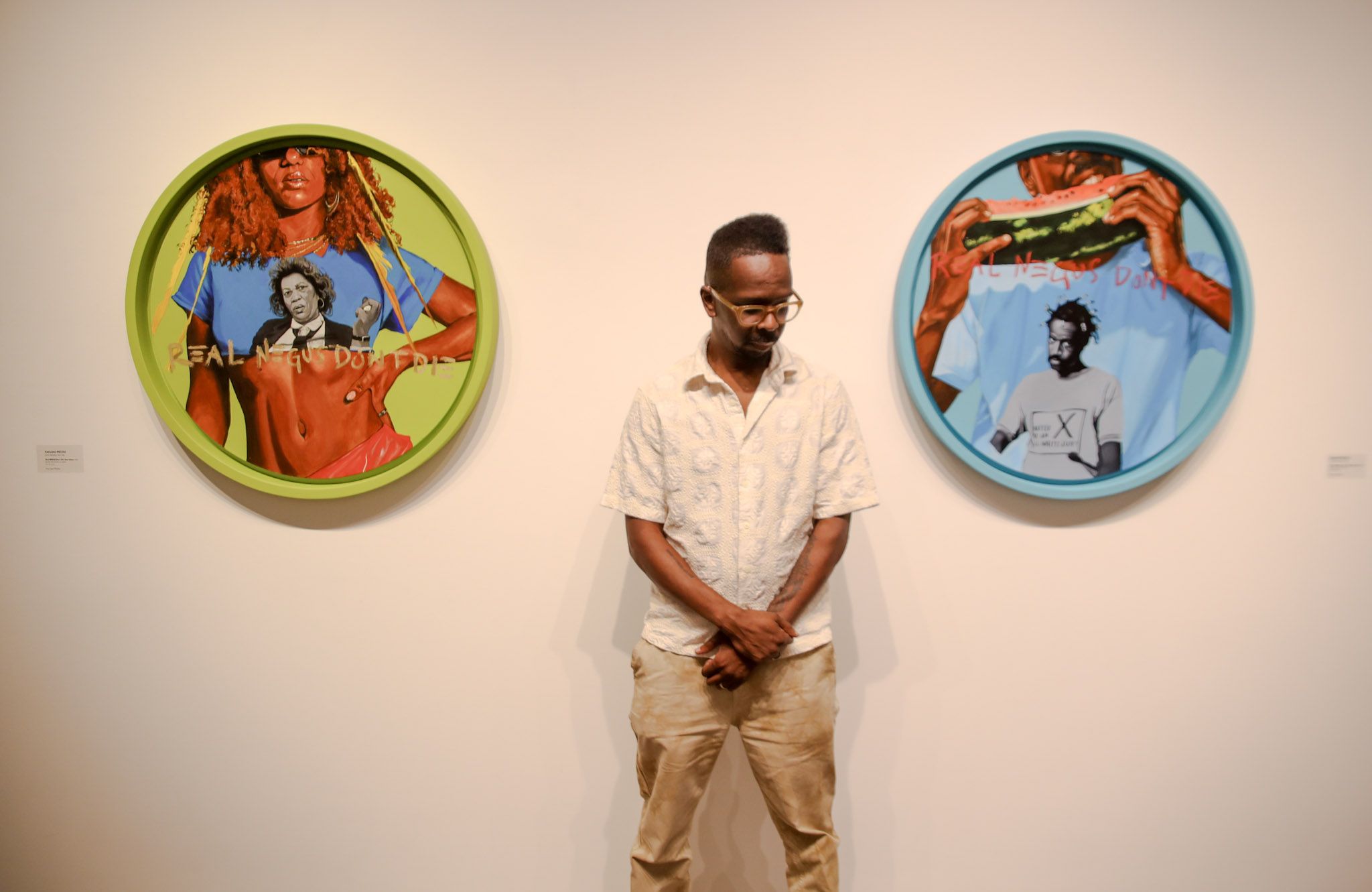
Fahamu Pecou on Black identity and resilience

Add Axios as your preferred source to
see more of our stories on Google.
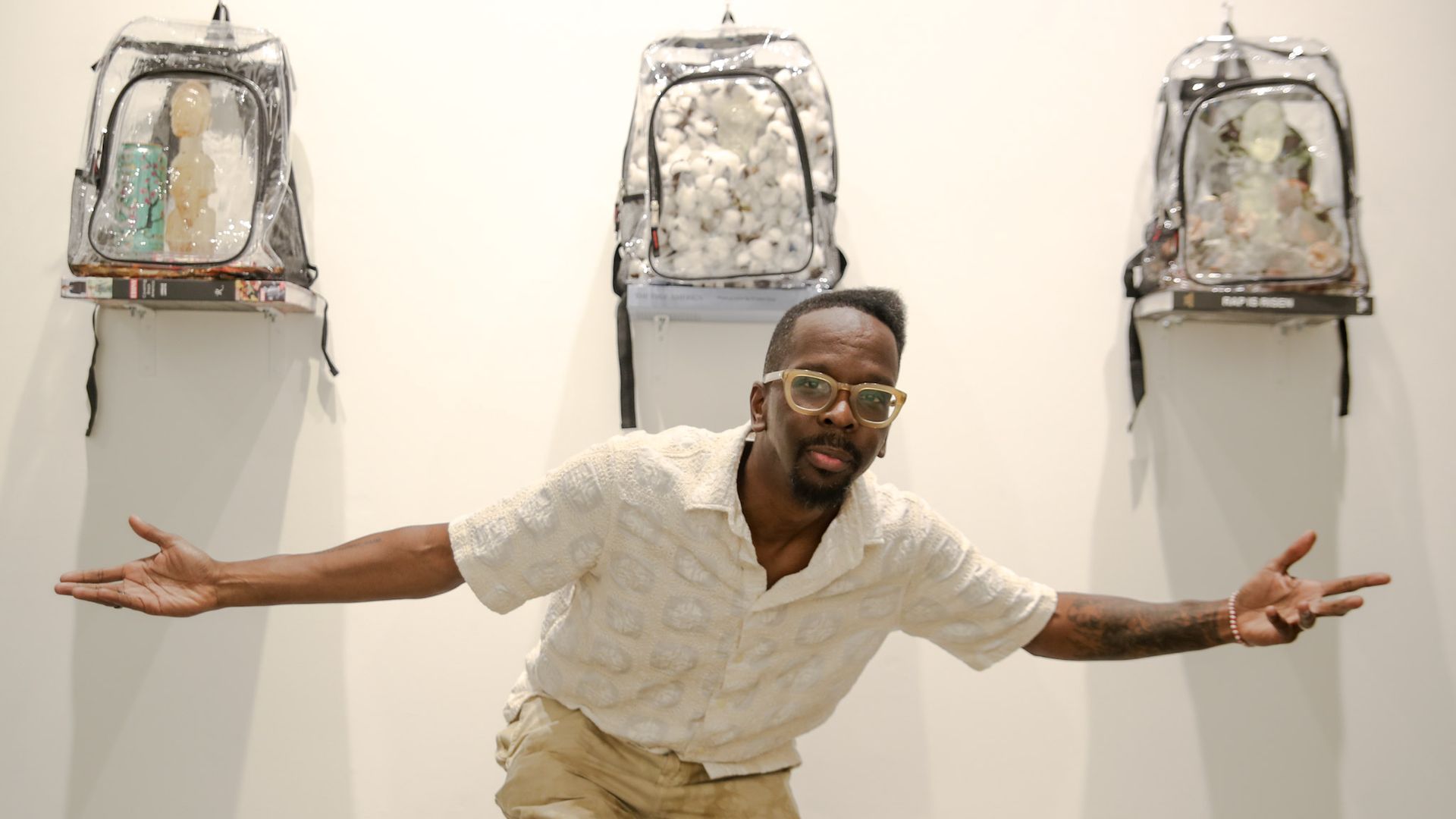
Artist Fahamu Pecou poses in front of his backpack sculptures, each filled with symbolic items that reflect resilience, history, and the complexity of Black identity. Photo: Malcolm K. Porter
Fahamu Pecou's latest exhibition, "We Didn't Realize We Were Seeds," is on view at the Johnson Lowe Gallery in Atlanta through November 23.
The big picture: This exhibition, featuring a striking 12-foot totem titled "The Rose That Grew Through Concrete," invites viewers into Pecou's world — a space where Black identity, cultural resilience, and artistic symbolism intersect.
- With an aesthetic grounded in research and informed by icons like Tupac Shakur, Pecou addresses Blackness on his terms.
Zoom out: Through the interplay of trauma and triumph, Pecou seeks to define Black identity beyond stereotypes imposed by external forces.
- The exhibition is more than just art; it's a dialogue on survival, resilience, and the complex beauty of Black culture, conveyed through layers of cultural symbols and visual references.
Below is an excerpt from Axios' conversation with Pecou, edited and condensed for clarity.
Tell me about the exhibit.
"The exhibit is called "We Didn't Realize We Were Seeds." The title itself starts the conversation.
- "The words 'they didn't realize we were seeds' have the 'they' crossed out and 'we' emphasized, highlighting how identity, especially Black identity, is often externally imposed. This exhibit is about self-determining that identity.
What do you hope people take away from this exhibit?
"I want people to recognize that Black identity isn't solely defined by trauma, though it plays a part. It's about evolving beyond imposed narratives.
- "We're like seeds, enduring and breaking through adversity, but becoming beautiful despite it. That's the essence of my work — celebrating resilience and the beauty within it."
How does Tupac and his legacy influence your work?
"I'm in an ongoing conversation with Tupac. Watching the "Dear Mama" documentary about Tupac and his mother sparked something in me.
- "Their struggle, despite hardship, showcased resilience and brilliance. It mirrored my own family's journey and led me to create this totem — 'The Rose That Grew Through Concrete.' It's adorned with cultural symbols, taking elements often seen as negative and elevating them to something beautiful."
/2024/11/05/1730835557729.gif)
Your work is multilayered, referencing everything from hip-hop to historical trauma. How does that process work for you?
"My work is rooted in Black cultural expression, drawing on the concept of 'Afrotropes,' recurring symbols in Black culture that speak across generations.
- "I connect this to the Congo cosmogram, a depiction of time as cyclical, not linear. In Black culture, past, present, and future are all happening simultaneously — they're all part of a continuous conversation.
- "For me, it's like hip-hop. Hip-hop takes old jazz riffs, African drum patterns, samples of past sounds, and combines them to create something entirely new — a composition where all of these times and influences coalesce."
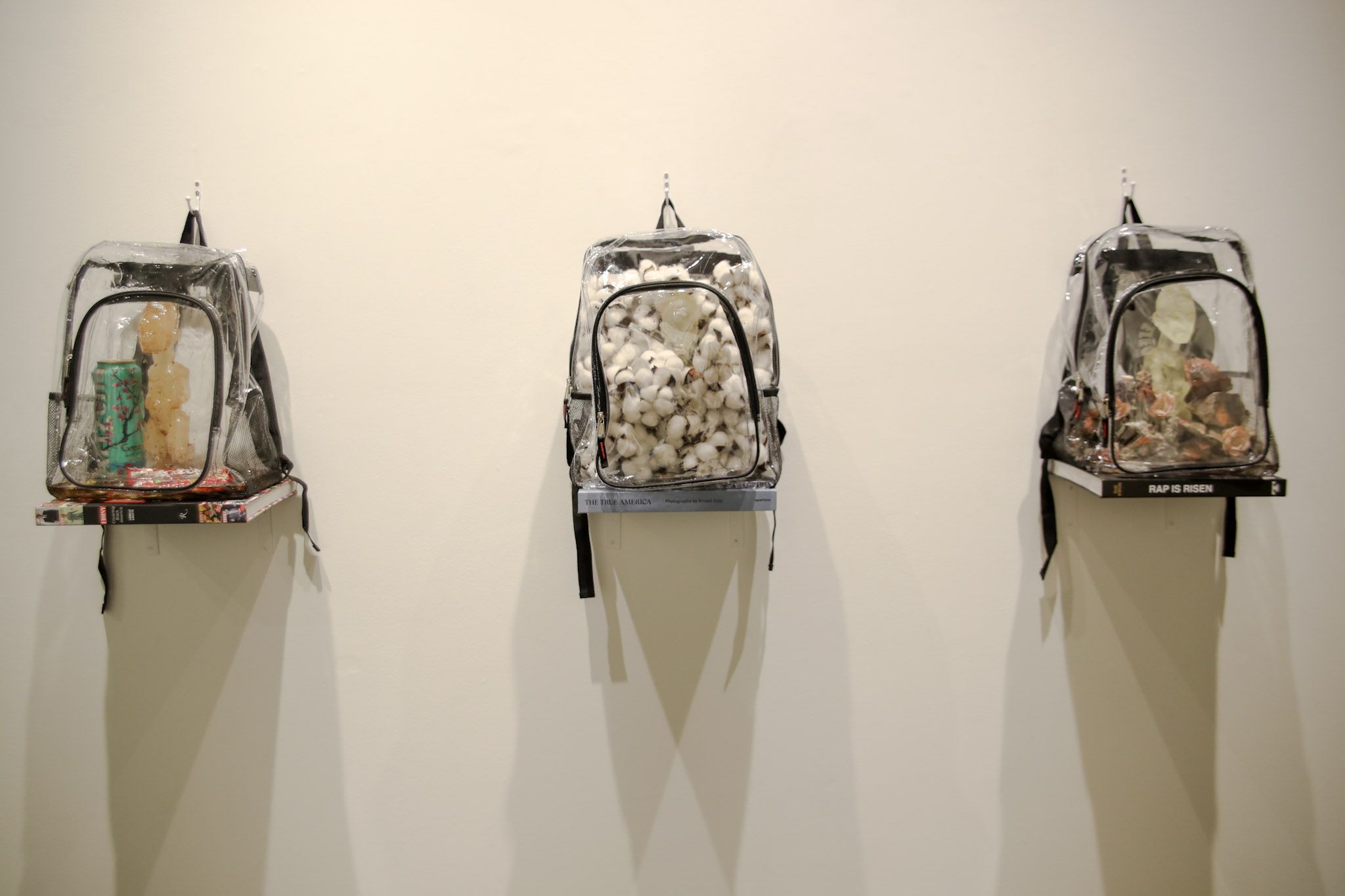
Can you explain the significance of the smaller statues inside the backpacks, with elements like Skittles, blood, and cotton?
"That statue is packed with layers, symbolizing historical trauma and resilience.
- "The backpack, Skittles, and what might look like blood reference Trayvon Martin, while the statue filled with cotton connects to the legacy of slavery. These elements honor our history, pain, and survival, but I don't want the focus to only be on trauma."
Why is Atlanta such an essential place for this exhibit?
"Atlanta shaped me in ways no other place could. Being Black here means you see possibilities you wouldn't elsewhere.
- "It's my first gallery show here since 2011, and it feels like coming full circle, given my first-ever show was here. Atlanta lets me be unapologetically myself, and I want to pass on that sense of agency."
How did you decide on your style as an artist?
"I self-taught graphic design, inspired by hip-hop magazines, and started by marketing myself like a rapper. My style developed as a satirical take on Black representation in art.
- "I wanted to challenge stereotypes and confront expectations around Black masculinity. My work is unapologetically Black because authenticity resonates more with audiences."