How a Georgia Tech library keeps Atari alive

Add Axios as your preferred source to
see more of our stories on Google.
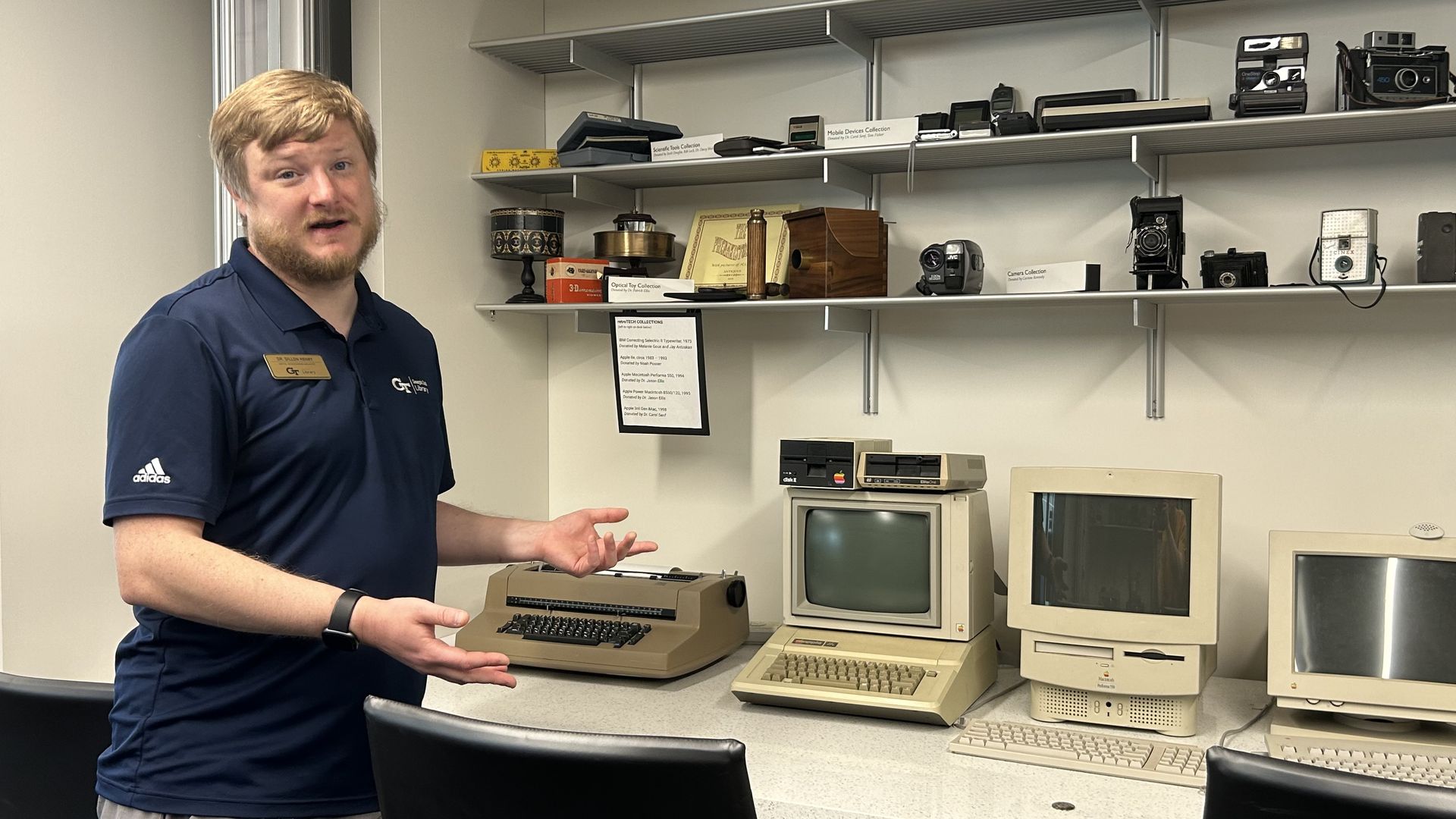
Digital accessioning archivist Dillon Henry oversees the RetroTECH Lab. Credit: Thomas Wheatley/Axios
Tucked away on the third floor of a Georgia Tech library, the RetroTECH lab sits ready to transport students to the land of Frogger, camcorders, those old-school classroom Macs and more.
Why it matters: Yesterday's video gaming consoles, movie players, and tape decks are great teachers of how technology works and can be the only way to access classic or cult content.
- Plus, it's just a really cool sight to see.
Zoom in: Overseen by digital accessioning archivist Dillon Henry, the collection includes circa 19th-century wax cylinder phonographs created by Thomas Edison.
- Plus, there's more recent tech like the N64. (You bet there's a copy of the console's classic GoldenEye.)
- The archive attracts engineering tech students and has hosted high school classes on field trips, Henry told Axios. He also opens the lab for Mario Kart sessions.
Other tech in the collection includes a Motorola bag phone and the Braun calculator that inspired the one on your iPhone.
The intrigue: According to the Software Preservation Network, 87% of commercial video games released before 2010 are not available for purchase from their original rights holders.
- Having physical copies of those games — and the devices for which they're designed — ensures they can still be accessed and enjoyed.
Fun fact: The technologies are cultural artifacts.
- The library owns a Philips CD-i, an early effort at supplanting video game cartridges with compact discs. (Terrible cutscenes from the system's Zelda game won YouTube fame and spawned memes.)
The intrigue: On Tuesday, he placed an order for LSD: Dream Emulator, a Japanese game for the PlayStation 1 that achieved cult status for trippy gameplay.
What's missing: Henry regularly scouts eBay and gaming sites for hard-to-find additions to the collection.
- He's on the lookout for early laptops and personal computers like the Commodore 64 and Amiga 500. He also wants more wax cylinder phonographs to give students the opportunity to record their own music on the long-gone medium.