College Park hopes development will encourage growth stunted by airport expansion

Add Axios as your preferred source to
see more of our stories on Google.
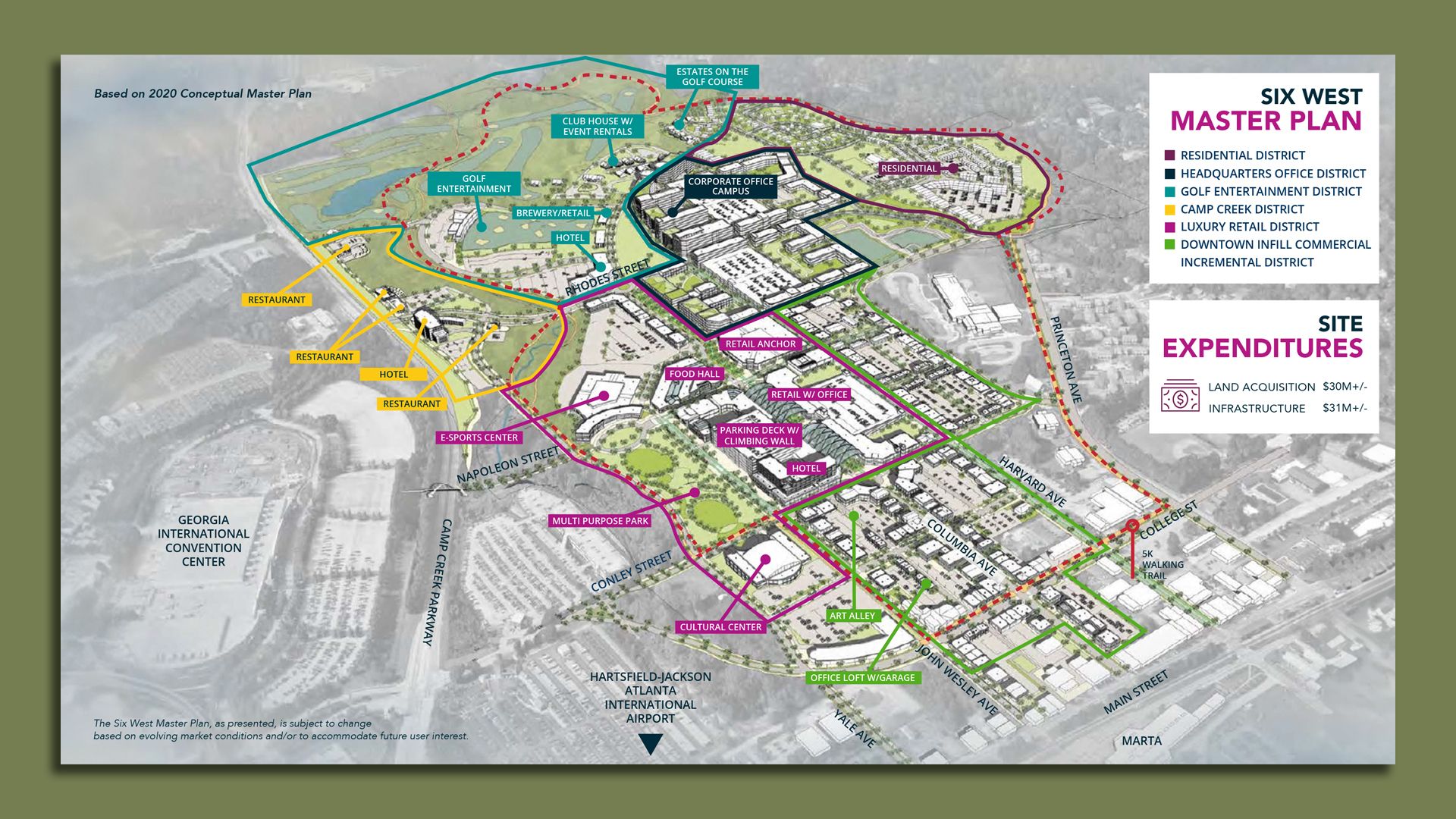
The master plan for College Park's proposed Six West development. Image: City of College Park
The city of College Park hopes a sprawling mixed-use project constructed in the shadows of the world's busiest airport will boost its population, which has been decimated by the facility's growth.
Why it matters: As Hartsfield-Jackson Atlanta International Airport's footprint grew over the last several decades, residents were uprooted from neighborhoods and any reminders that those communities existed — streets, businesses and other points of interest — were eventually wiped off the map.
- This dramatic drop in residents not only means fewer people on city tax rolls but takes away a community's sense of place.
The latest: College Park's proposed Six West development would sit on about 311 acres owned by the city west of downtown, east of the College Park Golf Course and northwest of the airport.
- A city document envisions a private development containing hundreds of residential units, hundreds of thousands square feet of retail space, more than two million square feet of space and more than 1,000 hotel rooms.
What they're saying: Michelle Alexander, College Park's economic development director, told Axios that the project could help reverse some of the "devastating" effects the airport's expansion has had on the city.
- "It doesn't let you have a sense of community," she said of the uses immediately surrounding the airport. "Those aren't uses that create walkable, livable communities."
Flashback: The airport in the 1970s began buying up property surrounding its facilities that weren't necessarily going to be part of the footprint, but "were close enough to the airport to be severely impacted," said Hannah Palmer, an East Point resident who wrote the book "Flight Path," which chronicles how the expansion gobbled up homes and communities.
- Thousands of homes, businesses, churches and schools were bought because they were "too close" to the airport and would be affected by noise.
- "I imagine that at the time, homeowners were grateful to get a buyout," she said. "But that means that some of that land just sat vacant for decades."
- This is evident when you drive around College Park, as you can see streets, mailboxes, stop signs and driveways, but the homes are gone and the land is "going back to nature," Palmer said.
By the numbers: College Park's population has dwindled as the airport has grown. According to U.S. Census Bureau data compiled by Erik Steiner of the Center for Spatial and Textual Analysis at Stanford University, College Park in 1970 had 18,203 people.
- It experienced a brief spike in 1980 with 24,632 people, but the population has since dipped to 13,914 as of 2022, US Census data show.
The big picture: The damage is not only limited to College Park, but Palmer told Axios that cities like Hapeville and Riverdale, as well as communities along Old National Highway have experienced a loss of residents due to airport buyouts.
- "I was just amazed that such a huge project could go on and it was misunderstood or completely under the radar for those of us who lived there and did not have any understanding of the big picture," she said.
The bottom line: Palmer told Axios that the expansion and the population loss has caused a "domino effect" resulting in south metro Atlanta missing out on the growth and investment that other parts of the region have experienced.
- She hopes Six West will be the catalyst that will bring "benefits to the community."
- "I'm not against the airport," she said. "I'm really proud of it, and I use it and enjoy it. But I'm ready to see some balance between the world's busiest airport and the city that it sits next to."