Atlanta's federal forecasters know when to seek shelter too

Add Axios as your preferred source to
see more of our stories on Google.
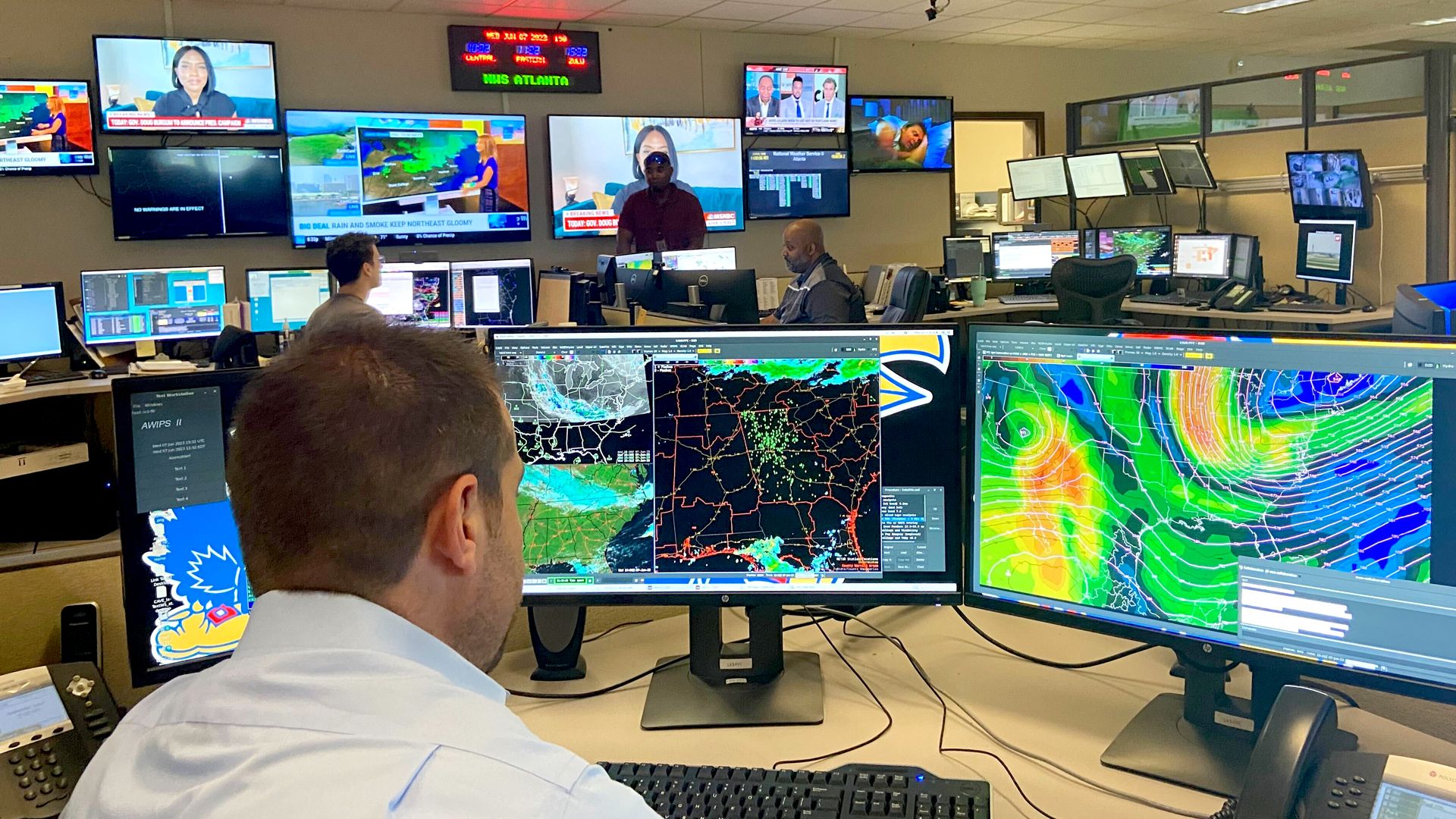
The National Weather Service's David Nadler pores over wind projections and other maps. Photo: Thomas Wheatley/Axios
Through rain, sleet, snow, tornadoes… and heat waves, sunny skies, and everything else Mother Nature can conjure, the National Weather Service's Atlanta division is there. Here's how they work.
Why it matters: The 24/7 forecasting hub outside Atlanta Regional Airport in Peachtree City keeps watch on the weather in roughly two-thirds of Georgia's 159 counties and provides real-time data hoovered up by government officials, TV meteorologists, financial analysts and more.
- The forecast you check daily using an app on your phone? The weather update at the top of every edition of Axios Atlanta? They're built using NWS data.
Driving the news: Georgia sees tornadoes from the west, hurricanes from the Gulf and whatever else the wind has stirred up on its way east, making the state a fascinating and challenging place to forecast the weather, said David Nadler, the office's warning coordination meteorologist.
- Flooding, for example, looks a lot different in South Georgia's sandy and absorbent soil than in the mountain north, where rocky geology routes rainfall to waterways much faster.
How it works: At any moment of the day and depending on the weather, up to eight meteorologists bounce between computer screens reading Doppler radars and running models to create regular forecasts — including one every two hours specifically for Hartsfield-Jackson Atlanta International Airport.
- Twice a day, the team and 90 other offices across the country release a hydrogen balloon to measure air pressure, wind and other factors.
- The balloon pops when it reaches 100,000 feet and the Styrofoam transmitter — marked "harmless weather instrument" to allay concerns — falls to Earth.
What they’re saying: Kirk Melhuish, a meteorologist who delivered weather reports on WSB Radio for 34 years, told Axios that NWS’ alerts were hugely important.
- “When you’re a one-person department broadcasting, you can’t do the work of a staff, especially on quick changing breaking weather like severe storms,” he said, adding that he still turns to the service for a heads-up on severe storms.
Flashback: The NWS began collecting data in Atlanta on Sept. 25, 1878, in the Kimball House, a grand hotel building (demolished long ago) in Downtown.
- Forecasters and their equipment bounced around downtown before landing at the Atlanta airport in the late 1920s. The agency moved to its Peachtree City office in 1994.
Threat level: The headquarters is built to withstand winds roughly 110 mph.
- But if a strong storm starts barreling down on the building — like when an EF-4 tornado tore through nearby Newnan in 2021 — the staff can hand off operations to NWS' Birmingham office and hunker down in a concrete-and-steel room in the center of the headquarters.
- For the rare Snowpocalypse-level lockdown, Nadler said, the office has cots and supplies.
The bottom line: Weather forecasting comes down to a mix of data, technology and highly skilled human analysis. It's as much of an art form as it is a science — and nobody's perfect.
- "Weather prediction, even today, is extremely challenging," said Nadler, who spent his teenage years checking his amateur forecasts against official weather reports for fun. "You just have to accept the fact that you're gonna miss the forecast. But the key is, how do you learn from it?
- "You move on and then over time, it's almost like your own AI learning kind of thing."