"Ghost Pools" explores race, class and swimming in East Point

Add Axios as your preferred source to
see more of our stories on Google.
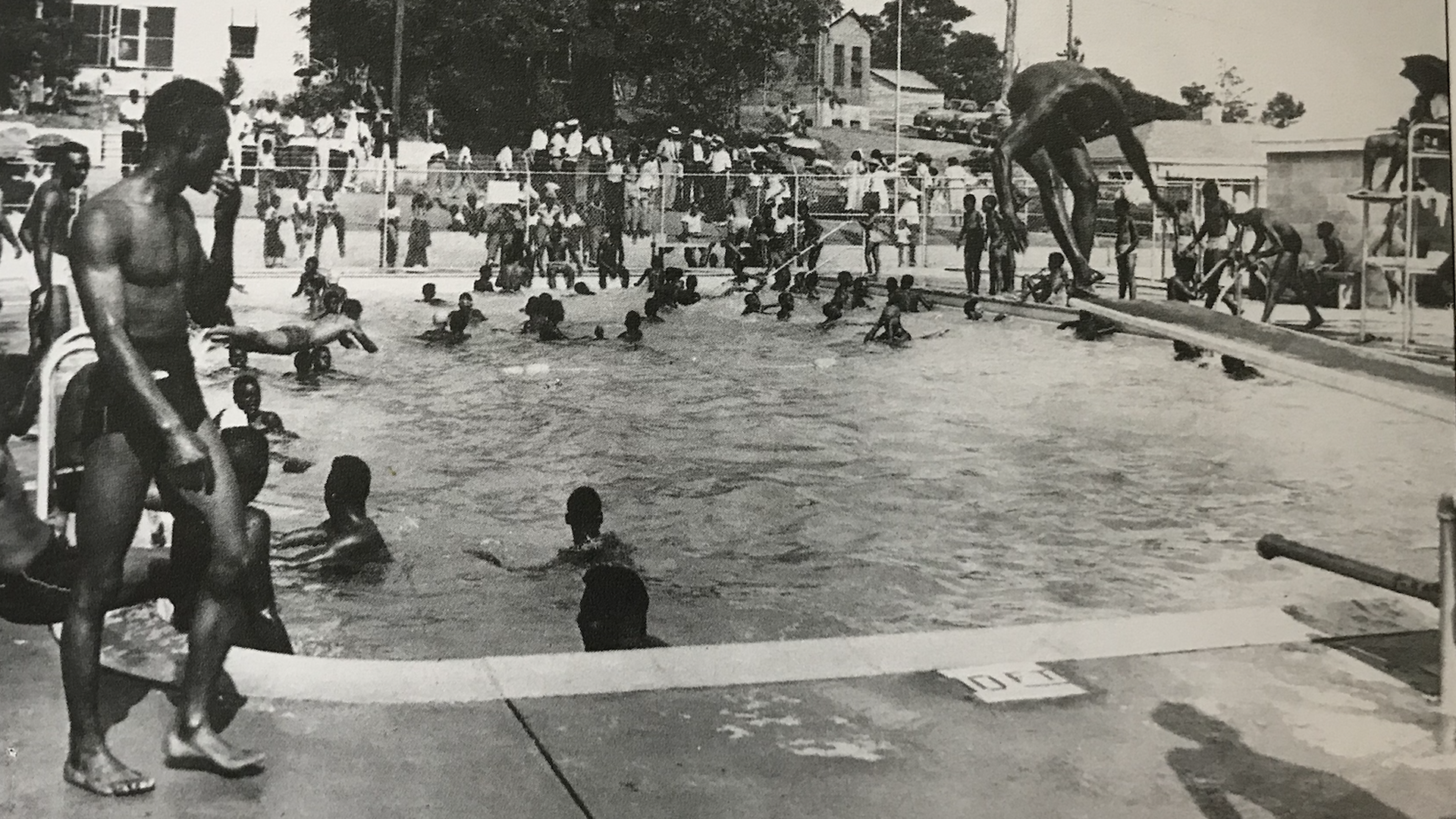
The Randall Street Pool. Photo: Courtesy of the East Point Historical Society
A multimedia installation, opening Saturday, examines how segregated public swimming pools shaped East Point and other communities before, during and after integration.
What's happening: Local writer Hannah Palmer's Ghost Pools explores the history of East Point's abandoned public pools starting in the 1960s when integration gave Black people greater access to shopping, dining and also swimming.
- The practice played out formally and informally in other cities throughout the South, and into the North.
Catch up quick: During the Jim Crow era, Spring Avenue Pool and Randall Street Pool were centers of East Point's white and Black communities, respectively.
- The pools became "battlegrounds for integration" in the 1960s. They fell into disrepair and closed in 1982 as public funding for such facilities dried up.
- The installation notes that lack of access to pools has contributed to disparities in the number of drowning deaths of Black swimmers compared to white swimmers.
Today the two locations are an empty grass field and a parking lot.
Details: On Saturday, the former pool locations will showcase the FLUX Projects installation, which mixes historical markers showcasing Palmer's research with dance from Ballethnic and Friends and sound by Santiago Páramo.
- The exhibition continues through the summer and includes an oral history listening session on June 17 organized by Ann Hill Bond of Capital B and Canopy Atlanta.
What they're saying: "Swimming is not only like this lifesaving, life-giving skill," Palmer told Axios. "It's a place where people come together and mingle and have fun and relax and experience joy — experience time outside — in a way that's really special and different."
In the weeds: Palmer, who lives in East Point, started researching the city's pools roughly seven years ago when her children approached swimming age, and she discovered no nearby options.
- Her research included discovering that the original segregated Grant Park pool was closed and partially filled in prior to integration in 1961 to become a home for Zoo Atlanta's seals.
Of note: Palmer, one of Atlanta's most inquisitive writers, explores the conflict between Atlanta's built and natural environments and how the two shape the region's history.
- "Flight Path," her 2017 book about growing up in a small town wiped off the map by the expansion of the Atlanta airport, is a modern must-have on a shelf of local books.