Martin Shrkeli is still trying to build a pharma empire, even though he's locked away in prison for the next 5-plus years, per the Wall Street Journal.
Why it matters: After his past moves in the industry, Shrkeli inspired at least 1 pharmaceutical CEO to jack up drug prices. The chief executive of Nostrum Laboratories told the Financial Times it was "a moral requirement" to sell an antibiotic at the highest price.
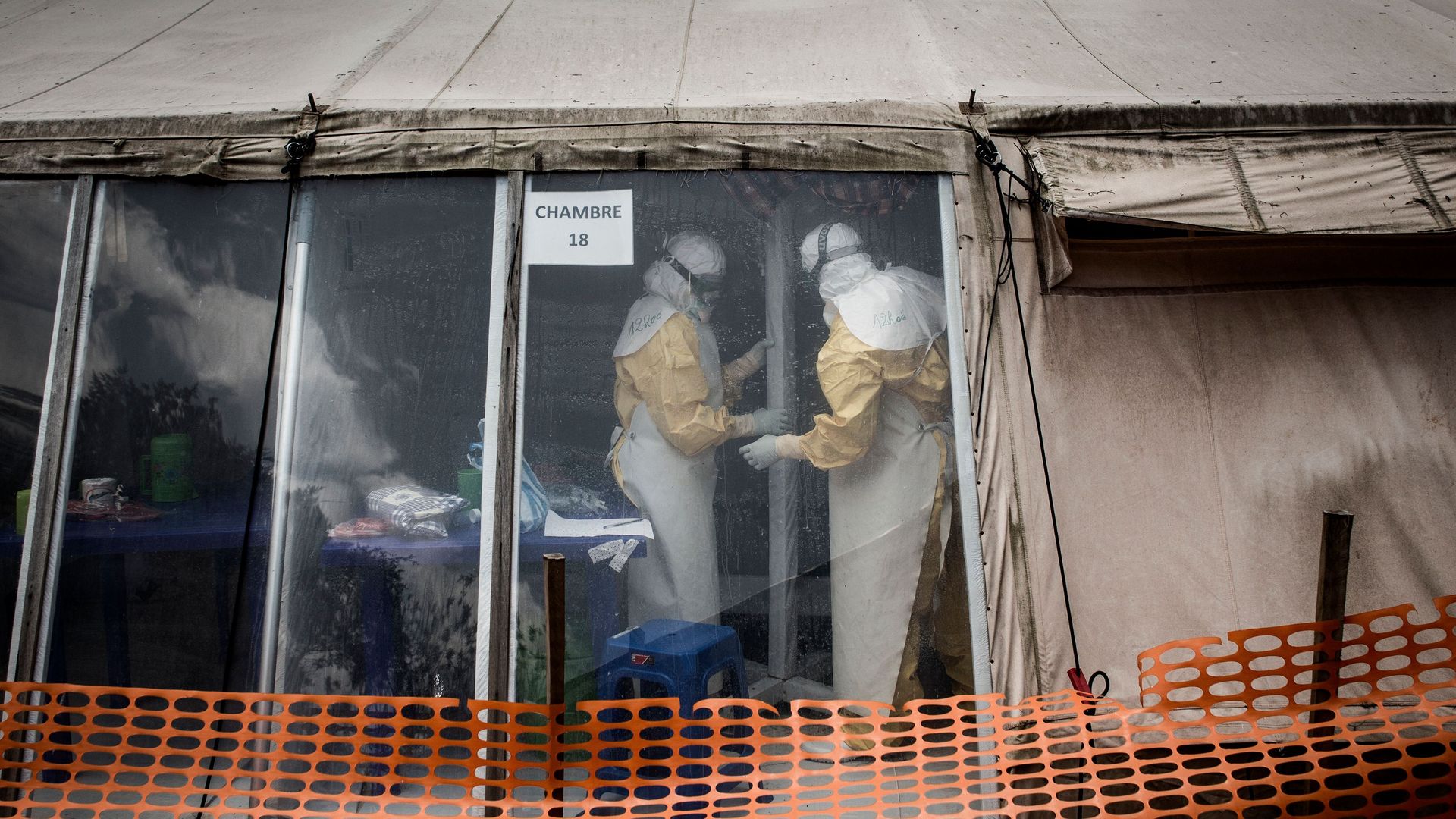
An Ebola treatment center in Butembo, the epicenter of an outbreak in the Democratic Republic of the Congo, was attacked again by armed assailants on Saturday morning, the AP reports.
What's happening: One police officer was killed in Saturday's attack and the treatment center currently remains open, per the AP. The center reopened only 1 week ago after Doctors Without Borders (MSF) temporarily halted operations in Butembo following last month's attack.
Cleveland County District Judge Thad Balkman decided on Friday that Purdue Pharma — the infamous manufacturer of OxyContin — along with Johnson & Johnson and Teva Pharmaceuticals Industries Ltd., are due in court May 28 in a multibillion-dollar lawsuit, despite efforts to postpone the trial, reports Reuters.
Details: Oklahoma's Attorney General Mike Hunter has accused the companies of feeding the state's opioid epidemic. Reuters also reported that Purdue was considering filing for bankruptcy, alleging such action could give the company time to review legal liabilities and delay the court case. Purdue's attorney argued moving the trial to Sept. 16 was necessary because the state "belatedly turned over 1.6 million pages of records critical to Purdue's defense ... But the judge said the drugmakers had not established the state's actions had prejudiced them."
The Wall Street Journal reports that HHS is thinking about forcing doctors and hospitals to publicly disclose how much they get paid from insurance companies — not just the list prices they start out with.
Why it matters: WSJ sums it up nicely — this move "would expose for the first time the actual cost of care."
Democrats’ Medicare for All debate has turned into a referendum on the existence of private health insurance. But simply having private health insurance isn’t the weird thing about the U.S. system — the weird thing is how we go about it.
The big picture: Health care in the U.S. is yoked to employment — it's a form of compensation for workers, and then we use a smattering of public programs to fill in the gaps. Other rich countries, though, treat health care like a social program and organize their systems accordingly. And their way is cheaper and more effective.
The United States pays much more than other developed countries per person for prescription drugs, but the average out-of-pocket portion of this is about on par with what people in other countries pay.
Between the lines: While this means that insurance in the U.S. covers a bigger portion of drug costs than in other countries, list prices are also higher here — meaning that plenty of people who are uninsured or have high deductibles are faced with large drug bills. And we're all paying for these high drug costs through taxes and premiums.
The Ebola outbreak in the Democratic Republic of the Congo has now passed 900 cases, and community mistrust and endemic conflict in the region continues to slow progress despite the availability of promising new treatment options.
Why it matters: This is the 2nd-largest outbreak of Ebola on record, and the first to occur in a country experiencing violent conflict, which is complicating response efforts.





/2019/03/07/1551997238484.gif?w=3840)


