Saturday's energy & climate stories

The climate confidence gap

"Ambition" is a constant refrain at climate summits, but new analysis finds little reason to believe most countries will fulfill their aggressive emissions pledges.
Driving the news: The research in Science analyzed countries' net-zero commitments, assigning a "confidence score" of higher, lower, or much lower.
- It's based on whether they're legally binding, have "credible" policy plans, and whether near-term policies put emissions on a downward path.
Threat level: The topline conclusion is that 90% of the 35 targets analyzed are in the "lower" or "much lower" confidence bucket.
- "Looking at policies instead of promises shows that global climate targets may be missed by a large margin," it notes.
- The "lower" club includes the U.S. and China, the world's top two emitters, while the European Union is in the "higher" band.
Why it matters: Reaching net-zero globally around 2050 is a guidepost for hitting increasingly long-shot Paris Agreement goals that hold temperature gains to well under 2°C, and ideally to 1.5°C, compared to preindustrial times.
How it works: The authors looked at future emissions and temperatures under five scenarios.
- They range from only current policies to combining them with varying amounts of faith in net-zero targets and nearer-term Paris pledges ("nationally determined contributions," or NDCs, in Paris-speak).
- The most optimistic case assumes nations fully implement their NDCs and long-term net-zero targets, regardless of how much credibility the authors assigned.
What they found: The most conservative case — looking only at existing policies — sees temperatures rising by a median estimate of 2.6°C (4.7°F) in 2100, with a wide band of uncertainty in both directions.
- When "higher confidence" net-zero targets are tossed in, the median rise is 2.4°C (4.3°F) — way past the Paris targets.
- That most optimistic case sees a median rise of 1.7°C (3.1°F) — not too far off the Paris target.
Of note: The new paper comes as a separate study warns that "the world has eliminated half of its remaining carbon budget to keep warming to 1.5 degrees Celsius compared with preindustrial levels in just the last three years," the Washington Post reports.
What we're watching: How many nations act on the Science paper's easier-said-than-done recommendations.
- The include putting net-zero targets into law — only 12 of 35 assessed are binding — to creating stronger, more detailed, and sector-specific implementation plans.
The bottom line: “Climate change targets are by their nature ambitious — there’s no point in setting a target for a foregone conclusion. But implementation must follow,” co-author Taryn Fransen of the World Resources Institute said in a statement.

Wildfire smoke is also a carbon emissions problem
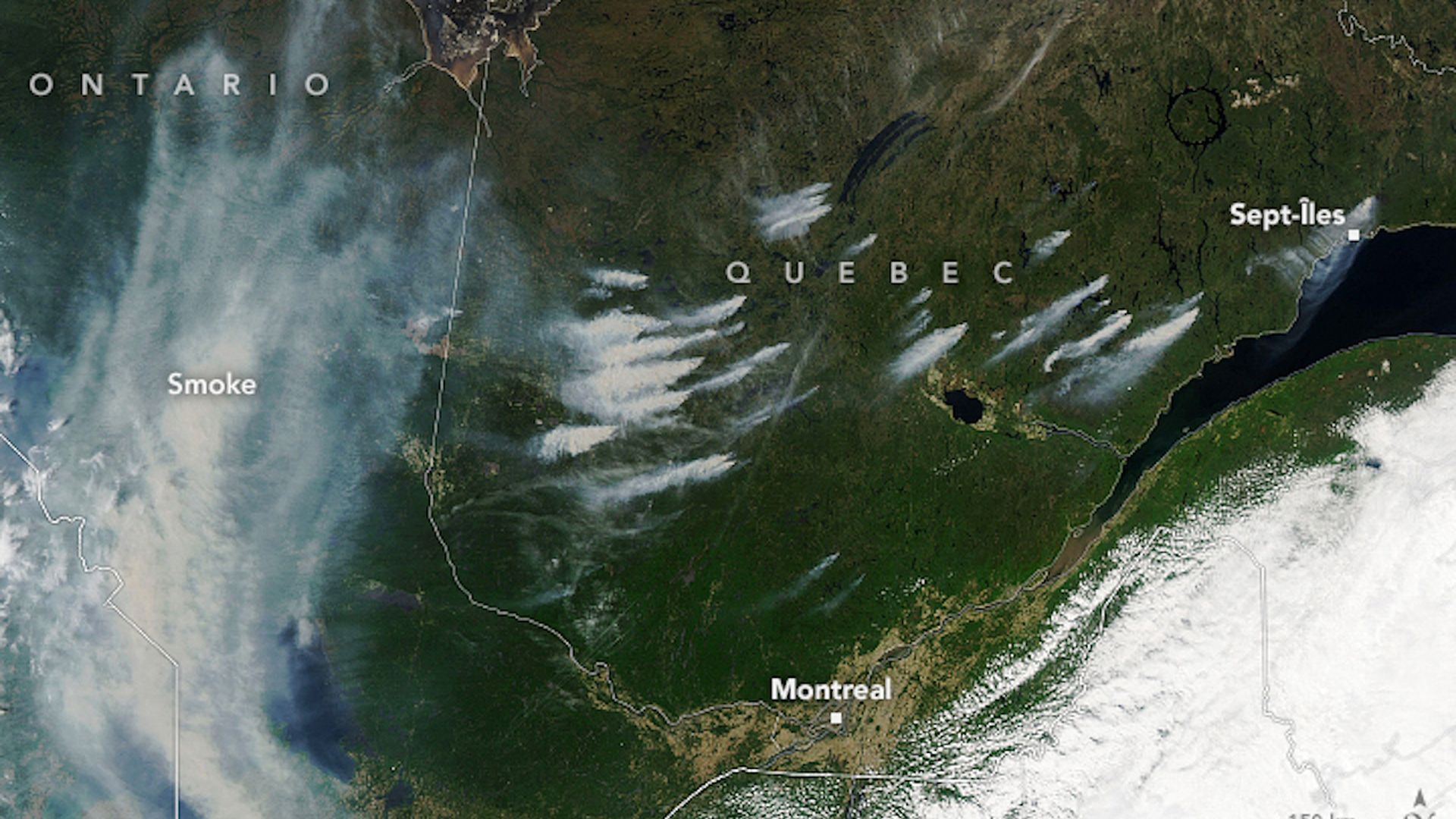
The worst wildfire-related smoke event in the U.S. since at least 2006 is beginning to wrap up, at least for the big cities on the East Coast, even as the dangerous summer fire weather continues in Canada.
Why it matters: What is happening in Canada does not stay in Canada, which the U.S. smoke crisis of the past few days has demonstrated. But there are global interests to worry about, too, because the U.S.'s northern neighbor is also breaking carbon emissions milestones.
Zoom in: Monitoring from the Copernicus Atmosphere Monitoring Service shows Canada is setting records for its wildfire-related carbon emissions so early in the fire season.
- Canadian wildfires set a record for carbon dioxide emissions during May as well as the first few days in June.
- This beats prior data for the same periods going back to 2003 when satellite fire emissions monitoring began.
- Ignited largely by lightning, the wildfires have been fueled in large part by climate change-worsened heat waves and dry conditions, along with land-use trends.
Of note: Though other ecosystems are also being affected, the trend toward increased wildfires in the Far North, particularly the boreal forests ringing the Arctic, is a positive climate feedback.
- The CO2 and methane released in such blazes cause more warming, which can then fuel more heat waves and wildfires in a vicious cycle.
The intrigue: Stanford University climate scientist Marshall Burke, whose work identified this smoke event as the worst since at least 2006, told Axios that the role played by climate change in this is clear.
- “They have a human component,” he said of these fires. “We should not think of these as a random occurrence.”
Record-breaking wildfire-related smoke event affects at least 61.8 million
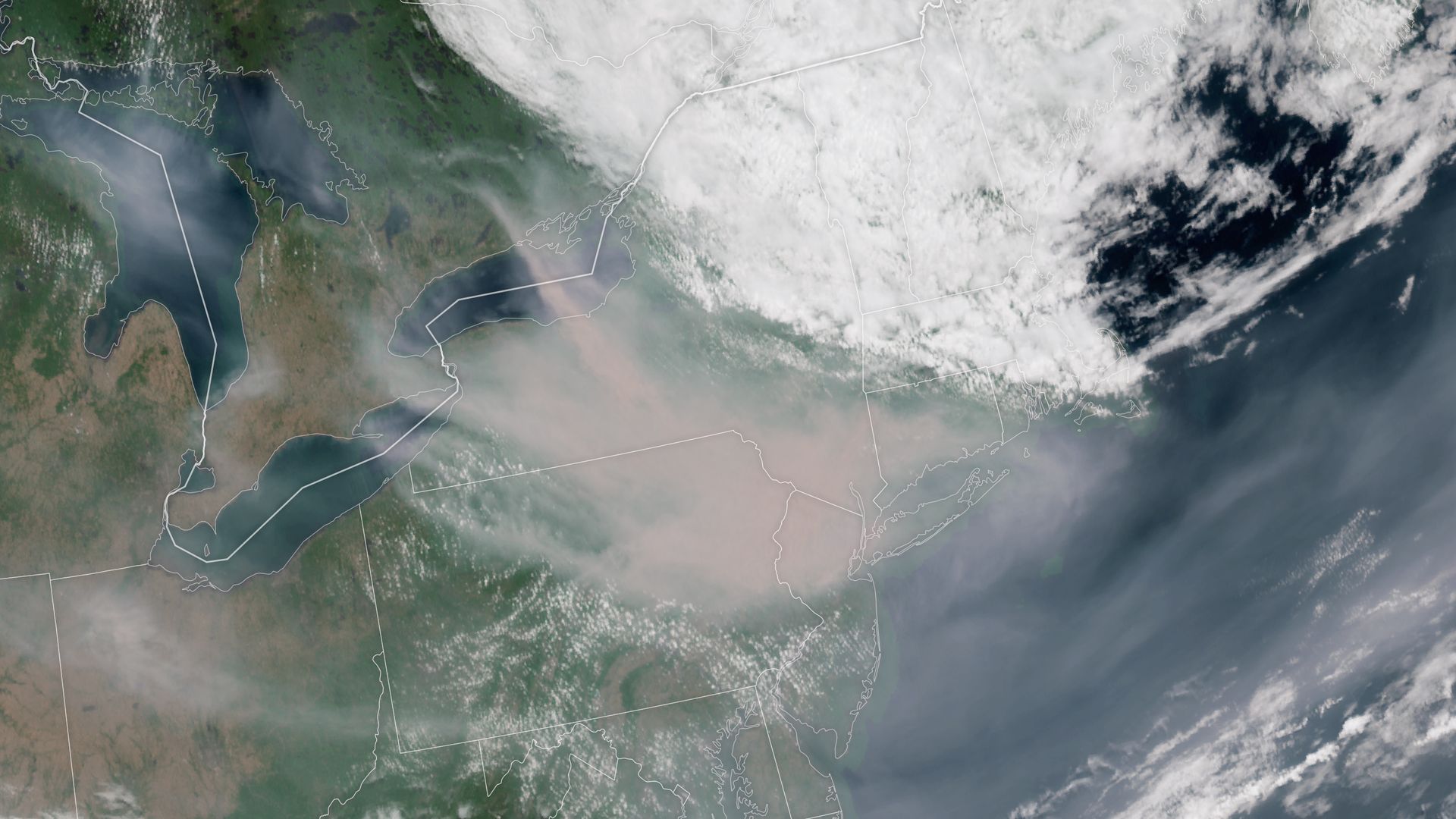
The scope and severity of the Canadian wildfire-induced smoke event that has enveloped the New York to Washington corridor is astonishing even sober-minded meteorologists and climate scientists.
The big picture: Poor air quality records have been shattered in multiple cities and states, including the nation's capital, which saw its first-ever "Code Purple" day for fine particulate pollution on Thursday.