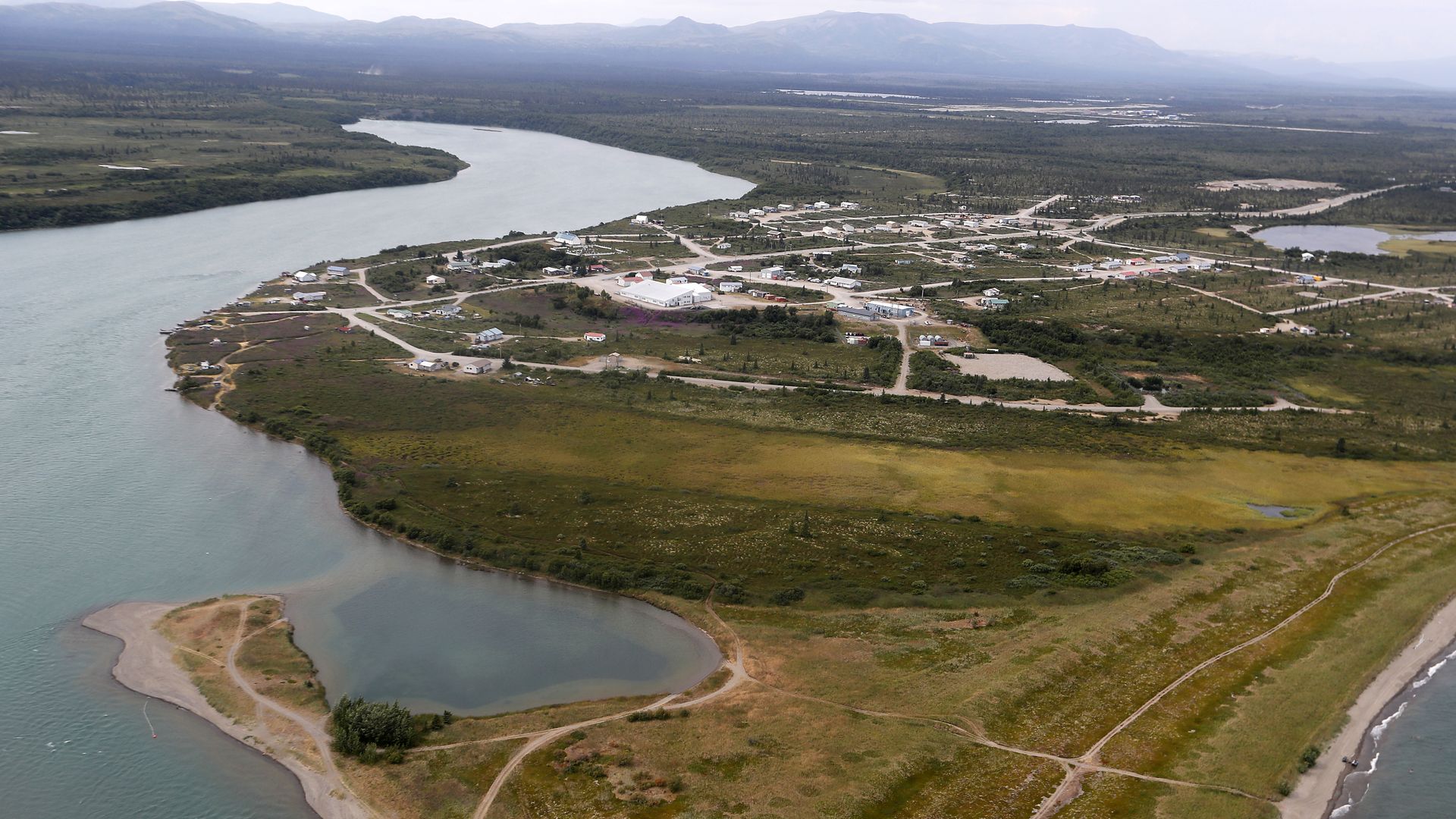
The U.S. Army Corps of Engineers denied a permit for the controversial Pebble Mine in Alaska on Wednesday, saying the "proposed project is contrary to the public interest," per the New York Times.
Why it matters: The decision is a win for Indigenous, environmental and fishing groups who argued the proposed gold and copper mine would be detrimental to the wildlife in region, which is home to the world's largest sockeye salmon fishery.
Powerful lobbying groups are throwing their support behind oil companies' efforts to keep climate-related lawsuits against the industry out of state courts.
Driving the news: The U.S. Chamber of Commerce and National Association of Manufacturers, among others, filed amicus briefs this week supporting Big Oil companies in a pending jurisdictional case before the Supreme Court.
Crude oil is tradingat its highest levels in eight months and prices may be poised to escape the rather narrow band where they've been stuck since June after coming back from their spring depths.
Why it matters: The gains this week don't just matter for the beleaguered industry's future — they're a sign that traders see the promise of COVID-19 vaccines allowing life to begin returning to the before times.
Enel Group,the Italy-based global power giant, is planning to spend $190 billion over the next decade in a push that includes a huge expansion of renewables and wider clean-energy infrastructure and business lines.
By the numbers: The company, already a big renewables player, said Tuesday that it's devoting $83 billion toward plans to grow its installed renewables capacity to 120 gigawatts by 2030, up from about 45 GW now.
Chicago-based Invenergy has announced the green energy generation and storage operator is installing what will be largest solar farm in the United States in five phases over the next three years through a $1.6 billion investment.
Why it matters: The 1,310-megawatt facility based in northeastern Texas aims to help consumer brands like AT&T, Honda, Google and McDonald's meet their clean energy goals while supplying 300,000 homes across three cities with power upon its completion in 2023.
As of Tuesday morning, we know a lot more about President-elect Joe Biden climate personnel orbit, even as picks for agencies like EPA and DOE are outstanding, so here are a few early conclusions.
Why it matters: They're the highest-level names yet announced who will have a role in what Biden is promising will be a far-reaching climate and energy agenda.
Dozens of oil-and-gas companies — including the big ones like BP, Shell and Total — are pledging to provide more detailed information about their methane emissions.
Why it matters: Methane is a very strong planet-warming gas and atmospheric concentrations keep rising, as new World Meteorological Organization data shows. Releases or leaks from oil-and-gas well sites, pipeline and other infrastructure are a key source.
A speech Friday by Esther George, president of the Federal Reserve Bank of Kansas City, offers an interesting high-level look at the economic influence of gasoline prices and why it may never be the same.
The big picture: Gasoline prices account for a smaller share of household spending than they once did — about 4% in the 1980s to roughly 2% last year, though it's much higher for low-income families.
Why it matters: Record levels of greenhouse gases are trapping heat in the atmosphere, increasing temperatures and driving more extreme weather, ice melt, sea-level rise and ocean acidification, the WMO said, noting that "carbon dioxide remains in the atmosphere for centuries and in the ocean for even longer."


/2020/11/25/1606314809496.gif?w=3840)