Thursday's economy stories


Social Capital says its 'IPO 2.0' is a better process for unicorns
Venture capital firm Social Capital wants to make going public cool again, this morning raising $600 million in an IPO for a blank check acquisition company that is designed to eventually acquire a tech "unicorn."
Unicorn? That's the Silicon Valley term for a privately-held startup valued at $1 billion or more.
Why it matters: There is a glut of highly-valued and well-capitalized startups that have avoided going public, often to avoid both the hassle of an IPO and the scrutiny that comes with being listed. The trend has frustrated a lot of startup employees and investors, who want to convert their equity into into cash. Social Capital hopes its approach can help alleviate the pressure.

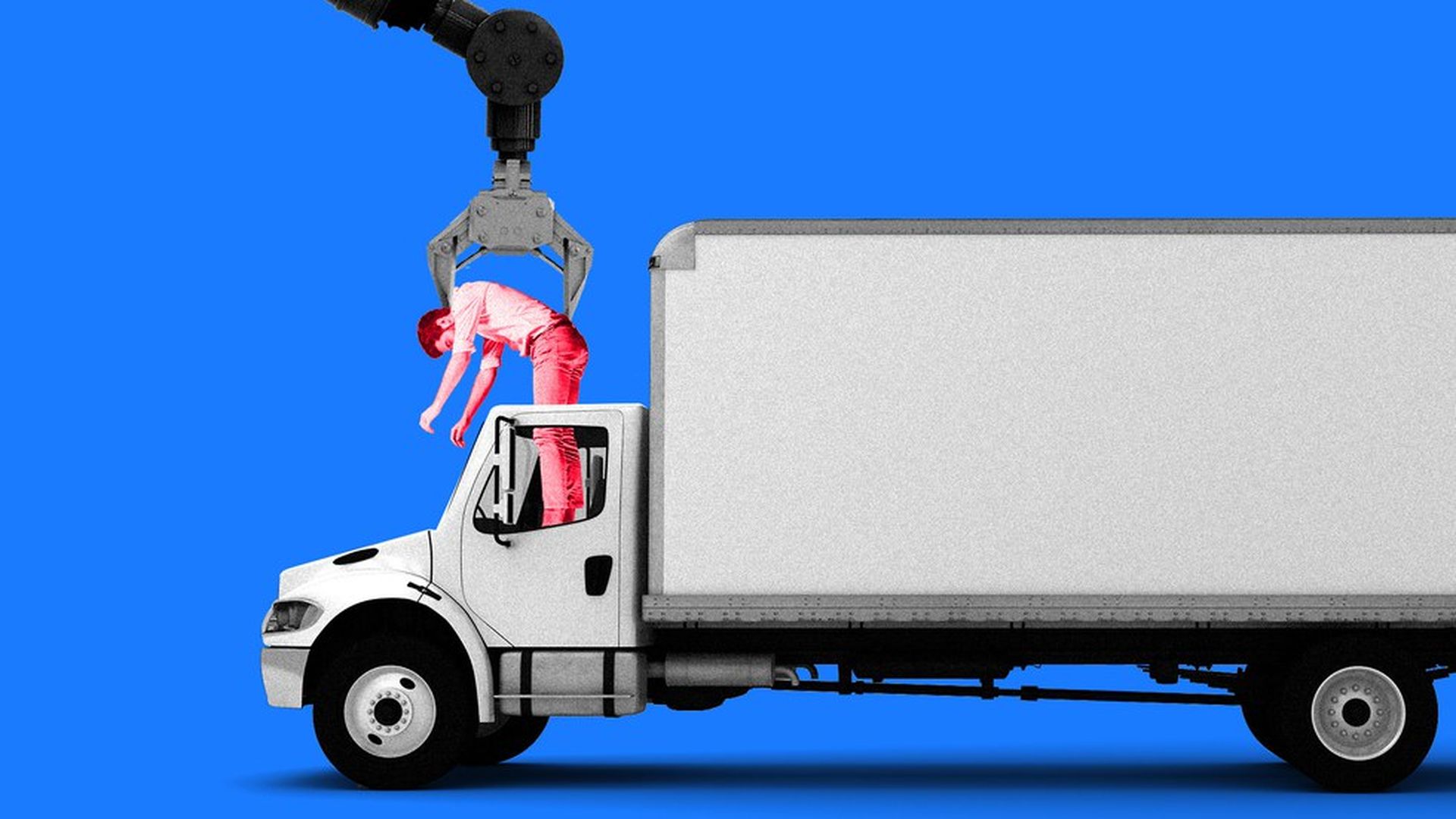
Truck driving jobs could be first casualty of self-driving cars
Truck drivers are stuck in the middle of the first major battle in Congress over whether self-driving cars and other artificial intelligence-enabled technologies could take away people's jobs.
On one side, you have Democrats claiming that rolling out automated trucks too quickly will hurt employment and safety; on the other, Republicans who want to quickly move a legislative package meant to speed up the deployment of self-driving technology.
The bigger picture: Truck drivers might be the first set of workers caught in the tug-of-war between old jobs and new technologies. But with Google, Amazon, IBM and numerous other companies staking their future of artificial intelligence, they won't be the last.

Chinese firms are cashing in on bitcoin-mining
Bitcoin mining has become very big business — one that Chinese entrepreneurs have built a vast infrastructure to exploit. The New York Times reports on the bitcoin mining boom in rural China, where firms have set up vast server farms to help maintain the bitcoin blockchain by solving cryptographic problems in return for payment in bitcoins.
Bitmain China is one firm cashing in, operating a bitcoin farm on the outskirts of the Gobi Desert near the Mongolian border that mints $318,000 worth of bitcoin each day.
Why it matters: Bitmain's success illustrates one half of China's love-hate relationship with Bitcoin. Regulators are cracking down on potentially dangerous speculation in the currency and worry that it will aid in the evasion of strict rules on moving money in and out of China. But government officials still want to allow profitable mining of the currency and cultivate expertise in a technology that will be important for the future digital economy.
America's insatiable wireless appetite
In many ways, the release of the first iPhone 10 years ago launched the smartphone era. Since then, mobile data consumption has skyrocketed and, in the process, helped turn wireless companies into digital media conglomerates.
By the numbers:
- Mobile data traffic has experienced a nine-fold increase since 2012 in North America, and it has the highest smartphone and 4G network adoption rates of any region worldwide, according to GSMA.
- In 2016, there were 291 million unique wireless subscribers in North America, representing 80% of the region's population.
- There are now more mobile subscriptions in the U.S. than people.