How Trump's newly launched immigration program could create legal chaos

Add Axios as your preferred source to
see more of our stories on Google.
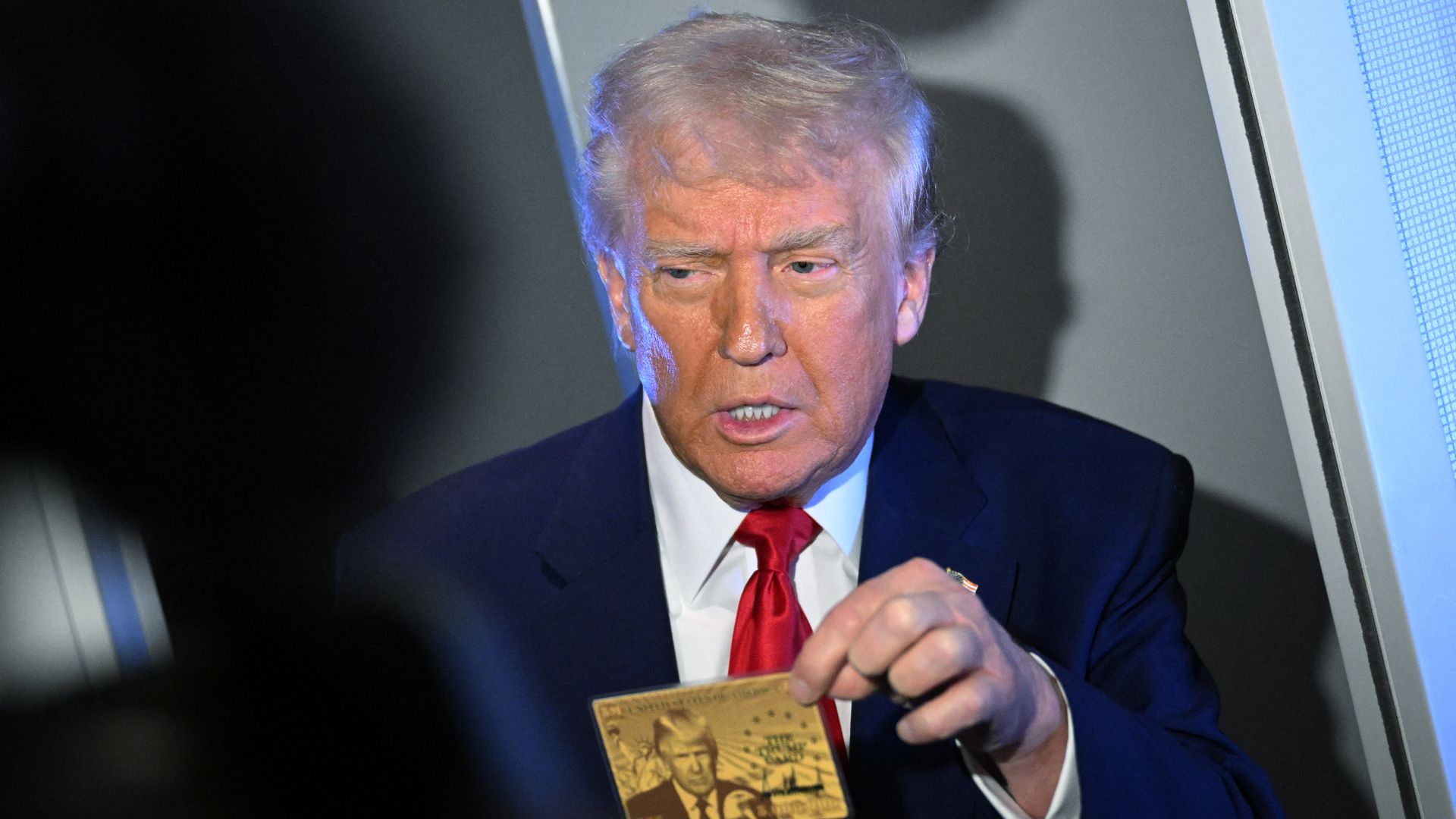
President Trump holds the Trump Gold Card while in flight on board Air Force One, en route to Florida in April. Photo: Mandel Ngan/AFP via Getty Images
President Trump's "gold card" program could endanger applicants' money, lead to revoked citizenship, or inspire fraud, legal experts told Axios.
The big picture: Trump's hardline immigration crackdown has disproportionately impacted impoverished households, but the president's Gold Card program could flip the script, causing financial and logistical problems for wealthy applicants.
Driving the news: The Trump administration began accepting applications for the gold card on Wednesday.
- The program allows people to apply for "legal status as a permanent resident" after being approved for an EB-1 or EB-2, visas typically reserved for highly-skilled workers or people with advanced professional degrees.
- These applicants must contribute an extra $1 million to the government to seal the deal.
What they're saying: Trump is ignoring the legal pathways to implement the program, which could create a variety of problems across the immigration system, experts told Axios.
- A new visa program needs to go through Congress and be authorized by a statute, Shev Dalal-Dheini, Senior Director of Government Relations at the American Immigration Lawyers Association (AILA), told Axios.
- Shira Levine, Deputy Legal Director at the Immigration Institute of the Bay Area, told Axios that bypassing legal mechanisms for the gold card programs reflects that Trump's administration "believes the immigration system is his personal playground and can be weaponized against individuals and communities."
The other side: "President Trump has been clear: our immigration system should benefit the United States of America, which deserves the best and brightest who can contribute to our country," White House spokesperson Kush Desai told Axios in a statement.
- "Unfortunately for liberals and Democrats, neither the Trump administration nor the American people are interested in flooding our country with people who cannot contribute to our country or follow our laws."
- The White House did not respond to Axios' request for comment on the legality of the program.
- U.S. Citizenship and Immigration Services did not immediately respond to Axios' Thursday afternoon request for comment.
State of play: Trump on Wednesday hailed the arrival of the gold card scheme as an "EXCITING" direct path to Citizenship "for all qualified and vetted people."
- The gold card site says applicants can receive U.S. residency "in record time" after paying a $15,000 processing fee.
- They must undergo a background check afterward. Certain nationalities are subject to a longer processing time, per the site.
- If their background is approved, applicants must contribute $1 million.
Zoom out: Wealthy applicants will likely face trouble because the Trump administration is disregarding concrete legal guidelines for the visa program, experts told Axios.
- Trump is "trying to squeeze" the gold card program into an existing one for highly-skilled immigrants, EB-1 and EB-2, said Dalal-Dheini, who worked for USCIS for over a decade before joining the AILA.
- In lieu of going through Congress, Trump could have gone through the "notice and comment rulemaking" process as the Biden administration did when it fortified the Deferred Action for Childhood Arrivals program into law, she said.
Threat level: Not using this legal pathway or the congressional route means a court can later decide that the program is illegal, which could mean applicants never get their $15,000 back — or even their $1 million contribution.
- Dalal-Dheini warned against applying for the visa "because if anyone challenges it and the court finds that it's illegal," an applicant can lose the money — "or at the very minimum, they'd have to sue the U.S. government to get it back."
- Their citizenship could be revoked, Dalal-Dheini said.
What we're watching: Using EB-1 and EB-2 as a loophole for the gold card means that intended recipients could lose out, Dalal-Dheini said, and the U.S. economy loses them.
- "They are supposed to go to Nobel Prize winners, people who have done groundbreaking research — doctors, athletes, [people] providing services," she said.
- "This gold card has no requirement. It's just, 'give us a million dollars and feel free to do whatever you want in the United States,' instead of "individuals of exceptional ability."
The Immigration Institute of the Bay Area's Levine, who was one of about 100 immigration judges that the Trump administration dismissed this year, told Axios that bypassing the legal process for visas risks fraud.
- Levine raised concerns that the the Trump administration had eroded the immigration system's rule of law, opening the door to fraud from "unscrupulous individuals."
- "There are not steps made to make sure people receive accurate information and have access to legitimate counsel," Levine said.
- "We've created a system where people don't know what the law is and everyone has to guess — what the Trump admin and his appointees say the rule is, rather than what it actually is."
Yes, but: Dalal-Dheini notes that gold card applicants are likely in a much different financial position than those applying for other visas, but said that "anyone could be preyed upon because they're desperate."
Between the lines: The card represents broader contradictions within Trump's immigration policies.
- Trump's H-1B changes have placed citizenship for college-educated immigrants further from reach.
- Under the change, corporations must pay a $100,000 fee to apply for H-1B visas for employees — up from $2,500.
- It's a move that's already leading to ripple effects across industries, including healthcare, manufacturing, and technology.
Of note: Experts and advocates noted discrepancies between the fast-tracking of the gold card, which is not enshrined in law, versus visa programs that have years-long waiting lists.
- The administration expresses "concerns around fraudulent situations related to asylum or other protections for low-income people that seem to be set aside for people who can't afford to set aside a million dollars," Malou Chavez, Executive Director Northwest Immigrant Rights Project, said.
- Chavez pointed to visas with a yearly cap and years-long waiting lists, such as the U Nonimmigrant visa, which is given to victims of certain crimes who aid law enforcement investigations.
Zoom in: Commerce Secretary Howard Lutnick told CNBC Thursday that the U.S. should focus on bringing in "the top of the best."
- "Why should we take people who are below average? It just doesn't make any sense."
Reality check: Fewer immigrants, on top of the retirement of the baby boom generation, likely means a headwind to overall economic growth, per Axios' Neil Irwin.
- The Trump administration's immigration crackdown is projected to cut the U.S. workforce by 6.8 million people by 2028 and 15.7 million by 2035, according to an October study.
- Fewer workers in the labor force could have a dramatic impact on the U.S. economy, from lower economic growth to reductions in the nation's goods and services produced.
- Industries with large shares of undocumented workers, such as construction, agriculture, and transportation, will likely be hit the worst. <br/>
