The industries that could be hardest hit by Trump's immigration crackdown

Add Axios as your preferred source to
see more of our stories on Google.


President-elect Trump's vow to deport millions of undocumented immigrants could eliminate workers from U.S. industries already projected to face shortages and cut up to 6.8% of the national gross domestic product.
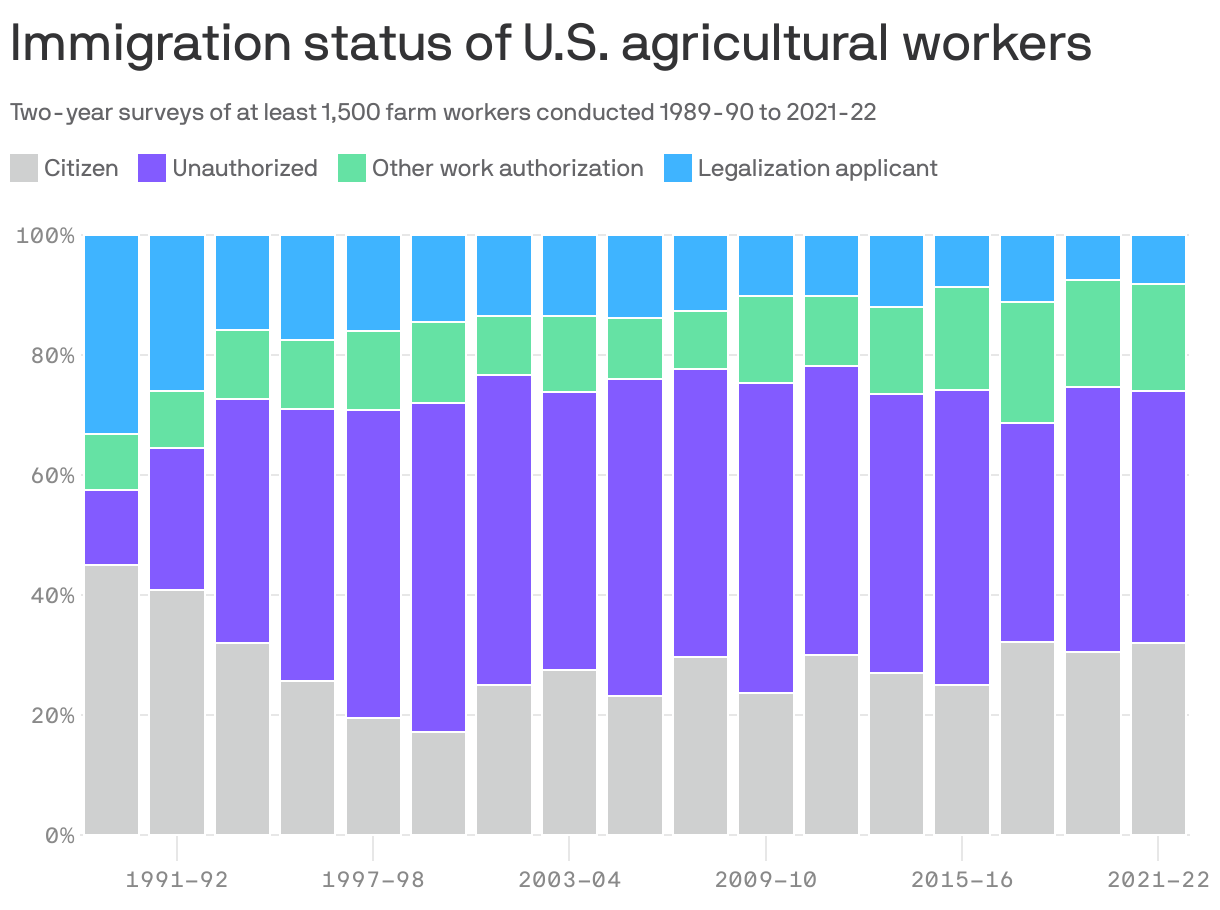
The big picture: While undocumented laborers make up a relatively small percentage of the total U.S. workforce, they have outsized roles in fields like construction, agriculture and hospitality.
Zoom in: Construction and agriculture workforces had the highest shares of undocumented workers as of 2022, per the American Immigration Council.
- Among the undocumented workforce: 39% of plasterers and stucco masons; 36% of drywall installers, ceiling tile installers, and tapers; 36% of roofers; and 31% of painters and paperhangers.
- 28% of graders and sorters for agricultural products were undocumented, as well as 25% of miscellaneous agricultural workers.
Most U.S. voters (75%) said undocumented immigrants mostly fill jobs that American citizens don't want, according to an October Pew Research report.
- Industries like hospitality, service, health care, construction and agriculture would face labor shortages without immigrant labor, according to the Center for Migration Studies.
Zoom out: A one-time operation to deport undocumented immigrants would cost at least $315 billion, according to an October report from the American Immigration Council.
- Mass deportations could lead to a loss of about 4.2% to 6.8% of annual GDP, per the report, amounting to between $1.1 trillion and $1.7 trillion. For comparison, the national GDP declined 4.3% during the 2007-09 Great Recession.
Mass deportations would also bring a heavy human toll.
- About 4 million mixed status families could be separated, affecting 8.5 million U.S. citizens with undocumented family members.
- It could slash the incomes of their households by an average of nearly 63%, or about $51K per year, the report found.
Reality check: From 2003 to 2022, unauthorized immigrants made up a relatively narrow range of all U.S. workers — between 4.4% and 5.4%, according to a July Pew Research report.
- This number is higher than the 3.3% of unauthorized immigrants in the total U.S. population because most undocumented people in the U.S. are workforce-aged, per Pew.
Context: Trump's deportation plans would use obscure laws, military funds and law enforcement officers from all levels of government to deport millions of people.
- Fast-track deportations would be expanded to apply to anyone who illegally crossed the border and couldn't prove they'd been living in the U.S. for more than two years. Currently, they're just for recent crossers encountered near the border.
- Trump's proposals would also curb legal immigration and limit asylum, the New York Times reported. He repeatedly tried to restrict access to asylum during his first term.
The latest: Trump on Monday said that he will declare a national emergency and use the U.S. military to carry out mass deportations.
- This month, he tapped Tom Homan, the former acting head of Immigration and Customs Enforcement (ICE), as "border czar" for his next term.
- Homan, who had a role in the controversial family separation policy during Trump's first administration, has been a strong supporter of Trump's mass deportation plans. He also led the deportation branch within Immigrations and Customs Enforcement under former President Obama.
Go deeper:
- "Our home is here": DACA recipients brace for Trump's return
- Immigrant advocates mobilize against planned mass deportations
- Trump confirms plans to use military for mass deportations
Editor's note: This story was corrected to say gross domestic product (not profit).
