How Trump's offshore drilling plan could collide with California's wind goals

Add Axios as your preferred source to
see more of our stories on Google.
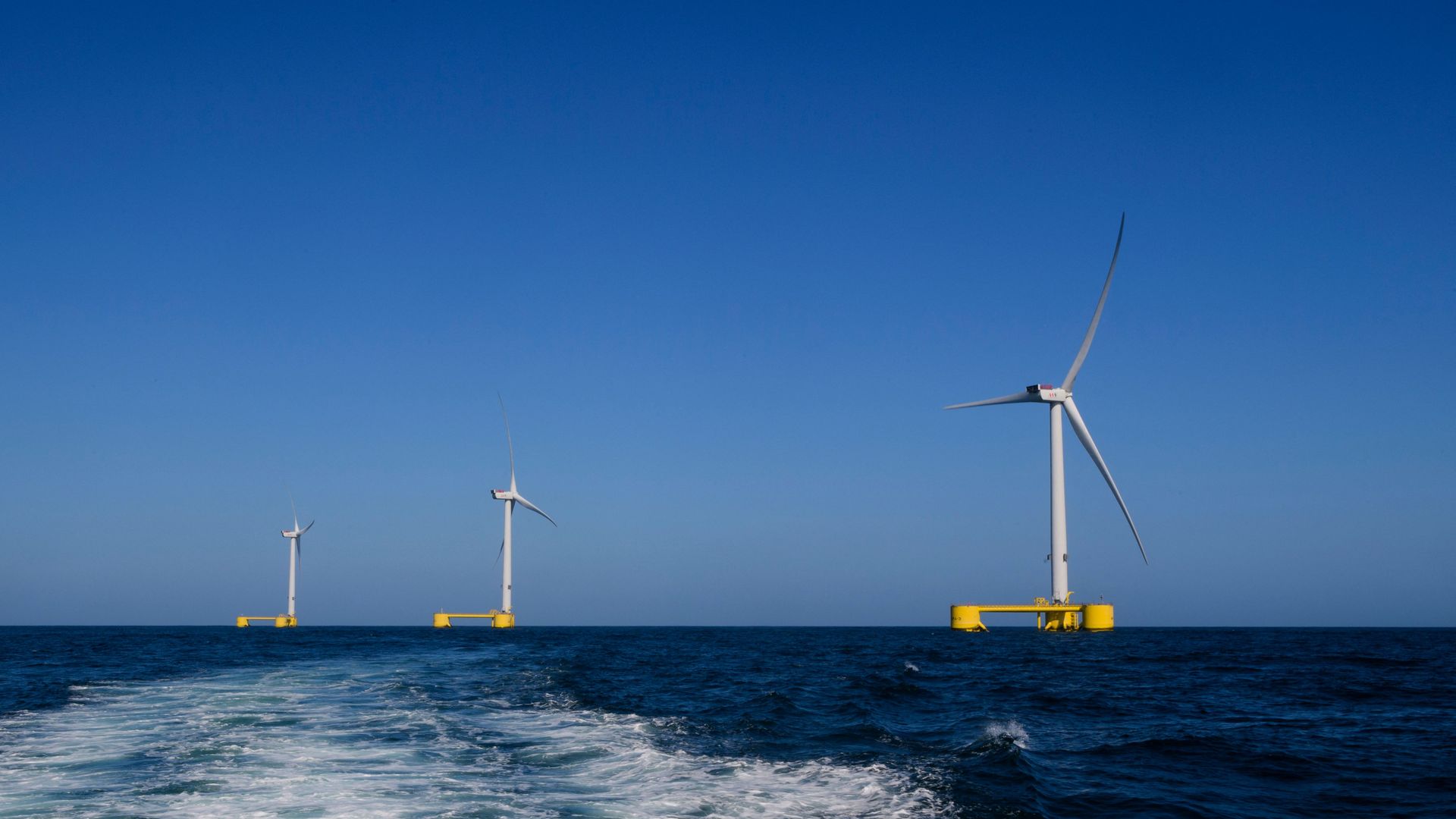
Wind turbines float offshore around 20km from the coast of northern Portugal. Photo: Miguel Riopa/AFP via Getty Images
The Trump administration's move to reopen California's coastal waters to offshore oil drilling could risk a direct collision with the state's emerging floating-wind industry.
State of play: The federal waters eyed for oil leasing could overlap with sites in northern and central California that have already been designated for floating offshore wind development, a cornerstone of the state's clean-energy roadmap.
- The proposed six lease sales would open auctions for oil and gas drilling in northern, central and southern California between 2027 and 2030, a move the Interior Department says is needed to address the nation's "growing energy needs" and maintain a steady workforce in the sector.
- California has imposed tight limits on offshore drilling since the 1969 Santa Barbara oil spill. Gov. Gavin Newsom, who declared a state of emergency in 2021 after a major oil spill off Huntington Beach, has repeatedly criticized offshore drilling as fundamentally at odds with the state's climate goals.
The big picture: Trump's oil and gas lease announcement comes amid the administration's efforts to curtail offshore wind projects and after withdrawing nearly half a billion in federal funding for California's deployment.
- Trump has instituted a broad halt on approving new projects in federal waters and is actively attempting to stop or reverse approvals for projects already under construction or with permits on the East Coast.
Catch up quick: The federal government leased 583 square miles of deep ocean waters 20 miles off Morro Bay and Humboldt counties for commercial-scale floating wind farms in 2022 — the first of such on the West Coast.
- California has a target of deploying 25 gigawatts of offshore-wind capacity by 2045 with the first 2 to 5 GW slated by 2030. Such projects require expansive ocean space for mooring lines, undersea cables and vessel access.
- Offshore wind developers, port authorities and utilities have already faced challenges, including a complex permitting process, community pushback and deep-water engineering hurdles.
Zoom in: Plans for oil and gas drilling could complicate that build-out and adds a fresh layer of uncertainty, though it's unclear until those lease boundaries are officially drawn, Irene Gutierrez, a senior attorney at the Natural Resources Defense Council, told Axios.
- "It's possible that there could be direct conflicts with the wind leases, or it's also possible that the oil and gas leases would be outside of the wind energy areas," she said.
- Nonetheless, introducing another massive energy project off California's coast could lead to competition for sea space, disruptions to marine ecosystems, increased boat traffic and bogged down environmental review timelines, per Gutierrez.
- "Bringing in this whole new dirty and polluting industry is something that is going to be very damaging," she added.
The other side: Erik Milito, president of the National Ocean Industries Association, an interest group representing the interests of oil, gas and wind, told Axios the Bureau of Ocean Energy Management has in the past "avoided overlap between offshore wind lease areas and existing oil and gas activity."
- "It's also worth noting that oil and gas leases are issued in smaller 3-mile by 3-mile blocks. BOEM has the ability to easily draw lease sales boundaries that do not overlap with other uses," he said in an emailed statement.
- "The offshore region is prime space for a multi-use blue economy…the U.S. should move even more toward multi-use activities that overlap."
Reality check: At the same time, it's possible that these lease sales don't materialize, Glenn Schwartz, director of energy policy for Rapidan Energy Group, told Politico.
- The leases could be vetoed by the state due to its power over pipelines and terminal construction, in addition to facing Biden era legal barriers that could trigger "lengthy and contentious litigation" before drilling could even be considered, he said.
Of note: California leaders signaled Thursday they're prepared to pursue potential legal action.
- "California will not stand by while the Trump Administration marches in and make a mess of our coastal towns and waterways in order to line the pockets of its wealthy friends," said Rob Bonta, the state's attorney general, said in a statement."
- "We're going to fight this with everything we have," U.S. Senator Alex Padilla and Rep. Jared Huffman said in a joint statement.
What we're watching: Padilla co-introduced a legislative package earlier this year, called the West Coast Ocean Protection Act, which would permanently ban fossil fuel drilling.
- Though the bills are currently sitting in the U.S. Senate Committee on Energy and Natural Resources, passage seems unlikely under a Republican majority in Congress.
