Trump's "drill, baby, drill" problem

Add Axios as your preferred source to
see more of our stories on Google.
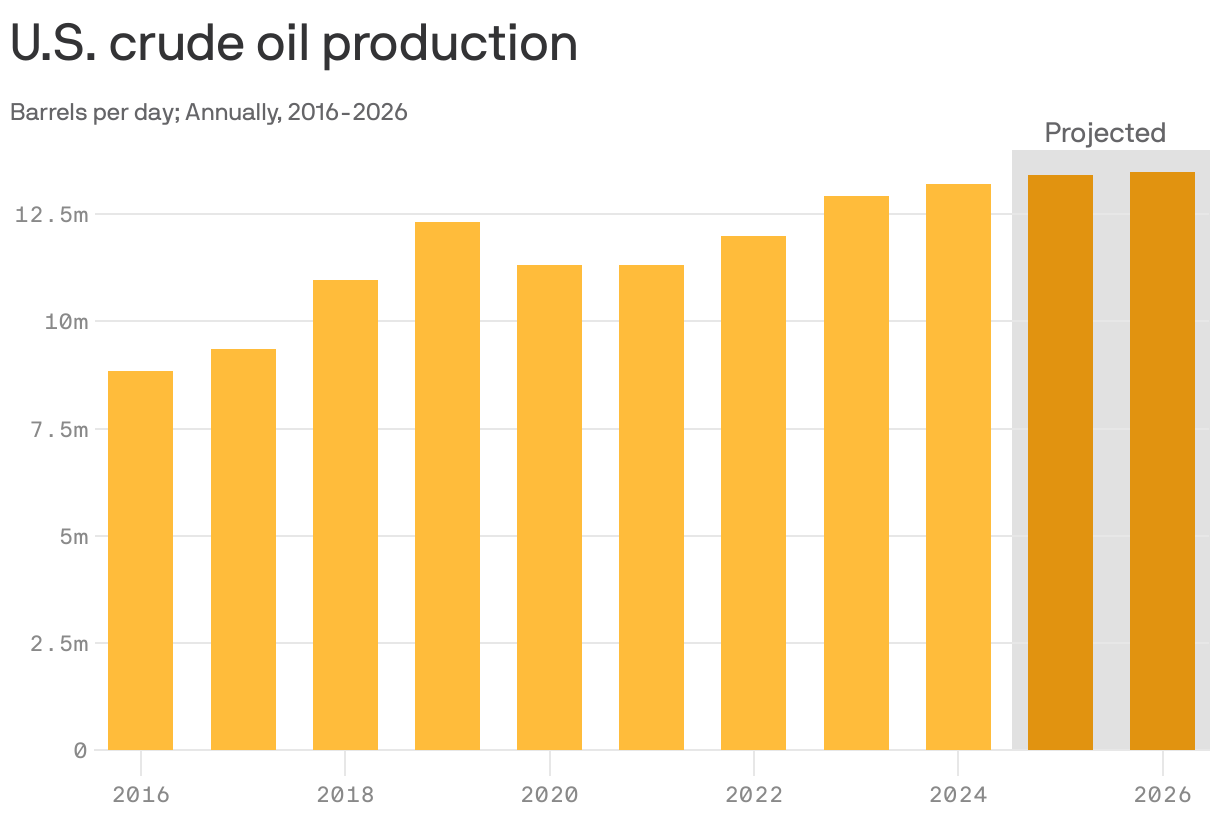
This chart helps explain why President-elect Trump won't have an easy time delivering on pledges to surge U.S. oil production — at least anytime soon.
State of play: The latest analysis from the Energy Department's independent stats arm sees just modest output growth this year and next (albeit from already record levels).
- It sees production rising less than 1% in 2026 "as operators slow activity due to price pressures."
Why it matters: Market fundamentals hold the cards on producers' decisions — and for now, they probably work against a U.S. surge.
- The Energy Information Administration sees global supply outstripping demand growth over the next two years.
- And it sees falling prices, with the U.S. benchmark WTI averaging $70 per barrel this year but falling to $62 in 2026.
Yes, but: These look-aheads change all the time. There's a reason major forecasting bodies do them monthly.
- Trump's vow to ease regulations could make more barrels economic to produce, though prices and investor goals are typically bigger drivers.
And the global picture is fluid. Think variables like the effect of new sanctions on Russian shipments; Trump's plan to tighten enforcement of Iranian sanctions; and whether OPEC+ adds barrels.
- The International Energy Agency this morning said expanded U.S. sanctions against Russia unveiled this month could "significantly disrupt" the country's supply.
- But for now, IEA is keeping its Russian supply forecast unchanged.
The big picture: It may take years to assess Trump's effect.
- One big thing to watch: efforts to expand oil and gas leasing in the Gulf of Mexico and frontier areas in Alaska.
- Those kinds of projects have decade-long timelines.
Stunning stat: Obviously the Permian Basin of Texas and New Mexico is the heart of American oil, but this is still wild: its share of total U.S. production should top 50% in 2026.
- "The expected production growth in the Permian in 2026 will be offset by contraction in other regions," EIA finds.
- It sees the Permian producing nearly 7 million barrels per day by the end of 2026. It was under 1 million 15 years ago.
What's next: Look for executive orders on Trump's first day that launch time-consuming bureaucratic work to loosen restrictions.
