"Desperate people do desperate things": Huckabee warns of West Bank collapse

Add Axios as your preferred source to
see more of our stories on Google.
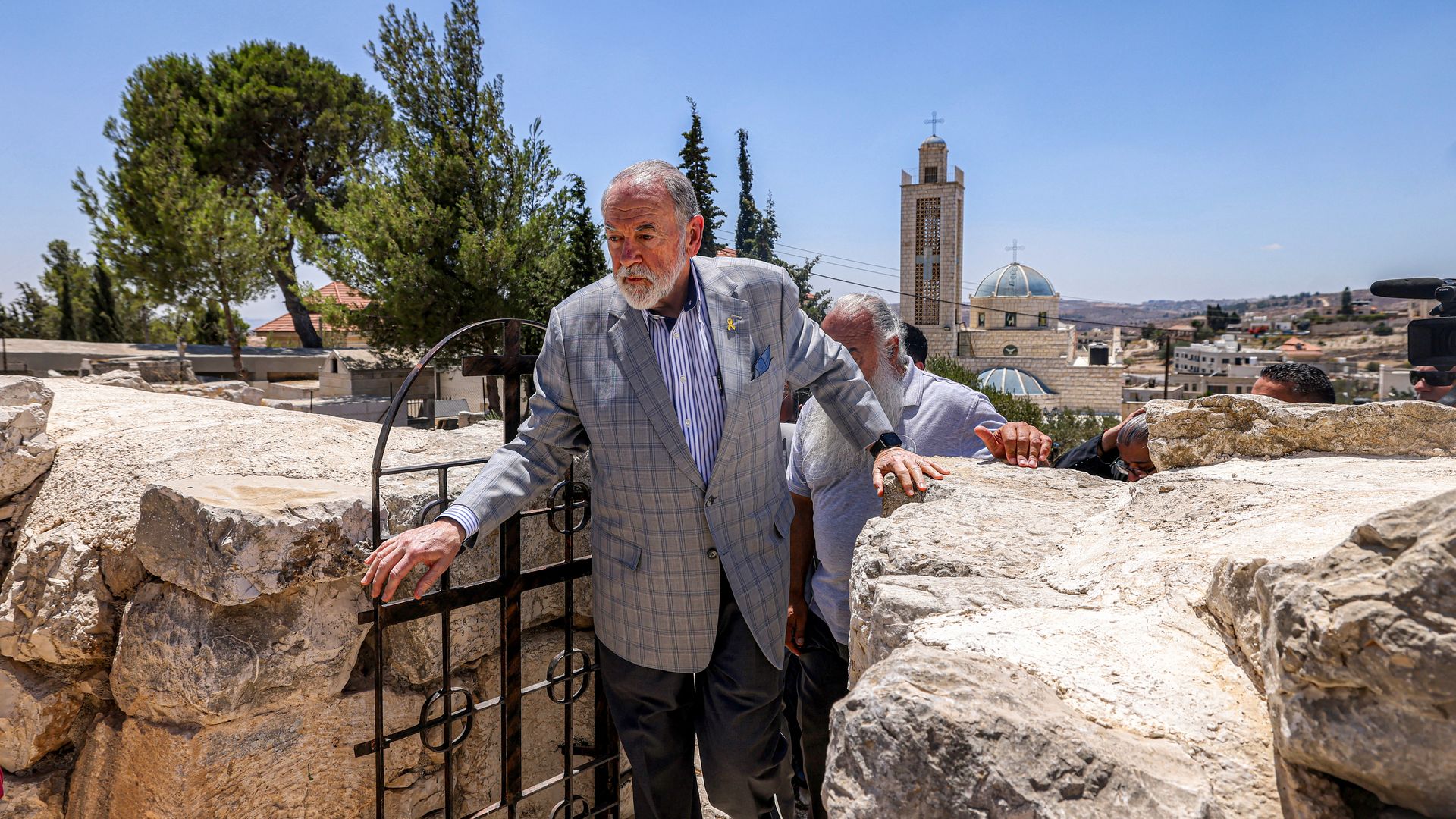
Mike Huckabee visits the Christian village of Taybeh in the West Bank in July. Photo: Jaafar Ashtiyeh/AFP via Getty
U.S. ambassador to Israel Mike Huckabee told Axios he's concerned there will be an economic collapse in the West Bank that could lead to violent escalation.
What he's saying: "If the Palestinian economy were to completely collapse, it won't be a winning deal for anyone. It would lead to an escalation and further desperation. Desperate people do desperate things," Huckabee said in an interview on Friday.
Why it matters: Israeli Finance Minister Bezalel Smotrich, an ultranationalist anti-Palestinian settler, has taken many steps over the last two years to weaken the Palestinian Authority, as he's promoted annexation of the West Bank by Israel.
- In the last four months, Smotrich has withheld hundreds of millions in tax revenues collected by Israel for the PA. He's also moved to cut Palestinian banks off from the Israeli financial system, though the Cabinet has yet to approve that step.
- In the past, Smotrich described the Palestinian Authority as a threat to Israel, and Hamas as an asset, because Hamas governing Gaza divides Palestinian governing power and lowers the chances of a Palestinian state.
- The collapse of the Palestinian economy and banking system could bring down the Palestinian Authority, creating a power vacuum that could throw the West Bank into chaos and exacerbate the conflict in the region.
Behind the scenes: Huckabee told Axios he's been negotiating with Israeli and Palestinian officials on a deal to release the Palestinian funds, remove the threat to Palestinian banks and decrease the risk of economic collapse.
- Huckabee met with Smotrich and other Israeli officials. He traveled to Ramallah for meetings with Palestinian Vice President Hussein al-Sheikh and Prime Minister Mohammad Mustafa.
- "Ambassador Huckabee told Palestinian leaders that he stressed to Israeli officials that the U.S. does not want to see financial collapse of the Palestinian Authority and said he will keep pressing," a senior Palestinian official told Axios.
State of play: In the meantime, the economic crisis in the West Bank deepens. The PA decided not to open the school year on Sept. 1 because of its inability to pay teachers' salaries. At the moment, the opening of the school year has been postponed to Sept. 8.
- "There is strong importance to see some resolution to this. There is a lot of deep concern to what it will do to businesses, banks and ordinary people like schoolteachers or taxi drivers and their ability to get a salary," Huckabee said.
- Palestinian officials say the negotiations over the financial deal are still stuck and claim the U.S. isn't pressing Israel enough on the issue.
Friction point: Huckabee's diplomatic efforts hit a roadblock in late July, after France and other Western countries announced they will recognize Palestinian statehood at the UN General Assembly in September.
- "We were in the middle of very difficult but advancing negotiations to try and resolve the financial crisis. I have been shuttling back and forth to bring resolution to that. But once the Palestinian Authority and the Europeans started talking about recognition, the discussions came to an abrupt halt. The Israeli view was that if the Palestinians declare a Palestinian state, there is no point to show good faith," Huckabee said.
Zoom in: In February, Palestinian President Mahmoud Abbas issued a decree revoking the system of payments to families of Palestinian prisoners in Israeli jails or to families of Palestinians who were killed or wounded during attacks against Israelis.
- The system — referred to as "pay for slay" by the Trump administration and the Israeli government — was a major point of friction between the U.S. and the Palestinian Authority.
- During President Trump's first term, Congress passed the Taylor Force Act, named after an American citizen killed in a terror attack in Tel Aviv.
- The law prohibited the U.S. government from providing any direct financial assistance to the Palestinian Authority as long as it gives payments to Palestinians involved in such attacks. The reform enacted by the Palestinian Authority was aimed at bringing the PA into compliance with the act.
In recent months, the State Department has been conducting a review of the new system to examine whether it upholds U.S. law.
- Huckabee said the review is still ongoing, but he claimed there are "serious questions about whether the payments to prisoners have completely stopped."
- He said statements by Abbas that prisoners will continue getting stipends undermines the ability to get to a resolution.
- "We have no definitive answer about how the money flows now. But this rhetoric raises concerns. If he says he wouldn't stop the payments, Israel doesn't have an incentive to release money that might go to the families of those who murdered Israelis," Huckabee said.
The other side: "The government of Israel is working in close coordination with the Trump administration and with the best ambassador ever for the State of Israel, Mike Huckabee," Smotrich's office said in a statement.
- The finance minister's office added that Israel shares the position recently expressed by the Trump administration and Secretary of State Marco Rubio against the Palestinian Authority's actions.
- "Israel believes that the Palestinian Authority must stop funding terrorism, stop educating for terrorism, stop acting unilaterally against Israel and seeking unilateral recognition. It must also condemn terrorism, end the funding of terrorists' families, and cease its international legal warfare against Israel. Until then, the Palestinian Authority is not a partner for anything," Smotrich's office said.
