Palestinian president revokes prisoner payments dubbed "pay for slay"

Add Axios as your preferred source to
see more of our stories on Google.
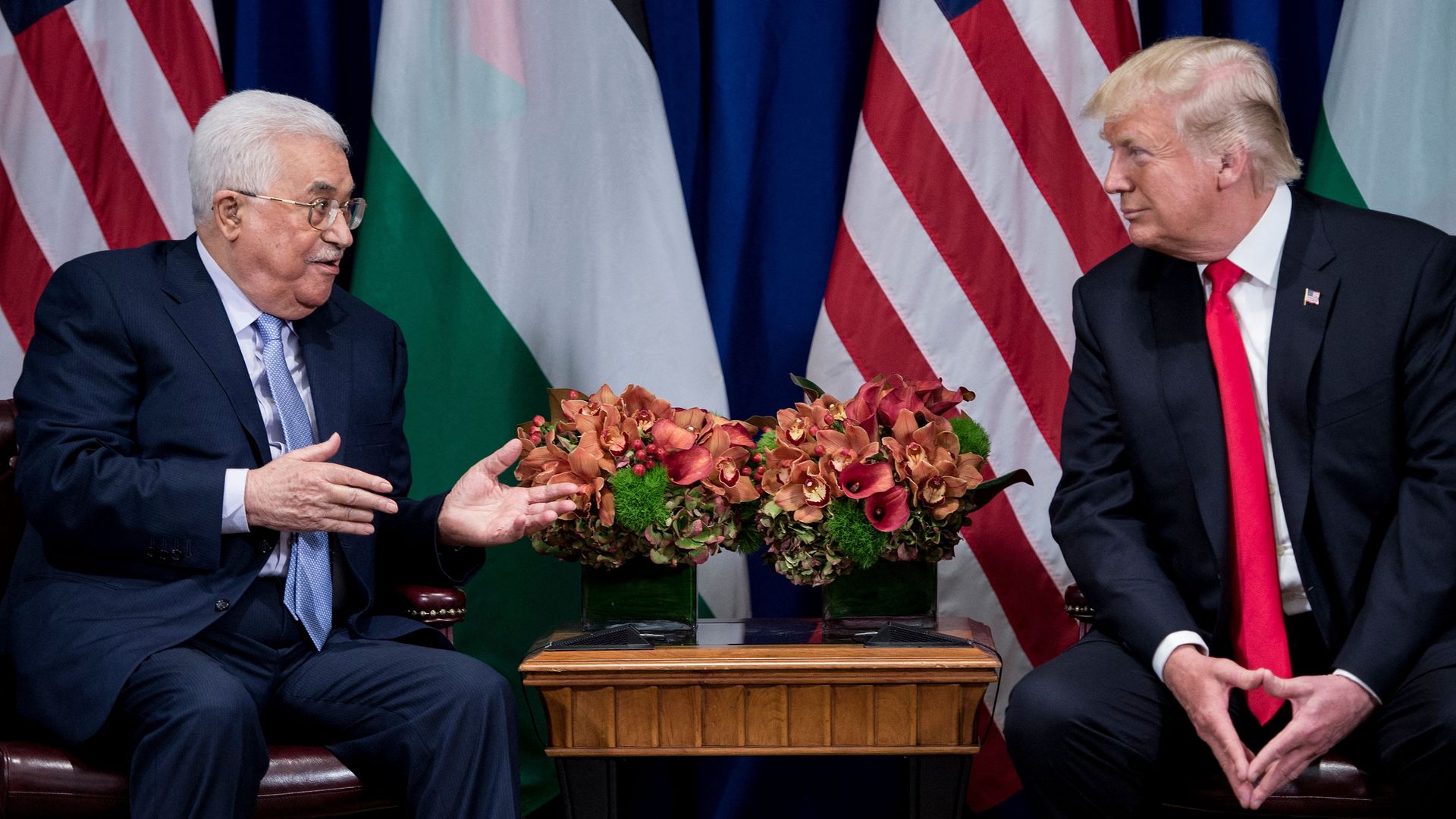
Palestinian Authority President Mahmoud Abbas speaks with Trump in 2017. Photo: Brendan Smialowski/AFP via Getty
Palestinian president Mahmoud Abbas has issued a decree on Monday revoking the system of payments to families of Palestinian prisoners in Israeli jails or to families of Palestinians who were killed or wounded during attacks against Israelis.
Why it matters: The system — referred to as "pay for slay" by the first Trump administration and the Israeli government — was a major point of friction between the U.S. and the Palestinian Authority.
- The U.S. and Israel have argued for years that the system incentivized attacks on Israelis, and repeatedly demanded that the Palestinian Authority revoke it.
- But the Israeli Foreign Ministry issued a statement Monday denying that the payments would actually end: "This is a new fraudulent trick by the Palestinian Authority, which intends to continue making payments to terrorists and their families through other payment channels."
Behind the scenes: The Biden administration, led by its representative for Palestinian affairs Hady Amr, negotiated with the Palestinian Authority on this issue over the course of two years, and the sides reached a deal in principle several months ago, a senior Palestinian official told Axios.
- Initially the PA didn't want to proceed due to the war in Gaza, a U.S. official said.
- But the senior Palestinian official said the PA was prepared to make the decision toward the end of Biden's term, but Abbas decided to wait until Trump took office to give the win to the new administration.
- The Palestinian official said the PA notified the Trump administration in advance of the announcement.
- Between the lines: Palestinian officials told Axios they hope Abbas' decision will improve relations with the Trump administration and with Congress and lead to the resumption of U.S. financial aid to the Palestinian Authority.
Flashback: During Trump's previous term in office Congress passed the Taylor Force Act, named after an American citizen killed in a terror attack in Tel Aviv.
- The law prohibited the U.S. government from providing any direct financial assistance to the Palestinian Authority as long as it gives payments to Palestinians involved in such attacks.
- The Israeli government later passed a law that deducts the amount of money the Palestinian Authority pays to prisoners and "martyrs'" families from the tax revenues it collects for the PA.
- Both laws exacerbated the PA's fiscal issues.
Zoom in: A Palestinian official said Abbas' presidential decree revokes articles contained in Palestinian laws and regulations concerning "the system of paying financial allowances to the families of prisoners, martyrs, and the wounded."
- The decree transfers the computerized cash assistance program, its database, and its financial, local, and international allocations from the Ministry of Social Development to the Palestinian National Foundation for Economic Empowerment, the Palestinian official said.
- According to a copy of the decree, all families that benefited from the previous system are subject to "the same standards applied without discrimination to all families benefiting from protection and social welfare programs" in the Palestinian Authority.
Friction point: When the Biden administration and the Palestinian Authority informed Israel last year about the planned change in the payments system, at least one senior member of Prime Minister Benjamin Netanyahu's team expressed reservations.
- Ron Dermer, Netanyahu's close confidant and minister for strategic affairs, claimed he didn't believe the move was real, a former U.S. official told Axios.
- Other members of Netanyahu's team were supportive. So were members of Congress briefed on the plan by the Biden administration, including Sen. Lindsey Graham, according to a former U.S. official.
Editor's note: This story was updated with the Israeli Foreign Ministry statement.
