Trump's birthright citizenship order blocked by judge despite SCOTUS ruling

Add Axios as your preferred source to
see more of our stories on Google.
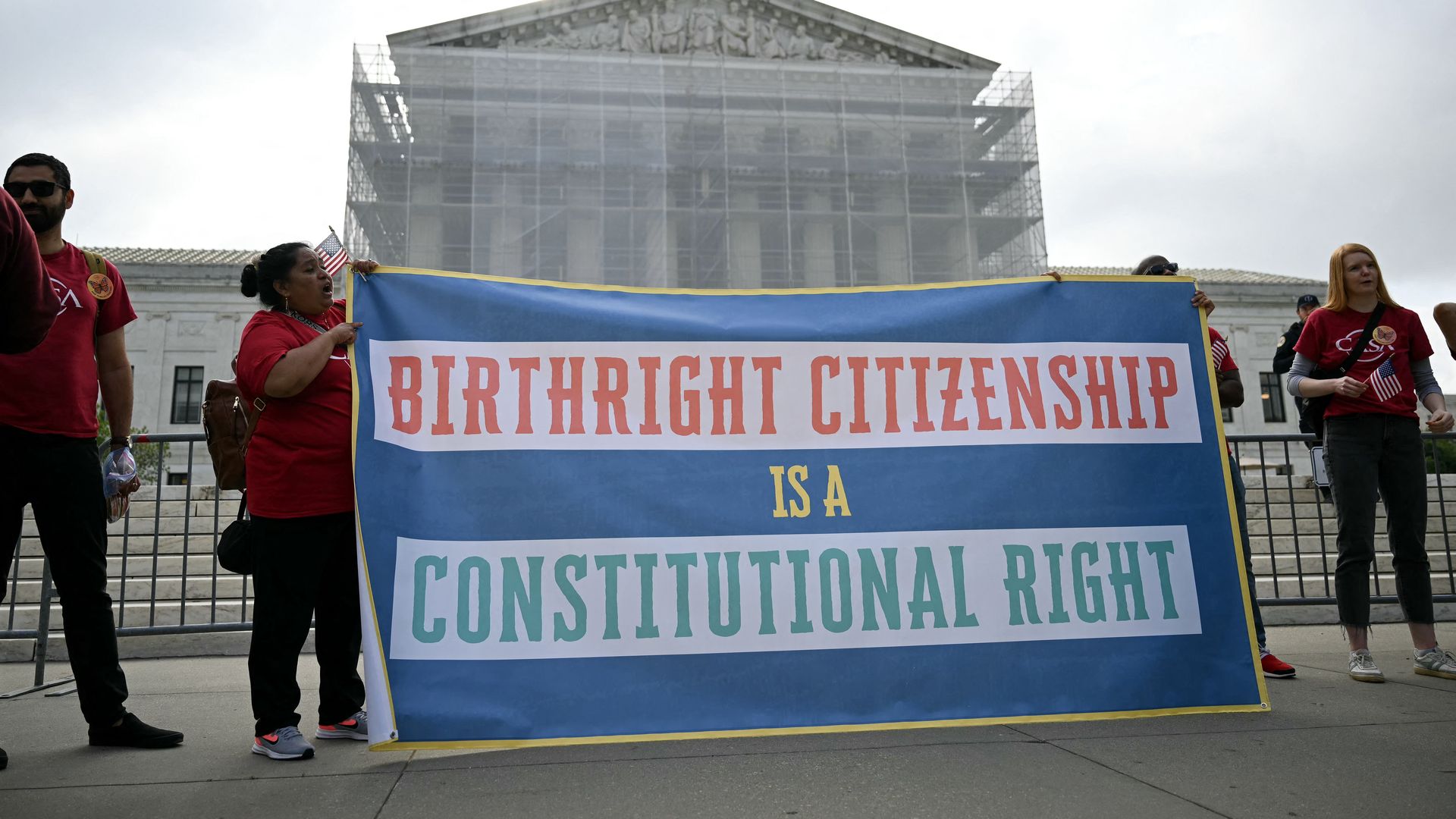
People hold a sign as they participate in a protest outside the Supreme Court over President Trump's order on birthright citizenship on May 15. Photo: Drew Angerer/AFP via Getty Images
A federal judge on Thursday blocked President Trump's executive order attacking birthright citizenship, nearly two weeks after the Supreme Court curbed lower courts' power to freeze federal policies.
The big picture: The high court's ruling last month imposed new limits on lower courts but left room for broader relief through class-action lawsuits. Thursday's order could be a critical new legal defense as judges navigate the restrictions to check nationwide policies.
Driving the news: U.S. District Judge Joseph Laplante granted a request from immigration rights advocates to certify a nationwide class of all children born after Trump's order went into effect who would be deprived of citizenship and ordered a preliminary injunction.
- Laplante stayed his preliminary injunction for seven days to give the government time to appeal.
- Laplante, an appointee of former President George W. Bush, described the preliminary injunction as "not a close call to the court," from the bench, noting that the "deprivation of U.S. citizenship" and abrupt policy change pose "irreparable harm," CNN reported.
Zoom out: Following the Supreme Court's 6-3 ruling in the case that considered courts' ability to freeze Trump's efforts to eliminate birthright citizenship, the American Civil Liberties Union and other groups swiftly brought a class-action lawsuit.
- In their request for the certification of a class "of all current and future children who are or will be denied" citizenship and their parents, the attorneys wrote that if the order remained in place, "those children will face numerous obstacles to life in the United States."
What they're saying: Cody Wofsy, the deputy director of the ACLU's Immigrants' Rights Project, described Laplante's ruling as a "huge victory" in a statement.
- "We are fighting to ensure President Trump doesn't trample on the citizenship rights of one single child," Wofsy said.
The other side: White House spokesperson Harrison Fields described the decision as "an obvious and unlawful attempt to circumvent the Supreme Court's clear order against universal relief" that "disregards the rule of law by abusing class action certification procedures."
- "The Trump Administration will be fighting vigorously against the attempts of these rogue district court judges to impede the policies President Trump was elected to implement," Fields said in a statement to Axios.
Catch up quick: Trump's order has been repeatedly blocked in federal courts as his administration seeks to unravel a right legal scholars say is guaranteed by the U.S. Constitution.
- Laplante, in a February preliminary injunction order, wrote, "As to plaintiffs' constitutional claim, the Executive Order contradicts the text of the Fourteenth Amendment and the century-old untouched precedent that interprets it."
- He noted that the Supreme Court has enumerated specific exceptions to birthright citizenship, such as children of foreign ministers.
- "The categories of people affected by the Executive Order," he wrote, "do not fit into those exceptions."
Editor's note: This is a breaking news story and has been updated throughout with additional information.
