Trump vs. the courts: Two early fights set stage for many more to come

Add Axios as your preferred source to
see more of our stories on Google.
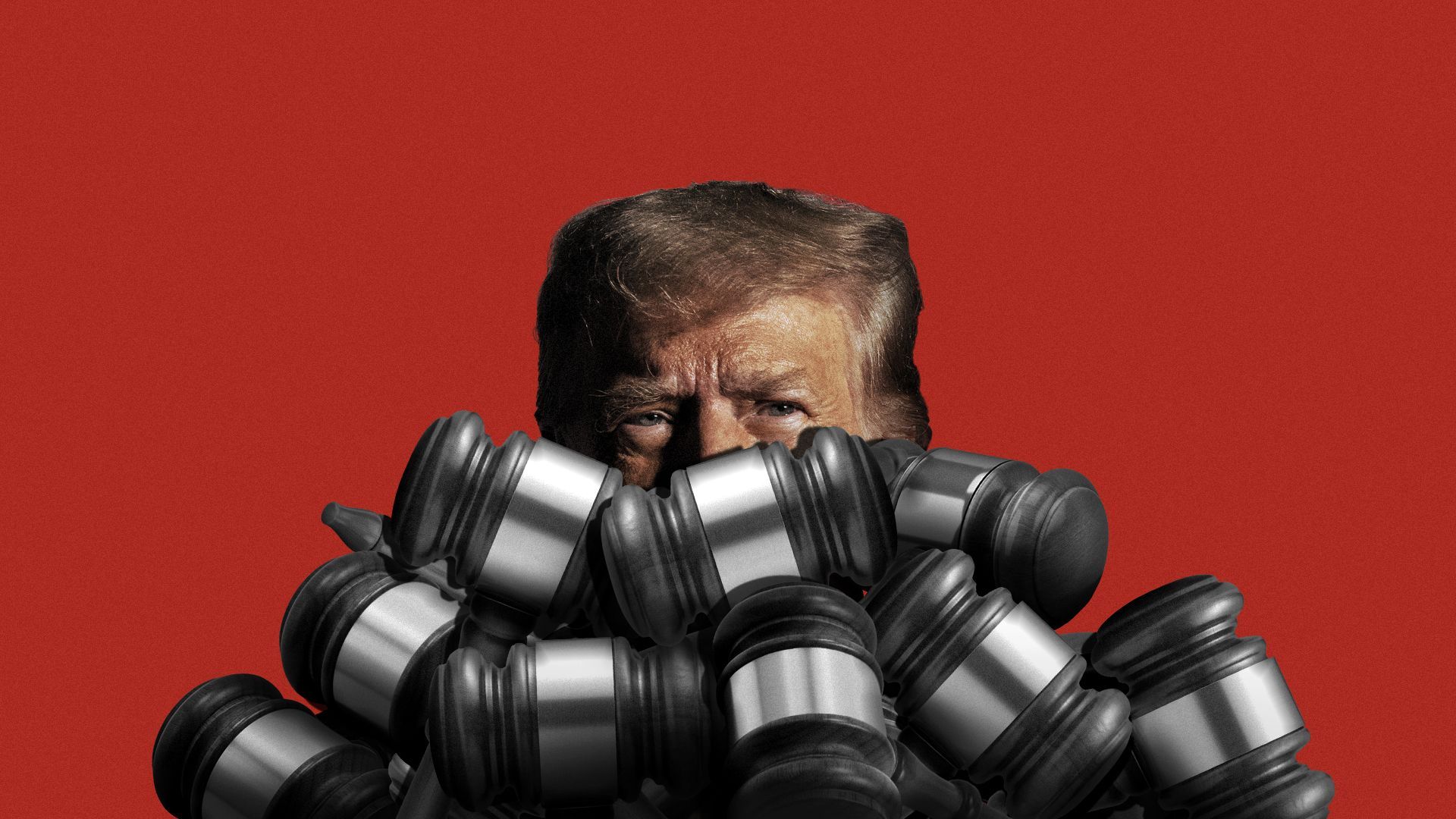
Photo illustration: Lindsey Bailey/Axios. Photo: Jeff Swenson/Getty Images
President Trump is pushing legal boundaries by design — testing the limits of his own power and the willingness of a conservative high court to enhance it.
Why it matters: Trump's shock-and-awe agenda is setting in motion multiple future Supreme Court showdowns. These legal challenges threaten to scuttle some of his priorities and delay parts of his swift, decisive show of force.
State of play: The White House yesterday rescinded a freeze on trillions of dollars in federal grants — two days after it was issued, and one day after a judge temporarily prevented it from taking effect.
- The freeze had sparked enormous on-the-ground confusion, and reignited a long-simmering legal debate about whether presidents have the power to refuse to spend money that Congress has appropriated.
- That's a serious constitutional question only the Supreme Court can ultimately answer.
Between the lines: The spending freeze was on a fast track to the high court the moment it was signed. The White House backed down this time, but it's prepared — and in many cases, eager — to fight many of these fights all the way to the end.
Trump's efforts to end birthright citizenship through an executive order have also been blocked in court.
- "This is a blatantly unconstitutional order," said U.S. District Judge John Coughenour of Seattle, who put a temporary stay on Trump's plans.
- Multiple suits over the citizenship order have been filed in multiple jurisdictions. So there'll be more rulings on the issue as it works its way toward the Supreme Court.
Legal experts largely think the Justice Department will have a hard time constructing a case against birthright citizenship.
- The 14th Amendment says, in part, that "all persons born or naturalized in the United States … are citizens of the United States." That has long been read as establishing birthright citizenship.
But in other areas, the Trump administration will be on much friendlier terrain.
- Inspectors general fired by Trump last week have argued their dismissals were illegal, citing federal oversight laws.
- But taking those claims to court could backfire. The Supreme Court's conservative majority generally takes an expansive view of presidential power, including the power to fire senior executive branch officials.
Zoom in: Unions representing government workers have filed multiple suits challenging Schedule F — the executive order that strips civil-service protections from scores of federal employees, making it easier for Trump (or any president) to fire them.
- Trump's efforts to slash the bureaucracy depend heavily on Schedule F — which means they'll depend on the outcome of those cases.
What to watch: Liberal advocacy organizations have sued over Trump's surprise decision to give DOGE, initially conceived as an outside advisory group, a home inside the government. That can't happen without congressional approval, they argue.
- There's also a suit pending over Trump's order on transgender inmates. More civil-rights cases are sure to arise as the White House and federal agencies further roll back diversity programs and protections for LGBTQ people.
- Some Trump spending cuts could also end up in court.
The bottom line: Almost everything of any significance the Trump administration does, or attempts to do, will end up in court. In less than two weeks, it has already touched off two fights that would likely put enormous constitutional questions before the Supreme Court.
- There will be many, many more.
