Trump's birthright citizenship threat faces constitutional hurdles

Add Axios as your preferred source to
see more of our stories on Google.
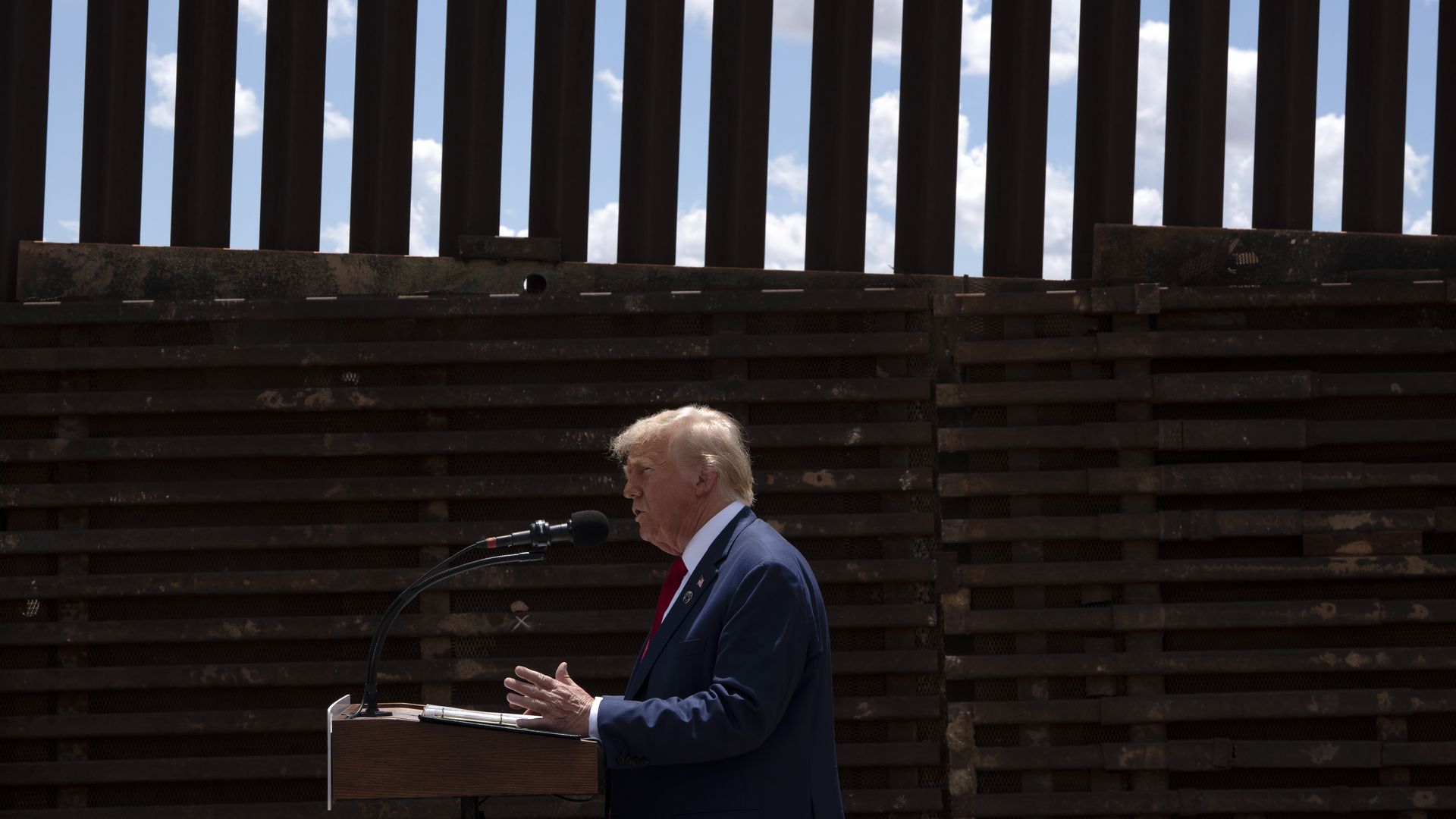
Trump speaks at the U.S.-Mexico border on August 22, south of Sierra Vista, Arizona. Photo: Rebecca Noble/Getty Images
In 2018, then-President Trump told Axios he intended to sign an executive order that would end the right to citizenship for babies of non-citizens and unauthorized immigrants born on U.S. soil.
- He didn't.
The big picture: But the president-elect has raised the possibility again as part of his sweeping immigration policy proposals.
The latest: In his first network interview since his election win, Trump told NBC's Kristen Welker on Sunday he "absolutely" still plans to end birthright citizenship on day one.
- "I was going to do it through executive action, but then we had to fix COVID first, to be honest with you," he said. "We have to end it. It's ridiculous."
- He echoed a false claim he often repeats that the United States is the only country that offers birthright citizenship. In reality, more than 30 countries have unrestricted birthright citizenship.
- Speaking with Axios during his first term, Trump argued he had discussed his plan to nix the protection with his legal counsel and contended he "can do it just with an executive order."
Reality check: It's the general consensus among immigration and constitutional scholars that the president has no authority to use executive action to change birthright citizenship, which is enshrined in the Constitution via the 14th Amendment.
- While Trump could issue an executive order as he's vowed to do, many experts believe it would be struck down by the courts.
Yes, but: Immigration advocates are taking the president-elect's threats seriously, as some conservatives push the argument that the constitutional amendment has been misapplied.
- Juliana Regina Macedo do Nascimento, United We Dream's deputy director of federal advocacy, noted the proliferation of conservative-leaning judges who may be more friendly to Trump's attempts.
- A recipient of the Deferred Action for Childhood Arrivals program, a federal policy that safeguards undocumented immigrants brought to the U.S. as children, she questions what ending birthright citizenship would mean for her.
- "The idea that if I were to have children, they would not be considered American when it's the only place we've ever known would be really preposterous and scary," Macedo do Nascimento told Axios.
Birthright citizenship in the U.S.
Birthright citizenship in the U.S. can be divided into two types: jus sanguinis, ancestry-based citizenship, and jus soli, birthplace-based citizenship.
- In the former, which means "right of blood," children born abroad to at least one U.S. citizen parent may be entitled to U.S. citizenship, if they meet certain requirements.
- Jus soli, on the other hand, is "the right of the soil" guaranteeing citizenship to almost everyone born in the U.S.
- Children of foreign diplomats are one group that does not receive birthright citizenship, as they are not "born ... subject to the jurisdiction" of the United States under the 14th Amendment.
State of play: There are two key points on the timeline of birthright citizenship precedent in the U.S., said Michael LeRoy, an immigration law expert and professor of labor and employment relations at the University of Illinois at Urbana-Champaign.
- The 14th Amendment in 1868 fortified the constitutional groundwork for birthright citizenship, stating that "All persons born or naturalized in the United States, and subject to the jurisdiction thereof, are citizens of the United States and of the state wherein they reside."
- The second point came some 30 years later, when the Supreme Court decision in U.S. v. Wong Kim Ark established the court's understanding of jus soli.
Wong Kim Ark was born in the U.S. to Chinese parents in the 1870s who were in the U.S. to work. As a young adult, he left the states temporarily to visit his parents, who had moved back to China.
- Upon his return to the U.S., he was denied entry under the Chinese Exclusion Act, despite being born on American soil.
- The Supreme Court ruled in 1898 that the citizenship clause of the 14th Amendment made him a birthright citizen.
Could Trump erase birthright citizenship?
While LeRoy says he can't predict how the Supreme Court would rule if the issue were again brought before the court, striking down a "clear provision in an amendment based on an executive order" could have far-reaching legal repercussions.
- "The day might come when a president of a different political party issues an executive order to limit or repeal the Second Amendment," he said. "To be clear, that cannot happen."
- He continued, "You cannot have an executive order that repeals the right to bear arms, nor can you have an executive order that repeals the birthright citizenship clause."
Trump and conservatives have argued the constitutional language "subject to the jurisdiction" of the U.S. does not cover undocumented immigrants.
- Ex-Trump lawyer John Eastman has been a staunch supporter of this view, arguing the line refers to people with full, political allegiance to the U.S.
The other side: Cody Wofsy, the deputy director of the ACLU Immigrants' Rights Project, told Axios the argument is "absolutely wrong, as the Supreme Court explained 125 years ago" in the Wong Kim Ark case.
- "Subject to the jurisdiction," he said, is about people who "can't be prosecuted." Ambassadors and foreign ministers — and their children, who are not not U.S. citizens upon birth — are the "clearest example."
There is an apparent consensus among scholars that courts would strike down an executive order on the issue as unconstitutional, making a constitutional amendment — or a dramatic reinterpretation of the 14th Amendment — the only attainable way to push the change through.
Wofsy says the ACLU is confident the courts would abide by the longstanding interpretation of the 14th Amendment should Trump try to "narrow who is a citizen of this country" via executive action.
Go deeper: Axios Explains: The past and present of Temporary Protected Status
