Scoop: Israel objected to secret U.S.-Hamas talks in tense call

Add Axios as your preferred source to
see more of our stories on Google.
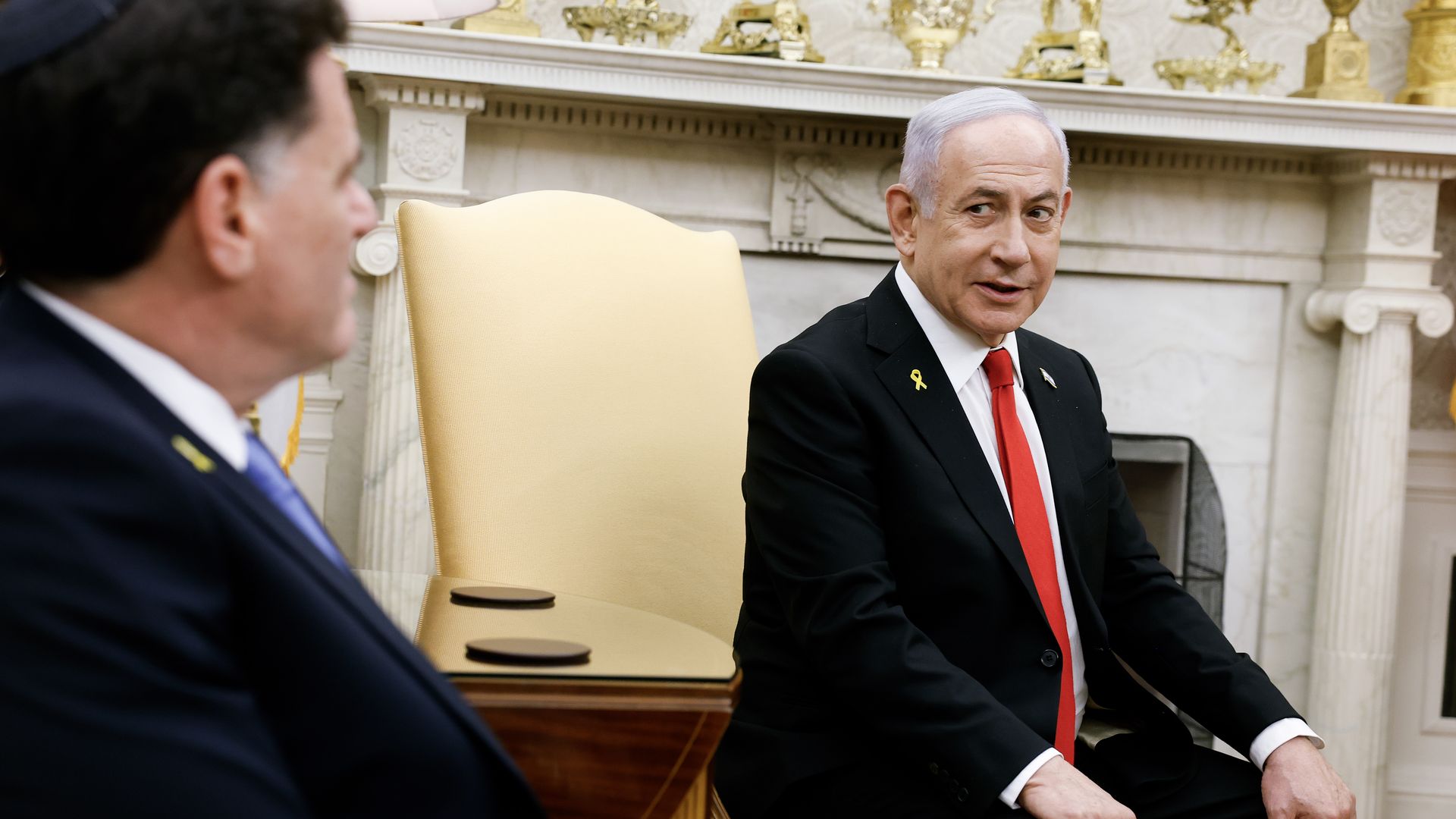
israeli Prime Minister Benjamin Netanyahu (right) and Minister of Strategic Affairs Ron Dermer at the White House last month. Photo: Anna Moneymaker/Getty Images
Israel's concerns over the Trump administration's secret negotiations with Hamas erupted in a contentious call Tuesday between Prime Minister Benjamin Netanyahu's right-hand man and the U.S. official leading the talks, an Israeli official and a source with knowledge of the call tell Axios.
Why it matters: When Trump aides sounded out Israeli officials in early February about the possibility of engaging directly with Hamas, the Israelis advised them not to do it — particularly not without preconditions. Israel found out through other channels that the U.S. was moving ahead anyway.
Driving the news: Netanyahu has avoided publicly criticizing President Trump since Axios revealed the unprecedented U.S.-Hamas talks on Wednesday, saying only that Israel had made its opinion clear to the U.S.
- But Netanyahu's closest confidant, Ron Dermer, was much less restrained a day earlier in a call with U.S. hostage envoy Adam Boehler, the sources say.
- The sources declined to be identified due to the sensitivity of the discussions.
Behind the scenes: The call happened several hours after Boehler met in Doha with Khalil al-Hayya, one of Hamas' most senior political officials and the head of its negotiating team.
- Boehler's negotiations in the Qatari capital began the week prior, with a meeting with lower-level Hamas officials.
- The talks were centered on bringing home American hostage Edan Alexander, 21, and the bodies of four deceased American hostages — part of Boehler's mandate as hostage envoy.
But the U.S. message was that such a deal would go a long way with Trump — who would then press for a broader deal that could involve a long-term truce, safe passage out of Gaza for Hamas leaders, the release of all remaining hostages, and the effective end of the war.
- The alternative was a renewed Israeli military campaign to destroy the group.
- Trump and his advisers hoped for a breakthrough prior to his address to Congress on Tuesday, but found Hamas' response insufficient.
Friction point: The talks also touched on specifics — like the number of Palestinian prisoners who would be released from Israeli jails in exchange for Alexander's safe return — that Israel hadn't agreed to.
- While Netanyahu was initially dismissive of the idea the U.S. would actually sit down with Hamas, he and his advisers grew more and more concerned after the idea became reality, according to a source familiar with his thinking.
Zoom in: In what both sources described as a "difficult" call, Dermer objected to Boehler making such proposals without Israel's consent.
- Boehler assured Dermer he wasn't close to a deal with Hamas and that he understood Israel's parameters, a source with direct knowledge said.
- One Israeli official claimed Dermer's intense call with Boehler led the White House to reevaluate its approach. Dermer declined to comment.
Flashback: The families of American hostages lobbied the Biden administration for months to talk directly with Hamas to get a separate deal to free their loved ones, three hostage family members tell Axios.
- The Biden administration didn't think such talks would yield results and worried about legitimizing Hamas, which the U.S. considers a terror group, a former official tells Axios.
- The official, who was directly involved in Biden's Gaza negotiations, told Axios the White House did have "track 1.5 talks," with a former U.S. official close to the administration speaking to Hamas officials about the possibility of a deal for the American hostages.
- "These talks went nowhere because what Hamas wanted was a ceasefire and prisoners, and it was in Israel's hands, not ours," the former Biden adviser said, arguing direct U.S.-Hamas talks would have only further complicated the main track of negotiations.
- When Trump envoy Steve Witkoff joined the efforts toward a Gaza deal in the closing days of the Biden administration, he proposed meeting directly with Hamas to speed up the talks, but that didn't ultimately happen at the time, an Israeli official and a former U.S. official said.
State of play: Trump and his advisers had a long meeting Wednesday about the talks with Hamas and decided they needed to send a strong public message.
- The idea was to both put pressure on Hamas to make concessions and to clarify that the U.S. position on the group had not changed, a U.S. official said.
- On Wednesday evening, shortly after he met with a group of freed hostages, Trump issued a new public ultimatum for Hamas to release all remaining hostages. "This is your last warning!" he wrote on Truth Social.
- Trump defended the talks with Hamas on Thursday as helpful to Israel because "we are talking about Israeli hostages."
What's next: Witkoff, who is scheduled to travel to the region early next week, said Thursday that Alexander's release is the administration's "top priority," and mentioned he is injured.
- He said "good humanitarian action by Hamas" regarding Alexander would "get them a lot of political capital," and emphasized that there was a "deadline" for Hamas to agree to a deal.
- Trump's envoy said that if Hamas doesn't take a more "reasonable" approach, "there is going to be some action taken" by Israel.
