Biden rolls out new climate targets ahead of Trump's inauguration

Add Axios as your preferred source to
see more of our stories on Google.
Just a month before President-elect Trump's inauguration, the Biden administration on Thursday put out new and more far-reaching national greenhouse gas reduction goals.
Why it matters: Even if, as expected, Trump withdraws the U.S. from the Paris Agreement for the second time and rolls back emissions regulations, the new targets were devised with some of his likely policies incorporated.
Zoom in: The U.S. Nationally Determined Contribution (NDC) — the official name for the non-binding climate goals under Paris — sends a signal to other countries ahead of Trump's arrival.
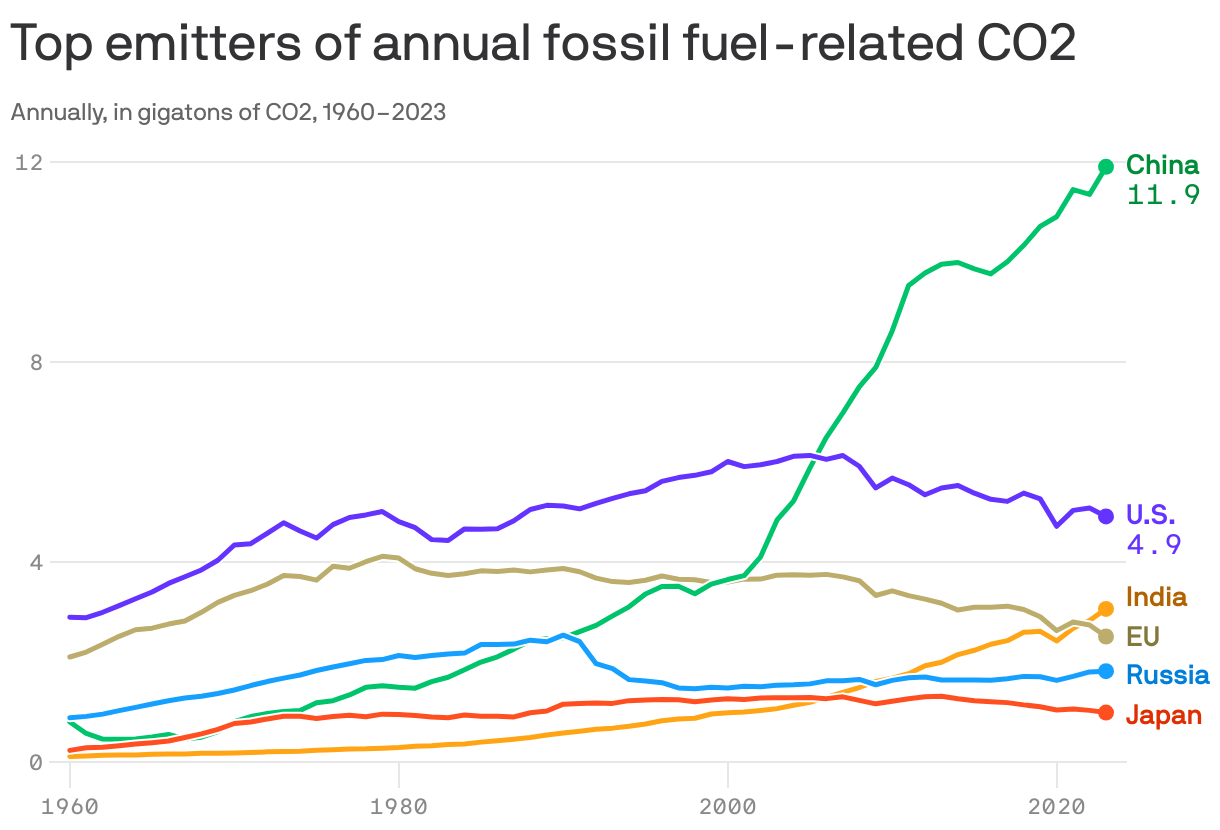
- In particular, it puts pressure on China — the world's top emitter — to issue more aggressive targets that include methane and other warming contributors by the UN deadline.
The big picture: "American industry will keep inventing and keep investing. State, local, and tribal governments will keep stepping up," President Biden said in a video message released Thursday morning.
- Senior administration officials said the numbers they are aiming for — to slash greenhouse gas emissions economy-wide by 61% to 66% below 2005 levels by 2035 — can be achieved with aggressive state, local and regional actions.
- The proposal includes a methane emissions reduction target of 35% below 2005 levels by 2035.
- During Trump's first term, governors and mayors helped put downward pressure on emissions while the executive branch favored more fossil fuel development and fewer regulations.
- "Sub-national leaders in the United States can continue to show the world that American climate leadership is determined by so much more than whoever sits in the Oval Office," top U.S. climate diplomat John Podesta told reporters in a Wednesday press call.
But the new targets could be imperiled if congressional Republicans and the Trump White House succeed in reversing most of the emissions-cutting laws and regulations enacted during the past four years.
- That includes a broad repeal of the Biden climate law, also known as the Inflation Reduction Act.
- The Paris Agreement requires that countries submit new NDCs by mid-February.
Yes, but: The targets come even though the U.S. isn't yet on track to meet its current guideposts — laid out in 2021 — of cutting emissions by 50% to 52% below 2005 levels by 2030.
- According to calculations by the Rhodium Group, the U.S. is currently on course to cut emissions by 32% to 43% relative to 2005 levels by 2030.
- This could drop considerably, though, to 23% to 34% below 2005 levels if EPA emissions regulations are repealed along with other measures, potentially including a whole-scale repeal of the sweeping Biden climate law.
- According to Podesta, the new goals would put the country on a linear, or slightly steeper, path to achieving its longer-term objective of net zero emissions by 2050.
By the numbers: Independent research shows the administration's target ranges are within reach but would be more difficult to achieve in the face of comprehensive rollbacks at the federal level.
- In fact, additional actions would be needed to achieve the previous goals for 2030.
- According to Rhodium's analysis, for example, the U.S. is headed for a 38% to 56% reduction in greenhouse gas emissions below 2005 levels by 2035. But this could be reduced to between 24% to 40%, depending on federal policies.
- The group's calculations of the impacts of rollbacks and repeals show that federal action alone could add 1 billion tons of CO2 emissions. For comparison, last year the U.S. emitted 4.9 billion tons of CO2 from burning fossil fuels, such as gas, coal and oil.
Separate research from the University of Maryland found that "strong leadership" from non-federal actors could get the U.S. to between a 54% to 62% emissions reduction target relative to 2005 levels by 2035.
- This built on previous work comparing emissions scenarios that incorporated various non-federal and national actions.
Zoom out: The details on the new U.S. goals come at a time when fundamental questions are being asked about whether the UN negotiations process is still able to address mounting environmental challenges.
- Recent summits ranging from COP29 in Azerbaijan to negotiations on a plastics treaty in Korea and biodiversity in Colombia have ended in divisive agreements or deadlocked.
- Meanwhile, governments that took up the mantle of climate leadership during Trump's first term, such as Germany, France and Canada, are enmeshed in political instability.
What they're saying: "The value of submitting the NDC is to send a clear signal internationally about this administration's commitment to the Paris Agreement and especially to set a strong benchmark for U.S. states, cities and other stakeholders to pursue," David Waskow of the World Resources Institute told Axios.
The bottom line: The new U.S. targets lie somewhere between symbolic and serious, given the potential for Trump to affect emissions more radically than anticipated.
