Israel conducts massive strike in Beirut targeting Hezbollah leader Hassan Nasrallah


Add Axios as your preferred source to
see more of our stories on Google.
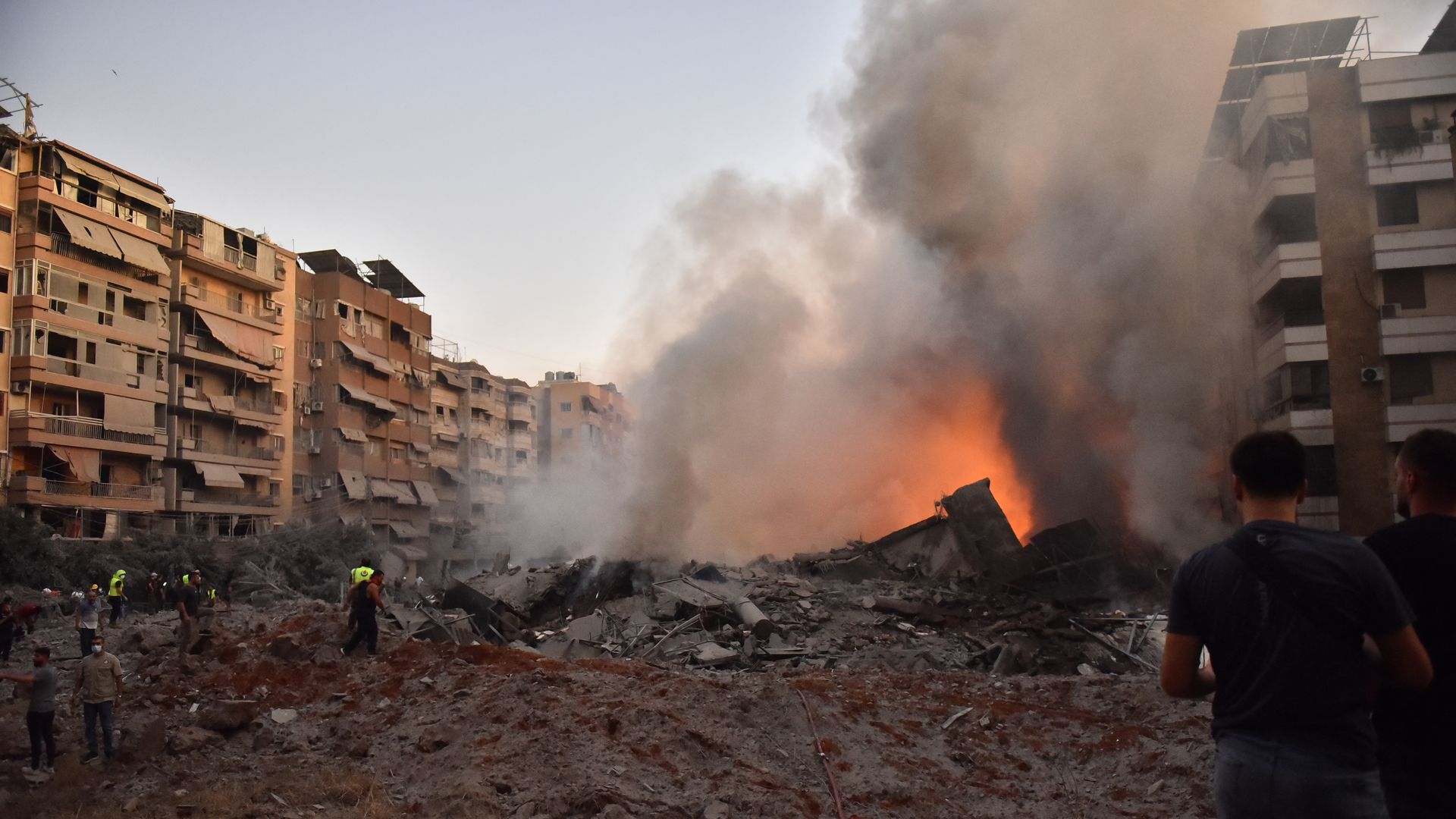
The aftermath of an Israeli strike in souther Beirut on Friday. Photo: Fadel Itani/AFP via Getty
Israel conducted an airstrike on Friday targeting Hezbollah's central headquarters in Beirut in an attempt to kill the group's leader Hassan Nasrallah, Israeli officials said.
Why it matters: The attack, which also hit residential buildings in the southern suburbs of Beirut, was the largest Israeli strike in Beirut since the 2006 war in Lebanon. At least six people were killed and 91 wounded, Lebanon's health ministry said on Friday, adding it is a preliminary assessment of the casualties.
- More than 700 people have been killed in Lebanon over the past 11 days of intense fighting between Israel and Hezbollah.
The latest: Israel Defense Forces (IDF) spokesperson Rear Adm. Daniel Hagari said Israeli jets are patrolling the airspace near Beirut International Airport and will not allow "hostile flights with weapons" to land there.
- "It is a civilian airport for civilian purposes and it needs to stay that way," Hagari said.
- The IDF on Friday night told residents in parts of southern Beirut to evacuate from areas near three specific buildings, where it claimed Hezbollah has been hiding anti-ship missiles, before striking them.
The White House said President Biden was briefed about the attacks several times on Friday by his national security team, and that he directed the Pentagon to "assess and adjust as necessary U.S. force posture in the region to enhance deterrence, ensure force protection, and support the full range of U.S. objectives."
- The Israeli Prime Minister's Office said Netanyahu will cut his trip to New York short and travel back to Israel on Friday, taking the unusual step of traveling on Shabbat (the Jewish Sabbath).
- Lebanese caretaker Prime Minister Najib Mikati said he was flying back from New York to Beirut early after the Israeli attack, per Lebanon's state news agency.
Driving the news: Israeli officials said senior Hezbollah officials were at the headquarters at the time of the strike. A senior Israeli official said there are indications Nasrallah was in the compound that was attacked.
- There has been no official response so far from Hezbollah on the attack or on Nasrallah's status. The Israeli source said the IDF did not yet have confirmation of whether he was hit.
- Hezbollah-affiliated al-Manar Television reported that four buildings in southern Beirut were struck.
- Hagari described the attack as a "precise strike on the central HQ of Hezbollah, which was intentionally built under residential buildings in Beirut in order to use them as human shields."
- Israeli Prime Minister Benjamin Netanyahu abruptly left a press briefing at the UN after receiving an update from his military adviser.
Friction point: An Israeli official said Israel notified the U.S. minutes before the strike in Beirut, but two senior U.S. officials denied that, telling Axios they had no prior warning.
- "We had no knowledge of it or involvement in it," a senior U.S. official said.
- Pentagon spokesperson Sabrina Singh said the U.S. did not have advanced warning of the Israeli strike in Beirut, adding that Israeli Defense Minister Yoav Gallant spoke on the phone with U.S. Secretary of Defense Lloyd Austin as the strike happened.
- President Biden later told reporters the U.S. had "no knowledge of or participation in" the IDF attack.
Behind the scenes: Two senior Israeli officials said the first discussion about the possibility of trying to assassinate Nasrallah took place on Wednesday before Netanyahu's trip to New York.
- The officials said the decision was to wait for an "operational opportunity," which arrived on Friday.
- One of the officials said the rationale behind the attack was that Nasrallah wouldn't decouple Hezbollah from Hamas in Gaza and stop the fighting on the northern border. "Therefore, the decision was to take him out of the decision-making picture," the official said.
Between the lines: The strike comes two days after the U.S. and France announced an initiative for an Israel-Hezbollah ceasefire, and after Secretary of State Antony Blinken and other U.S. officials called on Israel to avoid any further escalation that could spark all-out war.
- The White House was furious when Netanyahu denied any role in the ceasefire plan, despite having been involved in the talks leading up to the announcement. On Thursday, Netanyahu backtracked and said "Israel shares the aims" of the U.S.-backed proposal.
- But Friday's attack is another clear escalation from Israel and suggests Netanyahu's government has little interest in a ceasefire.
