Climeworks unveils new tech, global expansion plans

Add Axios as your preferred source to
see more of our stories on Google.
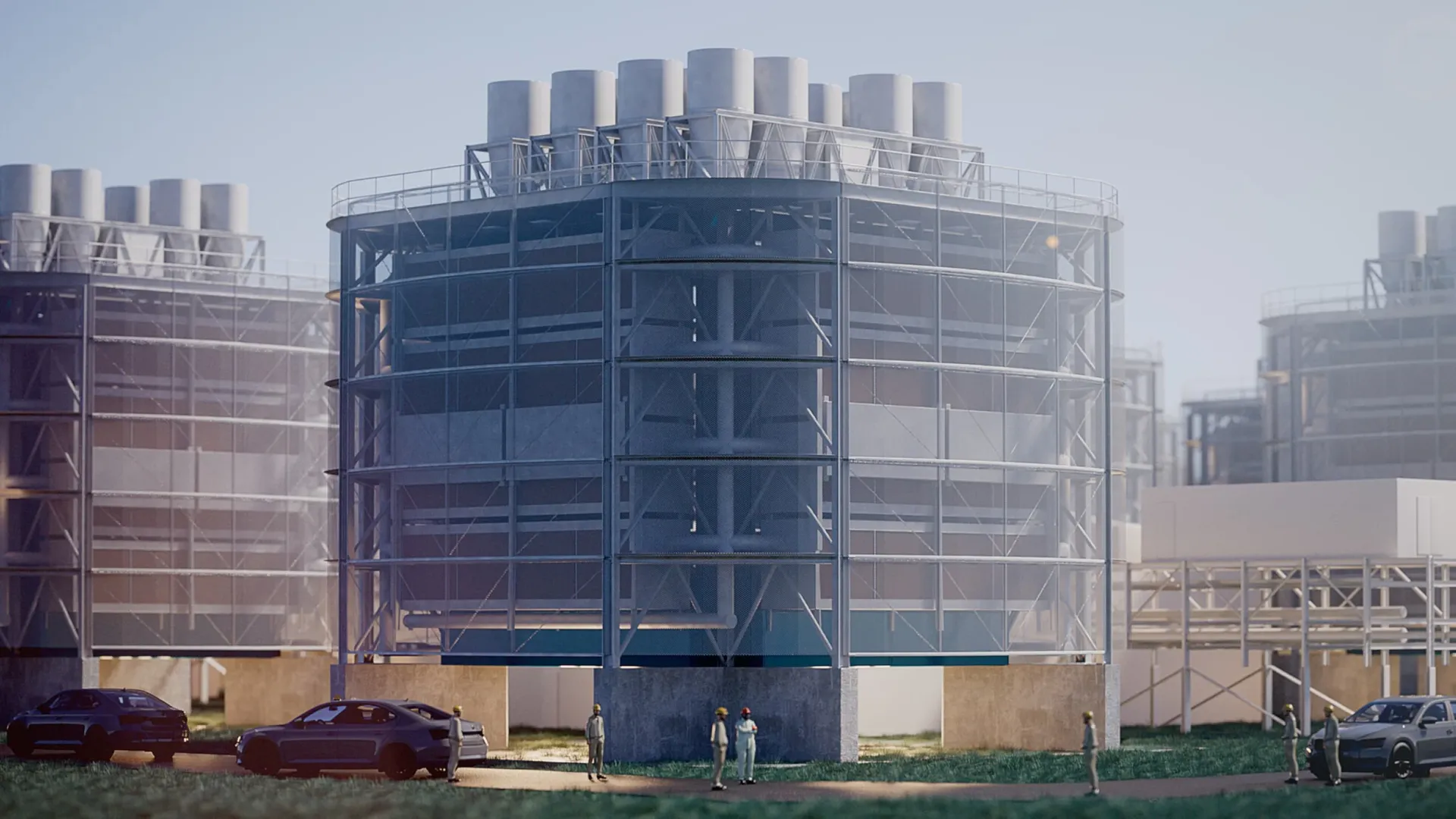
A rendering of Climeworks' new megaton-scale modular technology. Photo: Courtesty of Climeworks
ZURICH, Switzerland — Climeworks, a Swiss company and early mover in the quest to capture and store carbon dioxide from the air, has developed new technology that it claims cuts costs, energy use and the price of carbon removal.
Why it matters: A key task for direct air capture to scale dramatically in the next few decades is to lower the costs involved. Climeworks' goal is to get the cost of carbon removal down to between $400 to $600 per ton by 2030.
Zoom in: At a tour on Tuesday for journalists shortly before its annual carbon removal conference, Climeworks showed its test facility in the industrial city of Basel, about 50 miles northwest of Zurich.
- There, and at a smaller facility in Zurich, the company has been running what it calls its third-generation technology for direct air capture.
- "What you're looking at here is unparalleled," said Stefan Schenk, who heads up testing for Climeworks' 180-person research and development team, out of about 500 employees total. He pointed out the different features of the Basel site.
- Pipes lead to and from the air intakes, which look much like the firm's newly-opened Mammoth facility in Iceland.
- "No one else has this in the industry," Schenk said of the real-world test facility.
How it works: Climeworks uses modules containing structured sorbent materials, chemically removing CO2 as air is sucked in and run through the modules.
- Each module is 85 by 85 feet and 73 feet tall, the company says.
- The third-generation tech will allow for the removal of CO2 on a megaton scale, the company stated in a press release.
Between the lines: Climeworks' team is acutely aware that the technology must drastically grow to the gigaton scale within the next few decades, in order to have its intended effect of complementing emissions cuts and drawing down legacy emissions and carbon from hard-to-abate sectors.
- The UN climate panel, for example, projects carbon removal, including DAC, needs billions of tons of CO2 captured and permanently stored annually for emissions to go net negative. In other words, the success of technology like it is key to meeting Paris targets.
- Yet the technology is not nearly ready for that sort of scale, and may not be for decades.
- Climeworks co-CEO and co-founder Jan Wurzbacher likened the task facing developers to establishing an entirely new, multibillion-dollar-plus industry from scratch.
- Such tasks have been completed before, he said, citing, ironically, the oil and gas industry. Other Climeworks executives offered up the solar industry as an example, where rapid growth and plummeting prices have made it cost-competitive with other sources of electricity.
Yes, but: The sector is growing quickly, judging from the attendance at the ongoing carbon removal summit in Zurich. There's also more government, corporate and venture capital interest to incentivize the tech's use.
- Climeworks, for example, plans to first use its third-generation technology at its Project Cypress plant in Louisiana, which has funding from the Energy Department as part of its DAC Hubs program.
- The broad field of carbon removal is diverse, with firms such as Pachama that are pursuing projects that combine technology and natural carbon sinks to provide ways for companies to more reliably offset their CO2 emissions.
- Others are pursuing large-scale tree planting and monitoring, or are competitors of Climeworks in the chemistry-based DAC arena.
The intrigue: During a Tuesday press conference, Climeworks executives noted the importance of government policies that incentivize the development and deployment of DAC technologies, such as the DAC Hubs program in the U.S., as a critical growth factor.
- "We need compliance markets and [government] policies to get to billions of tons," Wurzbacher said.
- The firm is now involved in projects on at least three continents, with key facilities in Iceland, projects under development with the hydropower-linked firm Deep Sky in Quebec, a joint venture with a local company in Kenya, projects in Norway and plans for projects in Australia as well.
- It envisions getting costs of carbon removal down to between $150 to $250 per ton by 2050.
The bottom line: Climeworks' development since its founding in 2009 shows how a combination of slow, iterative development, testing and deployment — plus the accelerant of recent government policies — can allow a DAC company to arrive at the megaton scale.
- But the gigaton goal remains.
Disclosure: Climeworks covered Andrew's travel costs so he could moderate one of the conference sessions.
