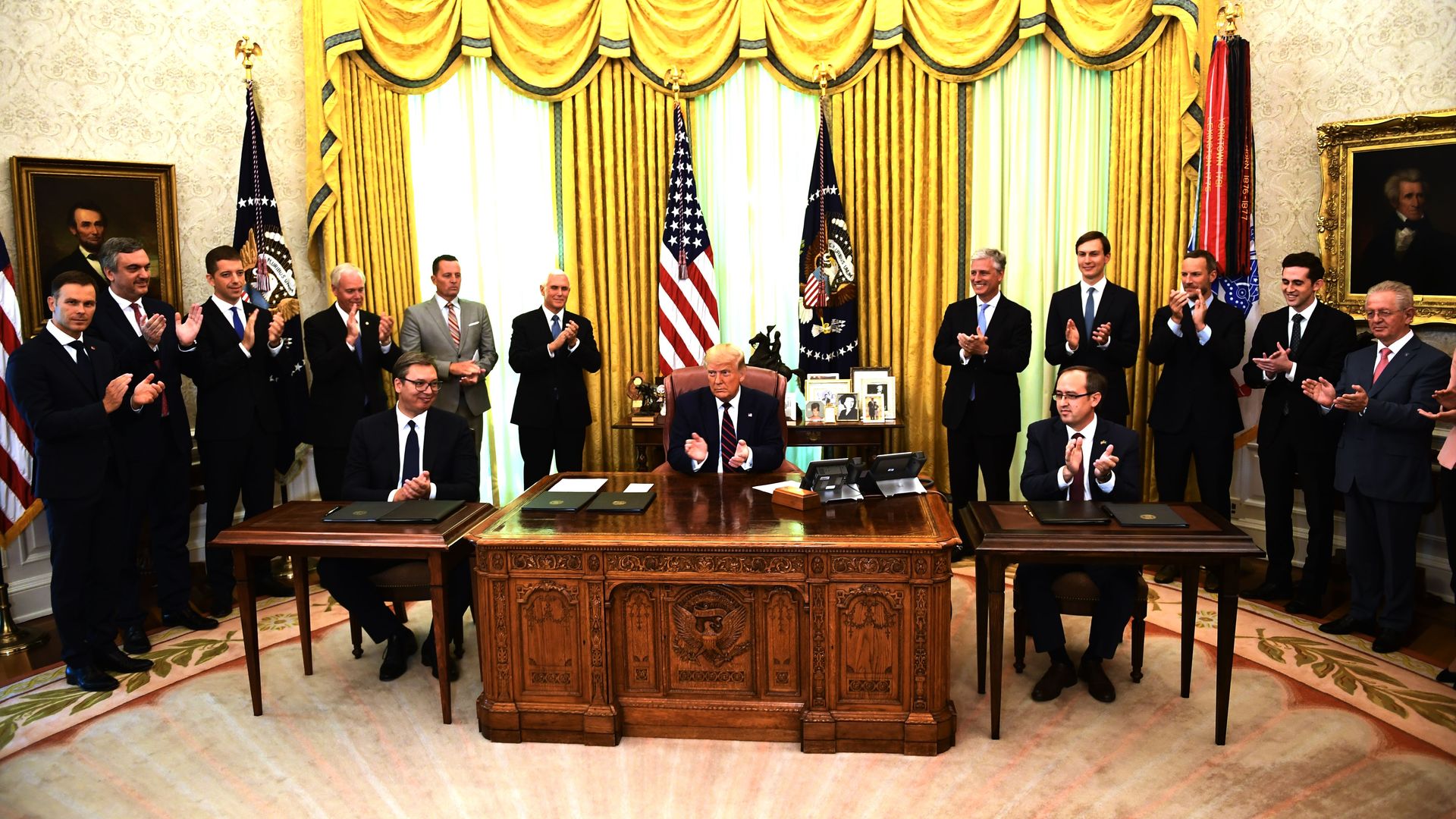
A White House summit between the leaders of Serbia and Kosovo ended with a twist on Friday: Both countries announced diplomatic breakthroughs not with one another, but with Israel.
Driving the news: Serbia has agreed to move its embassy to Jerusalem "by July," President Trump announced, while Kosovo and Israel will grant one another diplomatic recognition.
Louis Dreyfus, the Swiss agricultural trading giant, is in talks to sell a minority equity stake to Abu Dhabi sovereign wealth fund ADQ in a move that "could boost food security for the United Arab Emirates" amid the coronavirus pandemic, per Bloomberg.
Why it matters: In its 168 years, Louis Dreyfus has never before had a non-family shareholder.
Angela Merkel’s call to actionover the nerve agent attack on Russian opposition leader Alexei Navalny has been turned around on her: demands that the controversial Nord Stream 2 gas project be scrapped are growing louder.
Why it matters: The pipeline is nearly complete, and it would double Russia’s capacity to export gas directly to Germany.
The fashion industry is reeling from the stunning blow dealt by a global pandemic that closed stores, largely ended international travel, and caused consumer demand for its products to shrivel.
Bahrain announced Thursday that it had agreed to the United Arab Emirates' request that it allow flights between the UAE and Israel to pass through its airspace.
Why it matters: The move followed lobbying from the Trump administration, which is also in talks with the Bahrainis about possibly following the UAE into normalization with Israel.
There are few positions more uncomfortable nowadays than being an American company reliant on China. But reconfiguring supply chains is far from easy.
The big picture: A recent McKinsey report showed almost all industries at risk of supply-chain disruption. The exceptions are largely regional industries like glass, cement, and food.
U.S. consumers are getting less concerned about the impact of tariffs on their daily lives, new data show.
What happening: After consumer concern about the tariffs rose to record highs in April and May, CivicScience noted a consistent decline that has pushed overall readings on concern down to nearly their levels before the pandemic began in the U.S.