Monday's science stories

In 1997 we sent a laugh into space. Now we know whose.
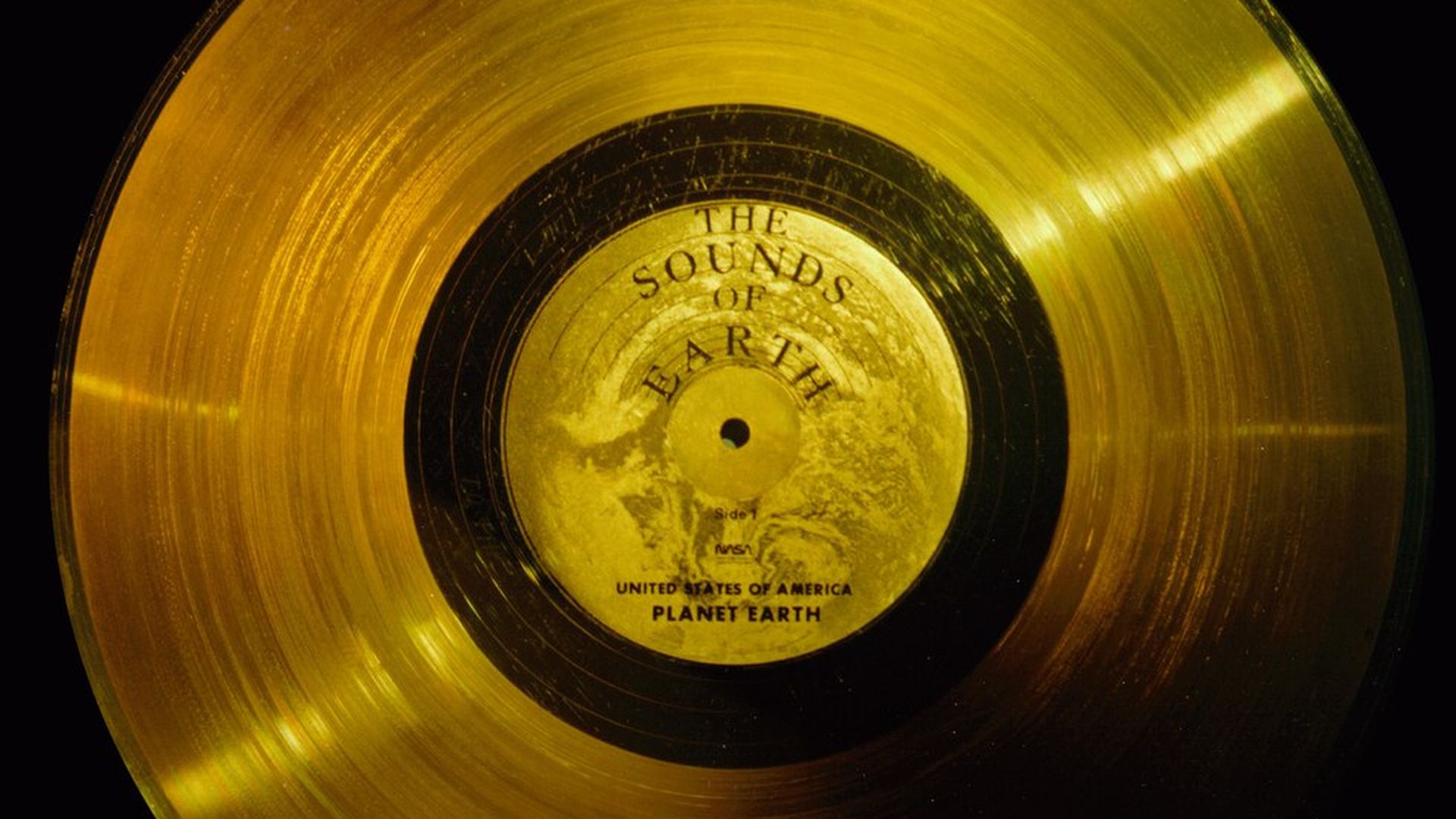
The Voyager satellites (there are two) each carry a golden record. The record's grooves contain the sounds of Earth, meant to represent our planet to any intelligent life. It includes whale songs, a jungle, a human heartbeat, thunder, Chuck Berry's Johnny B. Good and laughter. On earthly recordings, that laughter is hard to hear, which led an Atlantic reporter on a quest to learn what it sounded like — and find out who was laughing.
Perhaps unsurprisingly, the laugh (probably) belonged to late astronomer Carl Sagan. Sagan was integral in the record's conception, and while he was working on it he fell in love with the creative director, Ann Druyan. Their daughter, Sasha Sagan, told the Atlantic Druyan included the laugh because it "was the very first impression she ever had of my dad ... she wanted it to live on forever."

Defining the future: what is space?
/2017/12/15/1513303956847.gif?w=3840)
Humans have stared at the sky for millennia trying to figure out what is out there and what it tells us about our place in the universe. One of the most mysterious things is everywhere around us — in the gaps between planets and people and particles hums something that scientists and philosophers have spent a long time trying to understand: Space. For as fundamental to our existence and experience as space is, it's hard to describe and define it.
So, we asked four experts a deceptively simple question: what exactly is space?
- Sean Carroll, theoretical physicist, California Institute of Technology: Space is overrated
- Izabella Laba, mathematician, University of British Columbia: We can work with space without understanding its essence
- Bridget Falck, astrophysicist, University of Oslo: Space is a relation between things, not a thing itself
- David Albert, philosopher, Columbia University: Maybe there is no space

Space is a relation between things, not a thing itself
Our Expert Voices conversation on space.
You may have heard that space is expanding, or that the fabric of space-time ripples quite literally like a wave. These are absolutely true – and awesome – statements, but what do they imply about the nature of space?
Concepts like expanding space or gravitational waves often lead people to think of space as having existence in and of itself. But space has no meaning without distinct objects; a truly empty universe is no universe at all. One might object that in a vacuum, virtual particles pop into and out of existence – but then such a universe isn't really empty, is it?
The expansion of the Universe, gravitational waves, and other phenomena are the function of physical objects acting according to physical laws; they do not necessitate that space itself physically exists. Until a future theory of quantum gravity weighs in on the issue, there is no reason to think of space as a thing.
Bottom line: Space is not a thing. Space is merely the only way to conceptualize the existence of distinct things in the Universe, just as time is the only way to conceptualize a Universe in which things change.
Other voices in the conversation:
Sean Carroll, theoretical physicist, California Institute of Technology: Space is overrated
Izabella Laba, mathematician, University of British Columbia: We can work with space without understanding its essence
David Albert, philosopher, Columbia University: Maybe there is no space

We can work with space without understanding its essence
Our Expert Voices conversation on space.
In mathematics, "space" describes a setting where relations between objects imitate real life phenomena: distances, directions, continuity, convergence. In abstract settings, these relations can be warped or decoupled from one another so we can examine the meaning of each one separately. A space can have infinitely many dimensions, the surface of a ball need not be curved, or we can determine directions without being able to measure distances. The "points" in a space can be complicated objects with structure of their own, such as functions or matrices. Their properties are examined indirectly through the geometry of the space they live in. We build sophisticated and productive theories of mathematical spaces that require no knowledge of what the elements of these spaces truly are, only asking that they conform to certain geometric requirements. This might shed light on why we are able to function so well in the universe, developing science and technology, while there are still fundamental questions about the space we live in that remain unanswered. Bottom line: Mathematics works around the unknown, providing sufficient functionality even while the essence may still be under investigation. Other voices in the conversation:
Sean Carroll, theoretical physicist, California Institute of Technology: Space is overrated Bridget Falck, astrophysicist, University of Oslo: Space is a relation between things, not a thing itself David Albert, philosopher, Columbia University: Maybe there is no space

Maybe there is no space
Our Expert Voices conversation on space.
There's an obvious connection between how far away I am from something and the degree to which that thing can physically affect me. A rhinoceros, or an explosion, or a tornado, or what have you, is more dangerous to me the closer it is to me, and less dangerous to me the farther away it is from me. And we usually explain this to ourselves by saying that a distant explosion is less dangerous to me than a near one because the effects of a distant explosion have more space to cross, before they get to me, than the effects of a near one do.
New idea: With increasing excitement and intensity over the past 20 years or so, the following thought has occurred to scientists and philosophers: Maybe there is a way of eliminating the middleman here. We're used to thinking of the 'distances' between things as something that helps explain why some things affect one another a lot and others affect one another less – but maybe that's all backwards: maybe there's a way of thinking about the distances between things as nothing more than a measure of how much they affect one another!
Bottom line: Maybe the world, at its most fundamental level, is just this formless void in which things float, and affect one another – a void in which there is no distance, and no geometry, and no space – and that all the talk about distance and geometry and space is really just a way of keeping track of how those things affect one another.
Other voices in the conversation:
Sean Carroll, theoretical physicist, California Institute of Technology: Space is overrated
Izabella Laba, mathematician, University of British Columbia: We can work with space without understanding its essence
Bridget Falck, astrophysicist, University of Oslo: Space is a relation between things, not a thing itself

Space is overrated
Our Expert Voices conversation on space.
We tend to think of space as a fundamental part of reality's architecture: it's where everything is located. But that reflects an outdated, classical intuition.
New view: These days we know that quantum mechanics provides a more accurate view of the world. According to quantum theory, the world isn't actually made of "objects" with "locations" in three-dimensional "space." Those are simply convenient ways of talking about features of an abstract and more fundamental description of the universe: the wave function. It evolves in a mathematical realm with more than 10^(10^100) dimensions. That's an absurdly large number, which should just make you think "Wow, that's a lot of dimensions."
In this view, ordinary space is like "temperature" or "wetness" – not a fundamental category, but a useful approximation we invoke to describe a tiny sliver of reality.
Bottom line: Physics has a long way to go before we understand how space emerges from quantum mechanics, but we shouldn't be surprised that the fundamental nature of stuff is something very different from what we're used to.
Other voices in the conversation:
- Izabella Laba, mathematician, University of British Columbia: We can work with space without understanding its essence
- Bridget Falck, astrophysicist, University of Oslo: Space is a relation between things, not a thing itself
- David Albert, philosopher, Columbia University: Maybe there is no space
The Internet of Things is making it harder to study space
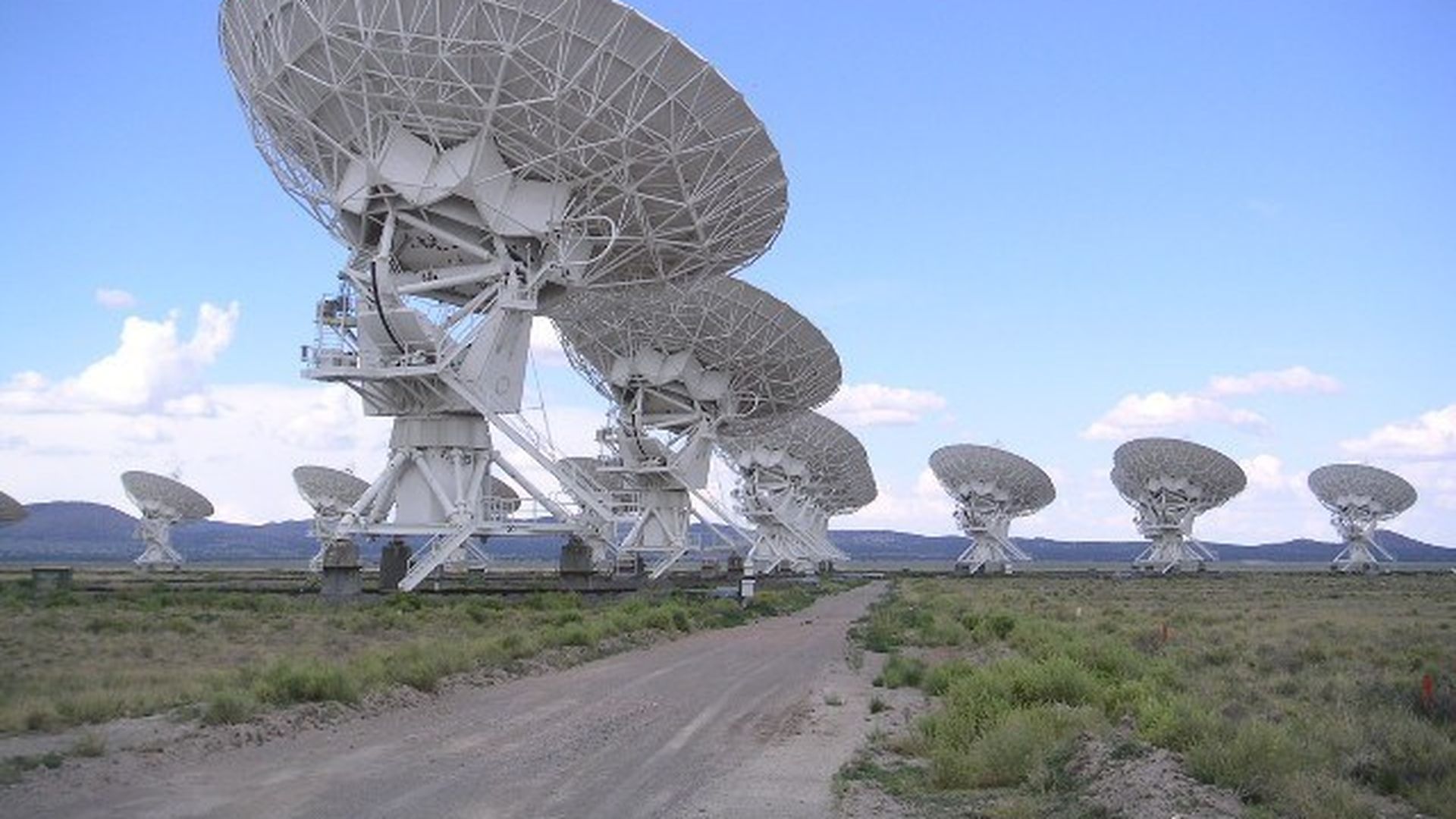
Most connected devices use radio waves, be it WiFi or Bluetooth. Although it makes our lives more convenient, it's making astronomers' lives harder, according to Wired. Radio waves don't just come from humans, they're emitted by objects in space, and scientists can use them to analyze just about everything, from stars to nebulas to comets.
Right now, some radio wavelengths are reserved exclusively for radio astronomy. But that doesn't mean they're the only frequencies space sends towards Earth, and it's getting harder to detect space's signals through all the earthly noise. (Mysterious "alien" radio signals detected in Australia in 2015 were caused by a microwave, for example.)
Military and industry groups are working toward possible solutions, but they come with their own challenges. The best solution is to figure out how to share the spectrum, says Wired's Sarah Scoles. "If you fill the spectrum with man-made emissions, you will never be able to understand certain parts of the universe," astronomer Liese vanZee told Wired.

Robot that mimics gecko could pick up space trash

Researchers at Stanford and NASA have developed a new robotic gripper that resembles gecko feet for use in space.
How it works: Geckos have small hairs on their feet that collectively work as an adhesive and allow them to climb smooth, vertical surfaces. The robotic gripper mimics those hairs using thousands of silicone rubber wedges pointing in opposite directions. When pulled together, they produce an adhesive force.
Why it matters: Hundreds of thousands of pieces of space junk orbit Earth, increasing the likelihood of space collisions and, in some cases, occupying prime positions for new satellites. If the gecko-inspired gripper can work in the cold environment of space (something the researchers plan to test), it could help robots collect debris and help clear the way.