January 18, 2024

🍻 Ready for another storm? We've got a (snow) packed edition for you today.
🎶 Today's last tune is a chill one from Ryan Dougherty, president of the Geothermal Exchange Organization: "Phantom Brickworks III" by Bibio.
1 big thing: EPW clears PROVE IT Act
Illustration: Aïda Amer/Axios
The Senate Environment and Public Works Committee advanced the PROVE IT Act — but the markup exposed inter-party tensions that could derail the bill, Nick writes.
Why it matters: The legislation is an important first step in the Hill discussion about carbon tariffs.
Driving the news: EPW moved the bill today in a 14-5 vote. Four Republicans — John Boozman, Lindsey Graham, Cynthia Lummis and Kevin Cramer (the lead sponsor) — joined all Democrats in voting "yes."
- PROVE IT, you may recall, would direct the Energy Department to study industrial greenhouse gas emissions from producers in the U.S. and around the world.
- Cramer also added an amendment during the markup that specifies that nothing in the bill "provides any new authority to any federal agency to impose, collect or enforce a greenhouse gas emissions tax, fee, duty, price or charge."
- Expect the coming House companion to have a similar provision, which is a nod to Republican concerns that the bill would lead to a carbon tax.
What they're saying: "Today was really monumental," Cramer told reporters afterward. "It was a big enough margin that I think we have an impetus for making a case for bringing it to the floor, either on its own or probably in the package of some sort."
- Proponents see PROVE IT as a precursor to an eventual U.S. carbon tariff regime.
- But they argued during the markup that it's necessary in the immediate term to respond to the EU's carbon border adjustment mechanism.
Yes, but: Republican opposition — including from ranking member Shelley Moore Capito — remains strong, and will probably be amplified in the House.
- Capito said a new data program could provide a statutory base for Democrats to impose a tax or tariff with the 50-vote threshold via reconciliation.
- She pointed to the IRA, in which Congress directed EPA to revise existing reporting requirements to facilitate a new fee on methane emissions.
- She tried to add an amendment that would have set a 60-vote threshold for carbon tariffs in a future reconciliation bill, but was rebuffed in a partisan vote.
Of note: Centrist and conservative climate groups wrote Congress this week urging support for the bill in a letter signed by high-profile trade groups like the American Petroleum Institute and the U.S. Chamber of Commerce.
- Meanwhile, more than 40 conservative groups penned their own letter, calling PROVE IT "a gateway for a carbon tax on imported goods and a domestic carbon tax."
- "The United States should push back against the EU's extreme green policies and not, under any circumstances, accept their disastrous environmental and energy policies," they wrote.
Our thought bubble: The war of words shows how contentious the carbon tariff fight could become.
- PROVE IT might be a stepping stone, but we don't see Congress getting real on carbon tariffs in 2024.
2. Exclusive: Center-right enters the ESG fray

Illustration: Aïda Amer/Axios
Some conservatives want Congress to stop politicizing ESG, Nick writes.
Driving the news: A coalition of center-right and free-market groups sent a letter to House Financial Services Committee leaders today arguing that legislators shouldn't "pass more bans or mandates targeting the investment decisions of individuals, pension funds, or businesses."
Why it matters: The letter, shared exclusively with Axios, is an attempt to cool off the Hill conversation around ESG investing. Using it as a political bludgeon, they warn, will ultimately hurt taxpayers and public pension funds.
Zoom in: The letter lays out a set of principles that include protecting pension funds from "politicization" and allowing businesses "to voluntarily adopt sustainable practices or address the social considerations of their workforce free from government mandates."
- Former Rep. Carlos Curbelo signed the letter, alongside Nick Loris of C3 Solutions, Devin Hartman of R Street and Pete Sepp of the National Taxpayers Union, among others.
Our thought bubble: These folks have some bona fides with what's left of the GOP's centrist wing on the Hill.
- They're taking a rare middle ground amid a barrage of anti-ESG messaging from well-monied conservative groups.
- They oppose both the SEC's proposed climate reporting requirements and the GOP ESG backlash that led states to ban environmental investing considerations and to stop doing business with major asset managers.
- "Democrats believed that they could somehow shape various social policies by directing federal, state and even local money into causes in which they believed," Sepp told Nick.
- "Republicans ran with that playbook, came up with their own reasons for divesting or investing or directing or mandating, and suddenly, this whole playing field has become contaminated."
What we're watching: Financial Services Chair Patrick McHenry has a slate of anti-ESG bills, but they haven't seen floor action.
- Not all of those are necessarily objectionable for the groups on the letter, and Loris said Republicans have thus far "largely been supportive" of their concerns.
- "I even think you saw a bit of a tone shift within the last couple of months, as the heat around ESG died down a little bit," he told Nick.
3. Wyden transmission credit was one that got away
Wyden in September. Photo: Drew Angerer/Getty Images
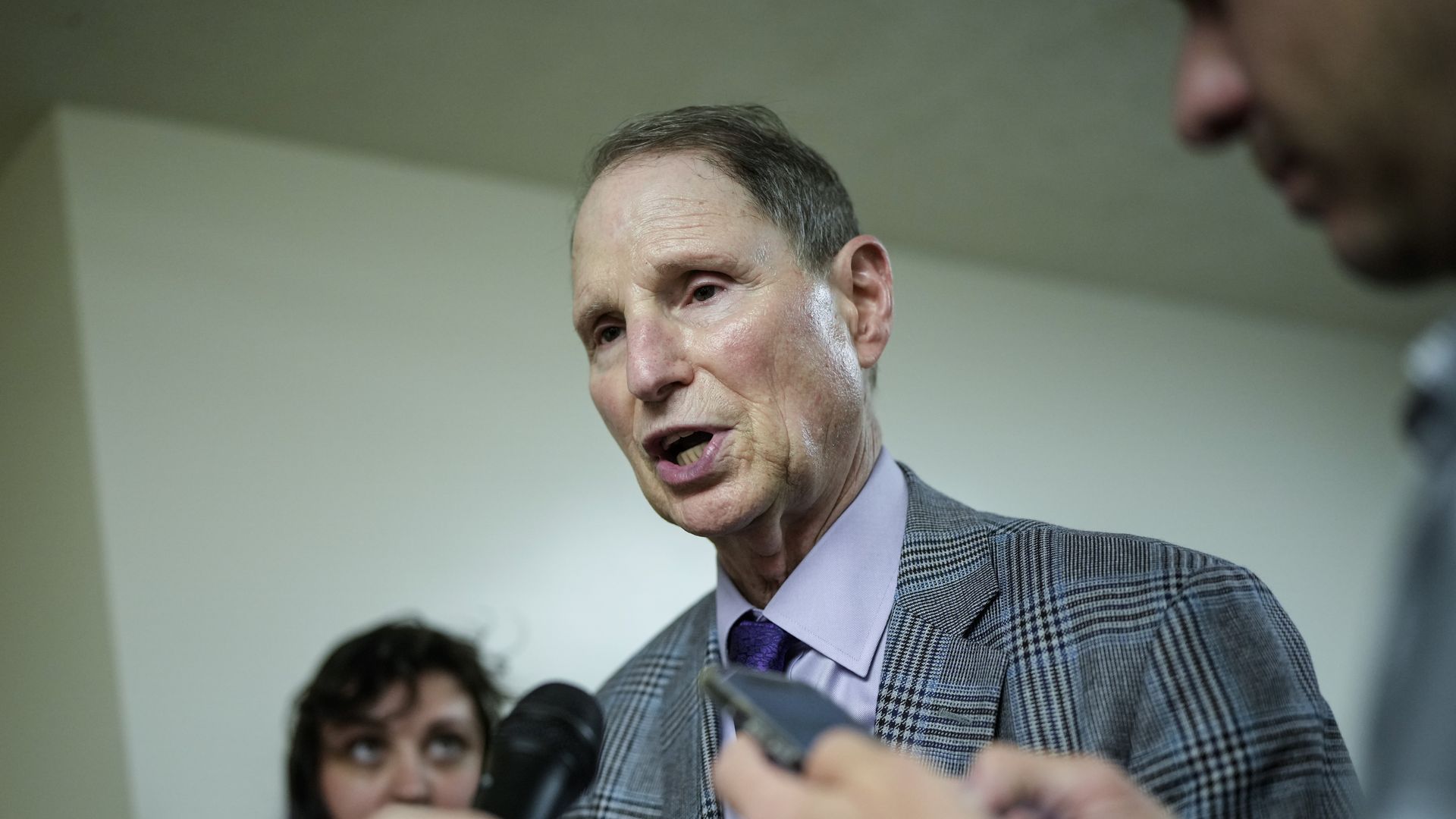
Senate Finance Chair Ron Wyden sees the transmission tax credit as the big climate policy left on the IRA cutting room floor, Jael writes.
Why it matters: Wyden is doubling down on creating a transmission credit as advocates for new wiring projects push for adding the idea to a nascent bicameral tax deal. (We told you about this effort yesterday.)
Driving the news: When Jael asked Wyden about the transmission credit push, he said: "I wanted to do more in this [deal], but it was a challenge on the other side."
- Wyden said the credit was the "big one" he didn't get in the IRA. "If you want to know, am I for a transmission expansion? Absolutely."
- The senator declined to divulge whether House Ways and Means Chair Jason Smith was the reason that transmission wasn't in the deal, simply adding the Republican has "been very constructive."
- Smith's office didn't respond to a request for comment.
Between the lines: Wyden's insistence on getting this credit — and Republicans' hemming and hawing over transmission — reveals how the coming election will likely decide whether the credit becomes law anytime soon.
4. Catch me up: Good Sam, spending and more

Illustration: Tiffany Herring/Axios
⛏️ 1. Good job, Sam: Senate EPW by a voice vote advanced a bill that would create a federal pilot program for "Good Samaritan" entities to clean up contaminated mine lands without facing a high risk of legal liability.
🍑 2. Train to Georgia: Rep. Buddy Carter is the new chair of Energy and Commerce's Environment Subcommittee. Carter noted his coastal district includes "the Okefenokee Swamp, major U.S. ports, critical mineral mines and a robust manufacturing industry."
💵 3. Another — sigh — spending update: The Senate passed the CR this afternoon (details here), and the House is taking it up now.
💨 4. Geothermal march: House Natural Resources yesterday advanced a bipartisan bill that would speed up permitting for geothermal projects on public lands.
✅ Thank you for reading Axios Pro Policy, and thanks to editors Chuck McCutcheon and David Nather and copy editor Amy Stern.
View archive