November 30, 2023

😍 Loving the Thursday vibes? Here's cute wildlife pics before the weekend.
🍻 Join Axios Pro on Dec. 7 for the final Happenings on the Hill Happy Hour of 2023.
- Meet, network and drink with Pro Policy reporters and leaders within the policy space. And the first person to ask Jael about her music will win a prize!
📻 Today's last tune is from Sen. Mark Kelly, who asked Alexa to put on classical music — but instead it played the Adele-led theme to "Skyfall." (Good one, Alexa.)
1 big thing: Dems' gassy problem
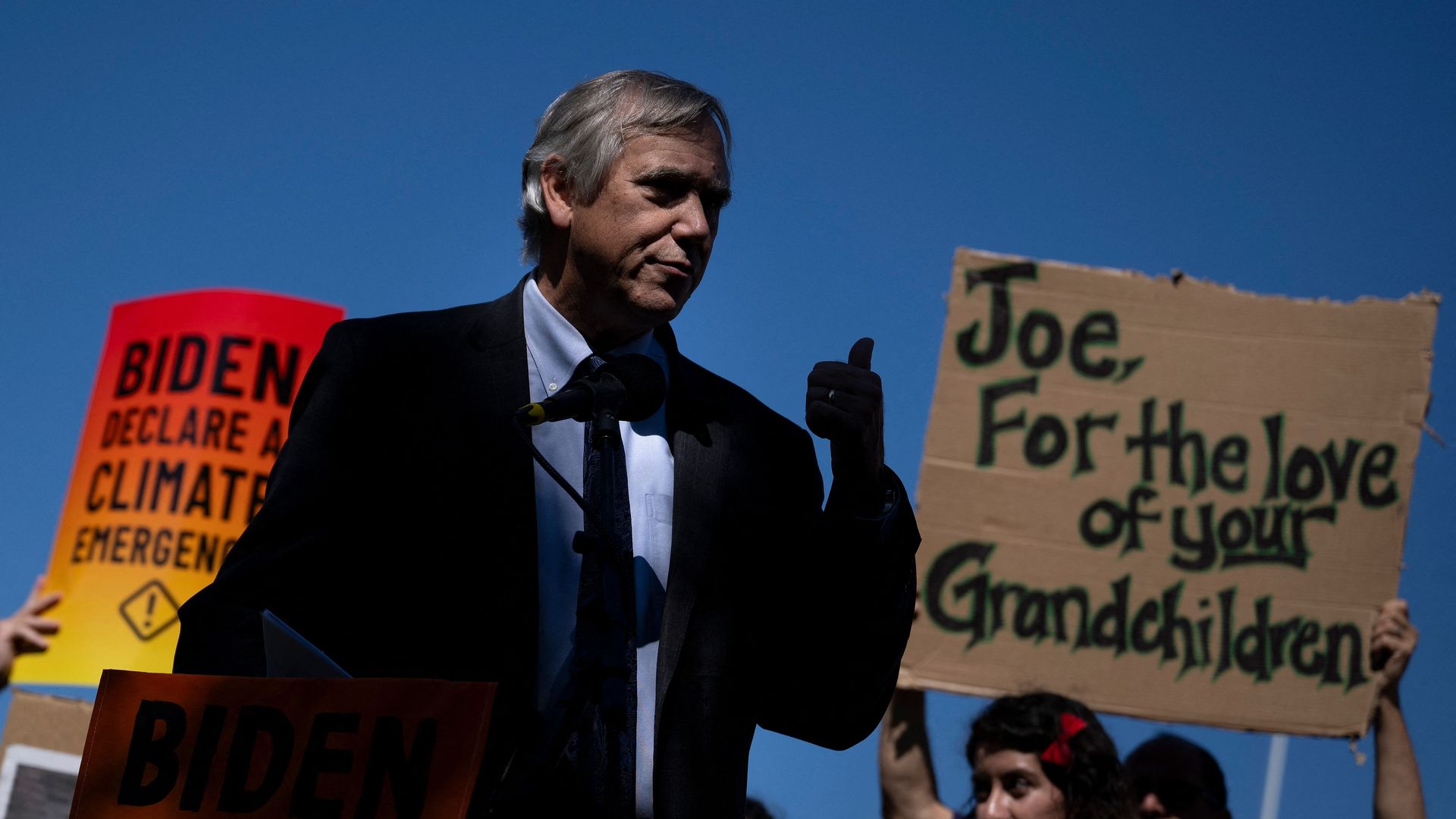
Merkley speaks at a September climate rally. Photo: Brendan Smialowski/AFP via Getty Images
Fury over U.S. liquified natural gas exports is fueling an end to the Biden administration's peace with Democratic climate hawks, Jael writes.
Why it matters: Democrats on the Hill largely held back from wide-ranging climate criticism of the Biden administration in light of the IRA, even after approval of the Willow oil project and the Mountain Valley Pipeline. No longer.
Driving the news: A cadre of Democrats led by Sen. Jeff Merkley sent a letter this month to the Energy Department requesting that it formally reconsider whether exports of liquefied natural gas — often a product of fracking — are "in the public interest."
- The U.S. last year became the world's largest exporter of natural gas, and several new export terminals are under consideration for federal approval.
- Merkley told Jael yesterday that the administration's willingness to let U.S. gas exports grow "deeply undermines our leadership in the world for climate policy."
- "If you greenlight more drilling in the Gulf and more gas pipelines in Alaska and LNG export facilities and the Willow project in the North Slope and the Mountain Valley Pipeline … you're just paving the way for climate oblivion."
DOE spokeswoman Charisma Troiano provided a statement to Jael saying the agency has "taken steps to further its environmental reviews in all" approvals for LNG exports to countries without a free trade agreement.
- That's "including directly considering the impacts of natural gas production and greenhouse gas emissions," Troiano said. The statement didn't address Merkley's letter.
What they're saying: "It's not only a policy contradiction that I don't know how you explain at the highest levels, but if anything, we're going backwards or stagnant in the battle to make the reductions," said House Natural Resources ranking member Raúl Grijalva, who signed Merkley's letter.
Between the lines: Democrats are getting louder amid boisterous climate activism in which protesters interrupt events featuring lawmakers and Biden officials.
- Notable disruptions include Fed chair Jerome Powell's derailed speech last month and Sen. Amy Klobuchar's interrupted talk in May on her book "The Joy of Politics."
- Just yesterday, individuals helped derail a Pete Buttigieg event at Michigan State University. Activists have started calling him "Petro Pete," as his Transportation Department also oversees some export approval decisions.
Behind much of this is Climate Defiance, a group opposed to more LNG exports that has won plaudits with the left as well as celebrities.
- The group seems to have hit a nerve. Along with securing a meeting with White House climate adviser Ali Zaidi, Climate Defiance founder Michael Greenberg told Jael that climate czar John Podesta committed to a sit-down before the end of the year during a coincidental run-in on the Metro.
- "He called Climate Defiance 'a pain in the ass,'" Greenberg said. "He said it in a half-joking, judging appreciation."
- Greenberg believes his group's activities have a real impact on the Hill too, after Klobuchar — who has drawn heat from environmentalists over her Enbridge Line 3 pipeline stances — voted against MVP in the debt deal.
The other side: The White House confirmed that Greenberg and Podesta met on the Metro and didn't contest Greenberg's characterization of the exchange.
- "President Biden has been clear that climate change is the existential threat of our time. That's why the president has led and delivered on the most ambitious climate agenda in history," White House spokesman Angelo Fernández Hernández said in a statement.
What we're watching: COP28 talks on global methane reduction, as the ultra-potent greenhouse gas has perhaps the most devastating warming impact from LNG production.
2. Nuclear fuel supply anxiety
Illustration: Tiffany Herring/Axios
The advanced nuclear industry has yet another challenge on the Hill: ensuring uranium supply, Nick writes.
Why it matters: The U.S. doesn't have much domestic supply of the high-assay low-enriched uranium, or HALEU, needed for many advanced reactor designs. That's one of the biggest hurdles to commercializing the technology at scale.
Driving the news: Sen. Joe Manchin told Nick today he's worried that the Nuclear Fuel Security Act might be the latest casualty in defense bill negotiations.
- "It's not done until it's done, but it doesn't look good," Manchin said.
- The bipartisan bill, tacked onto the Senate's version of the NDAA back in July, would establish a program at the Energy Department to boost domestic production of HALEU and low-enriched uranium.
- Add it to the list of energy-related provisions in procedural trouble as lawmakers negotiate a final NDAA (we've already told you about the ADVANCE Act and the CHIPS permitting rider).
- Manchin and Sen. John Barrasso used a Senate Energy and Natural Resources hearing this morning to implore colleagues to keep the bill in the NDAA, or pass it as part of a spending package.
Zoom in: Edward Stones, vice president of energy and climate at Dow, told the committee fuel supply is the biggest risk to his company's small modular reactor project with X-energy.
- Dow wants to put a reactor at an industrial site on the Gulf Coast with money from DOE.
- "We've said we want to start this up about 2030.… If we go past a place where our board can be comfortable that fuel is going to be available, we'll need to move back to what we do today, which is gas technology," Stones said.
Of note: The Biden administration included $2.2 billion for HALEU enrichment in its supplemental funding request, on top of the $700 million Congress doled out for HALEU in the IRA.
- The Senate may take up a foreign aid supplemental next week — but it's unclear if Congress will move the nuclear money this year, amid disputes about spending, the border and Ukraine.
3. Catch me up: Insurance probe, lead pipes

Illustration: Tiffany Herring/Axios
💵 1. Insurance casualty: Senate Budget Chair Sheldon Whitehouse said today he's zeroing in on Florida's Citizens Property Insurance Corp. in his investigation of the industry's climate practices.
- Whitehouse wants the company to hand over documents on its plans to address underwriting losses from climate impacts like hurricanes and sea-level rise.
- Citizens didn't immediately respond to a request for comment.
💧 2. Lead be gone: EPA today unveiled a proposal requiring cities to remove lead water pipes in the next 10 years.
- That immensely expensive project will be funded by the bipartisan infrastructure law, the agency said.
- "With this improved rule — along with historic investments from the Bipartisan Infrastructure Law — we can make a lead-free future a reality for all, no matter the color or their skin or their Zip code," the leaders of the Senate Lead Task Force, Tammy Duckworth and Cory Booker, said in a joint statement.
🌲 3. Wildfire management: Interior today released more than $468 million in infrastructure funds for wildfire mitigation and resilience projects.
✅ Thank you for reading Axios Pro Policy, and thanks to editors Chuck McCutcheon and David Nather and copy editor Amy Stern.
View archive