Axios What's Next

August 12, 2024
Boston is now home to the country's first bike-sharing program offering cargo e-bikes, Alex reports today.
- ππ» Thank you so much for your support, ideas and feedback. Aug. 16 will be our last daily send of the What's Next newsletter β but coverage of all the ways we work, play and get around will continue to appear on Axios.com.
- We also hope to see you in person at What's Next events, and plan to share special coverage of those with you. Follow Axios Events to be the first to know about them.
Today's newsletter is 986 words ... a 3Β½-minute read.
1 big thing: Cargo e-bikes sharing
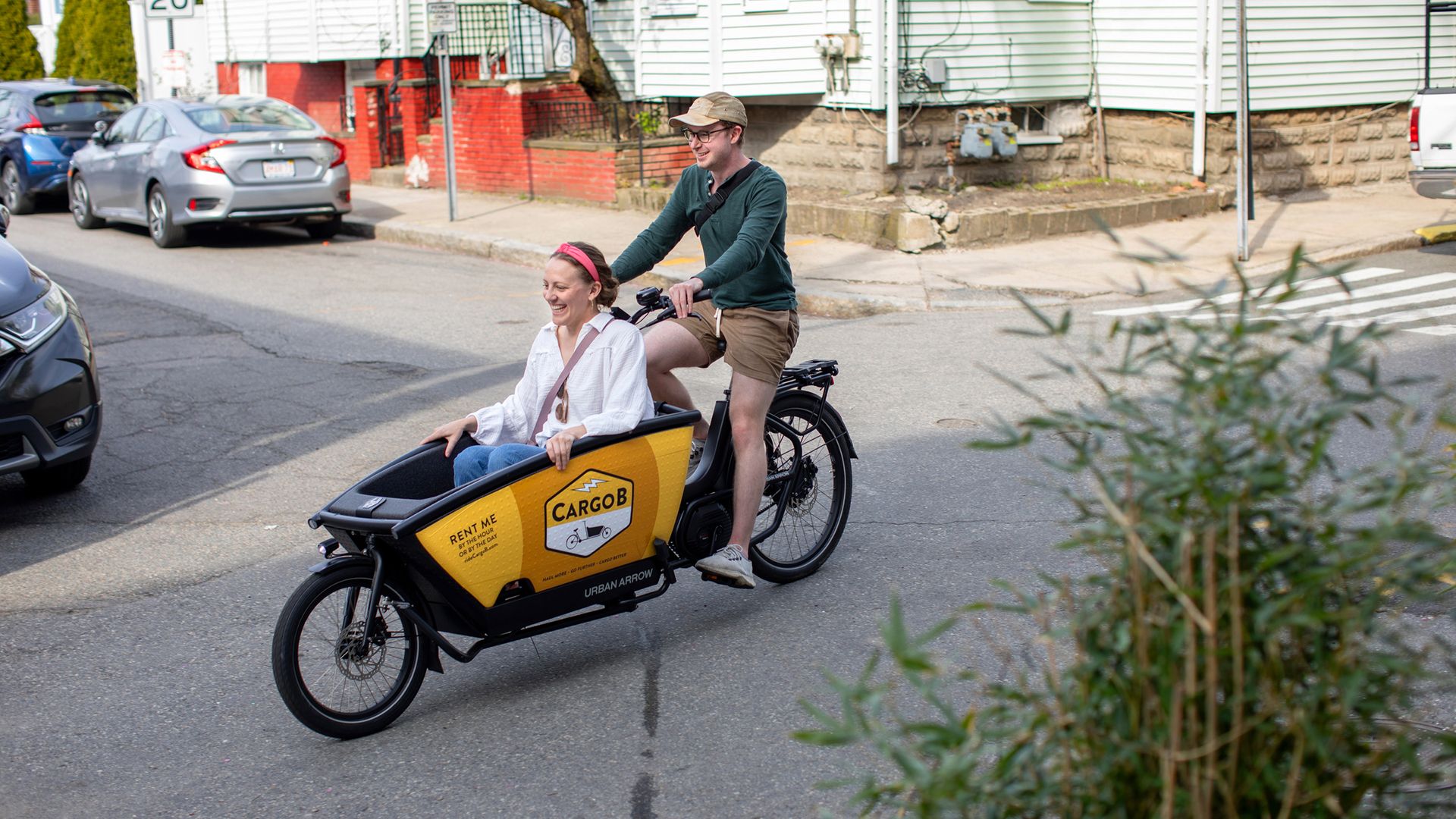
A first-in-the-nation bike-sharing program specifically offering cargo e-bikes recently launched in the Boston area.
Why it matters: Bike-share services β like Bluebikes in Boston, Citi Bike in New York City and Divvy Bikes in Chicago β have proven remarkably popular, offering people an alternative transportation option in big cities without the hassles of bike ownership.
- But cargo e-bikes are closer to an actual car replacement, with lots of room for groceries and other goods β or even passengers.
Driving the news: CargoB, the new Boston operation, is starting off with a small fleet of bikes from Urban Arrow, a favorite among cargo e-bike fans.
- It costs $2.50 to unlock a CargoB bike using a dedicated app. Then it's 25 cents a minute until you bring the bike back to its home station. (That's about the same price Boston's Bluebikes charges for single rides on its non-cargo e-bikes.)
- The bikes get about 30 miles of range on a single charge, CargoB says.
- And they're pedal-assist β meaning an electric motor helps push you along, making it easier to go long distances or carry heavy loads.
Zoom in: Locals or visitors can find CargoB's bikes in Jamaica Plain, Cambridge and Somerville, with a downtown location coming soon.
- The company has four bikes on offer so far, with two more on the way.
Caveat: CargoB's bikes aren't free floating, so they must be brought back to the location where you picked them up.
- That makes it easier for the startup's small team to manage its fleet without worrying about the bikes' condition or where they wind up.
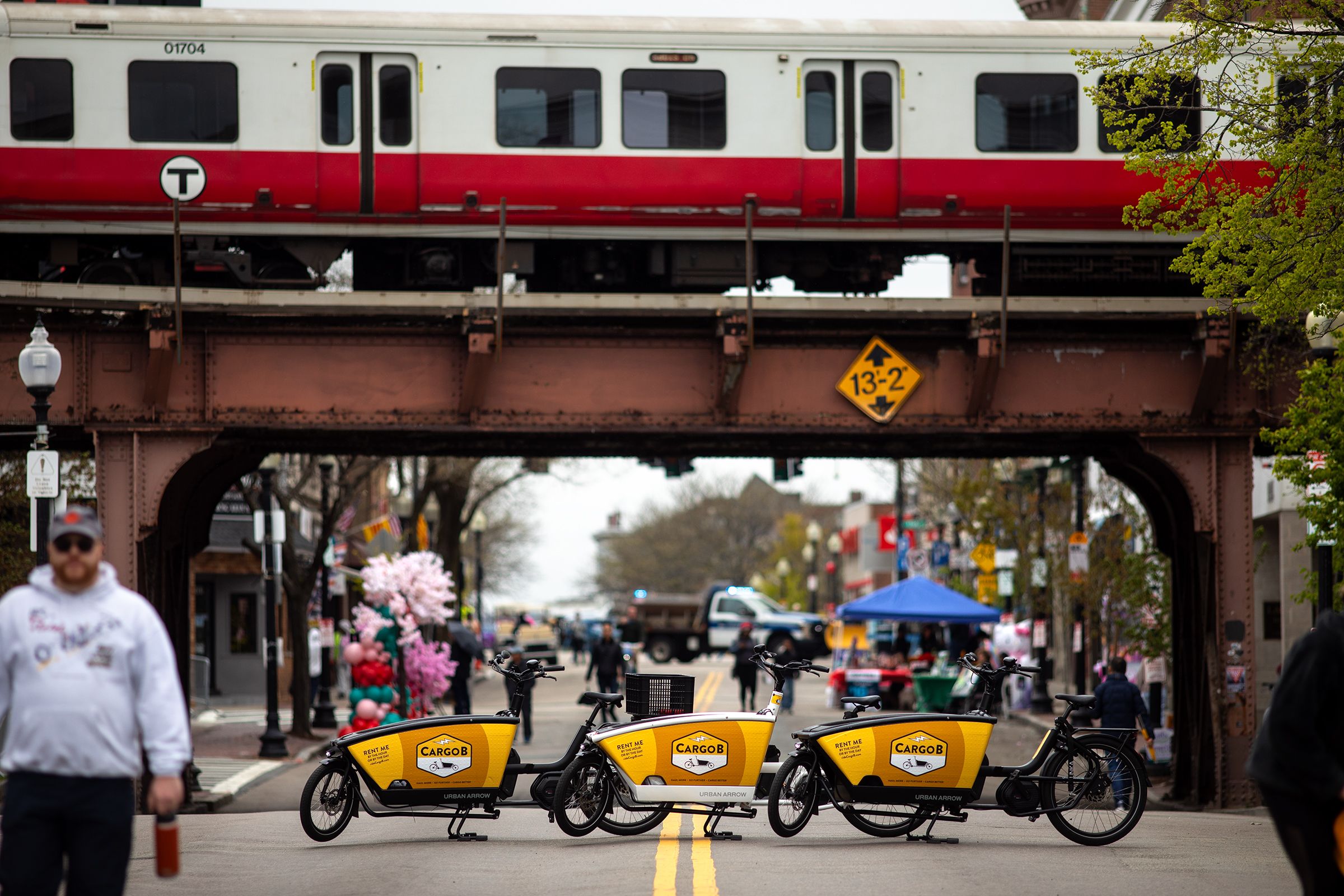
Reality check: Riding any kind of bike in the rain or snow β and Boston gets plenty of both β is only for the most dedicated bikeheads, even with Urban Arrow's rain cover accessory.
- But less hardcore users can always plan around the weather.
What they're saying: "We find ourselves white-knuckling our way through our commutes, and so I'm just like β let's just, where we can, hop on a bike and not have to be so stressed out about things," CargoB co-founder and CEO Dorothy Fennell tells Axios.
- "I could be worried about climate and housing prices and all kinds of stuff," adds Fennell, who's also a transportation planner.
- "But I'm like β okay, what can I control? I know cargo bikes, I know transportation policy, and I know how to stack features on a business to unlock barriers to these things.Β It's a very small thing that could have a massive impact... getting people out of their car."
The bottom line: Pretty much any time a bike trip replaces a car journey is a win, environmentally speaking.

2. Cable TV biz crumbles
Paramount Global last week took a $6 billion write-down on its cable TV business, the day after Warner Bros. Discovery did the same for $9 billion.
The big picture: Both companies are struggling to convince Wall Street that their streaming bets will make up for those losses.
- Paramount Global's stock tanked 12% in after-hours trading last Thursday, despite posting a streaming profit for the first time.
- Warner Bros. Discovery's fell 9% to an all-time low after its earnings release.
Between the lines: Both companies were created as a result of mega-mergers, yet neither is considered big enough to compete with Big Tech for streaming dominance.
- CBS merged with Viacom in 2019 to form ViacomCBS, now Paramount. WarnerMedia merged with Discovery to form WBD in 2022.
State of play: Paramount says it's looking for a streaming partner β likely a big tech firm β to scale its Paramount+ streaming service.
- WBD had discussions with Paramount late last year to discuss a merger.
- Wall Street isn't convinced that Paramount has the scale necessary to compete with Big Tech for streaming dominance.
Yes, but: While cable is challenged, analysts believe there will be a loyal set of pay-TV customers β around 50 million households β for the foreseeable future, thanks to cable networks like ESPN that own live sports rights.
What to watch: Entertainment giants are raising streaming prices to ensure that their investments start to break even.
3. "Self-driving" AI-powered labs
Self-driving scientific labs are the next AI asset countries are pursuing in hopes of gaining an economic and security edge.
Why it matters: Labs that autonomously run experiments promise to speed up the discovery of new materials, but they're still not sufficiently reliable, reproducible or widely available.
State of play: It currently takes 20 years and $100 million on average to go from the discovery of a new material to high-volume advanced manufacturing.
- "If you're trying to decarbonize the economy by 2050, that is just too long," says Tom Kalil, CEO of Renaissance Philanthropy, which connects scientists with philanthropists and foundations that might fund them.
- Self-driving labs could accelerate the process 100 to 1,000 times, says Milad Abolhasani, an associate professor at North Carolina State University who works on the technology β potentially bringing a 10-plus-year operation down to less than a few months and cutting the cost from $100 million to less than $1 million.
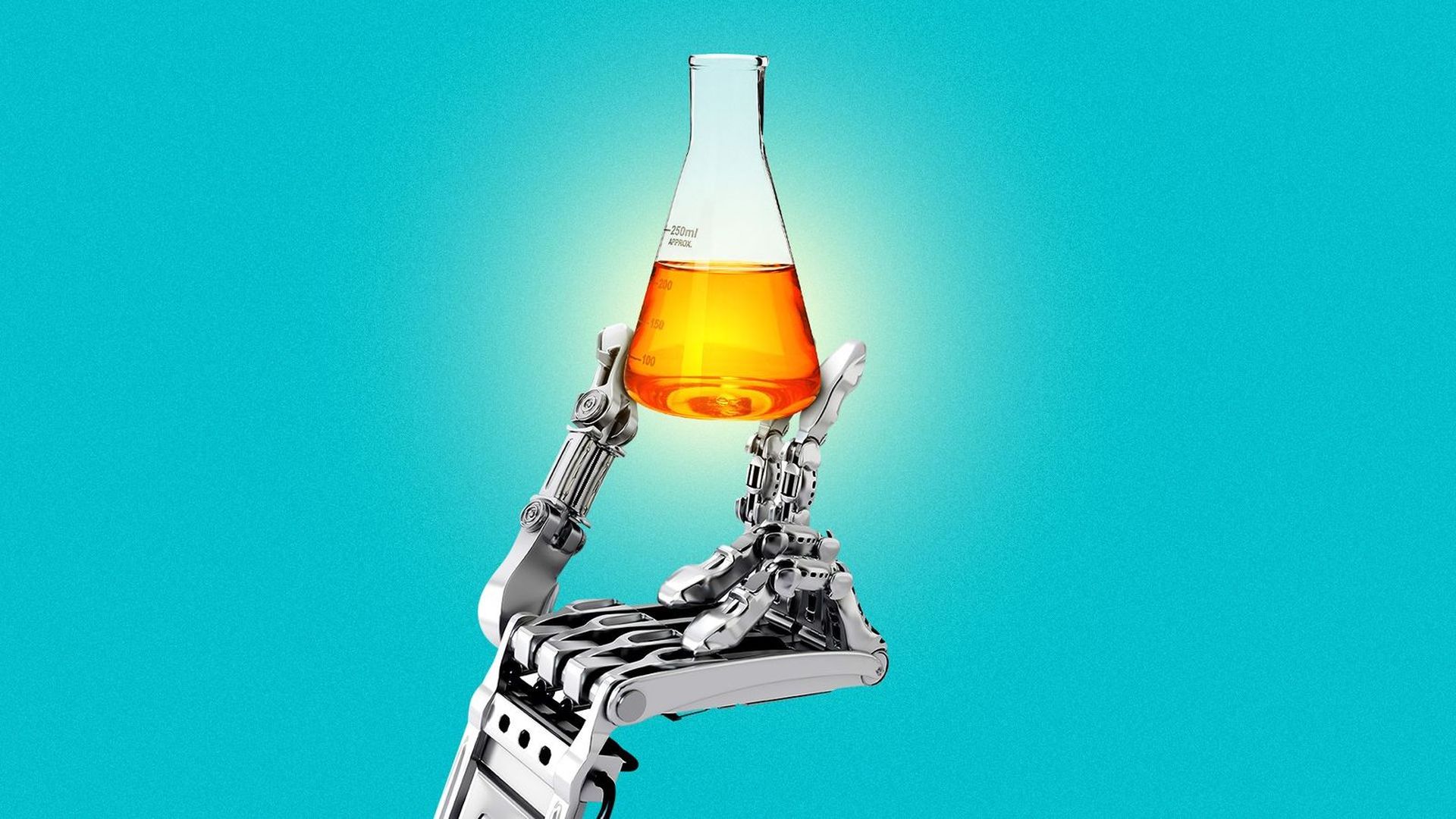
How it works: Self-driving labs combine robotics, AI and advanced computing to design, make, test and analyze potential new materials in a loop guided by AI that learns from experiments and makes decisions about what to do next.
- Today they're bespoke setups that mostly carry out relatively easy-to-automate experiments as proof-of-concept demonstrations.
- They've been used to optimize catalytic reactions, for example, gleaning more information in five days than researchers typically can in six months, Abolhasani and his colleagues reported in February.
- They've also run autonomous experiments to more rapidly develop "quantum dots" and find a more sustainable way to synthesize nanoparticles.
Yes, but: Self-driving labs still face engineering and hardware hurdles.
- Some of the challenges: how to make a wider variety of materials and molecules operate under harsh chemical and physical conditions, and carry out reactions with multiple steps β what Abolhasani calls "real chemistry."
Big thanksΒ to What's Next copy editor Amy Stern.
Was this email forwarded to you? Get your daily dose of What's Next by signing up here for our free newsletter.
Sign up for Axios What's Next