Self-driving labs are the new AI asset

Add Axios as your preferred source to
see more of our stories on Google.
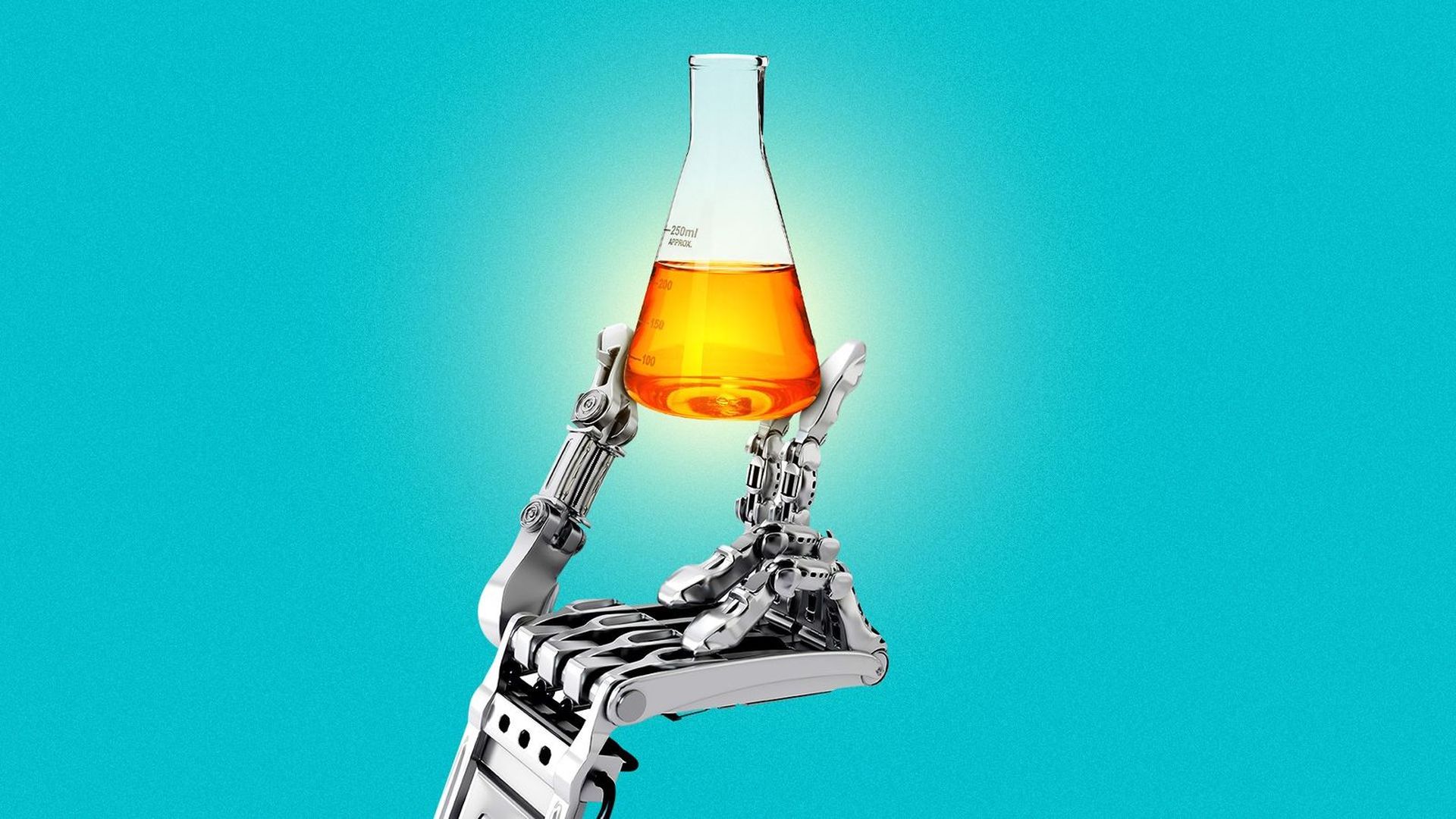
Illustration: Aïda Amer/Axios
Self-driving labs are the next AI asset countries are pursuing in hopes of gaining an economic and security edge.
Why it matters: Labs that autonomously run experiments promise to speed up the discovery of new materials, but they're still not sufficiently reliable, reproducible or widely available.
State of play: It currently takes 20 years and $100 million on average to go from the discovery of a new material to high-volume advanced manufacturing of it.
- "If you're trying to decarbonize the economy by 2050, that is just too long," says Tom Kalil, CEO of Renaissance Philanthropy, which connects scientists with philanthropists and foundations that might fund them.
- Self-driving labs could accelerate the process 100 to 1,000 times, potentially bringing a 10-plus-year operation down to less than a few months and cutting the cost from $100 million to less than $1 million, says Milad Abolhasani, an associate professor at North Carolina State University who works on the technology.
How it works: Self-driving labs combine robotics, AI and advanced computing to design, make, test and analyze potential new materials in a loop guided by AI that learns from the experiments it has run and makes decisions about what to do next.
- Today they're bespoke setups that mostly carry out relatively easy to automate experiments as proof-of-concept demonstrations.
- They've been used to optimize catalytic reactions, gleaning more information in five days than researchers typically can in six months, Abolhasani and his colleagues reported in February.
- They've also run autonomous experiments to more rapidly develop quantum dots and find a more sustainable way to synthesize nanoparticles.
- Last year, Google DeepMind and the self-driving "A-Lab" at Lawrence Berkeley National Laboratory reported discovering and producing more than 40 new materials in an autonomous lab. (That results was called into question by a team of researchers.)
- An international team of scientists recently described how they combined AI-guided experiments happening in five labs located around the world to find 21 new candidate materials for organic solid-state lasers.
Yes, but: Self-driving labs still face engineering and hardware hurdles: how to make a wider variety of materials and molecules, operate under harsh chemical and physical conditions, and carry out reactions with multiple steps — what Abolhasani calls "real chemistry."
- There also isn't standardized hardware and software, and there is nowhere near the amount of AI-training data that is available for chatbots.
- But once up and running, the labs can generate more data of their own and improve the models, says Charles Yang, AI policy adviser at the Office of Critical and Emerging Technologies at the Department of Energy, which has identified self-driving labs as a priority in its AI roadmap called FASST.
- There also aren't supply chains set up to support self-driving labs, and there is a lack of workforce skills in the U.S., which a recent workshop held by the DOE, NSF, NIST and other agencies identified as a critical gap.
Self-driving labs aren't the solution for every problem, but they could fundamentally change how some science is done, promising to limit the impact of the biases and quirks of individual scientists.
- But the technology also has some researchers asking if the promise —and pressure — to produce is leading scientists to adopt the tech before it is really ready, Julia Robinson recently reported for Chemistry World.
- Abolhasani says there needs to be a way to measure and compare the performance of different labs so they can be pointed toward suitable problems.
- Earlier this year, he and his colleague Amanda Volk outlined possible performance metrics, including how long they can operate, how much material they use and how efficient they are.
- "The biggest challenge is developing automation technologies that are reproducible, reliable, and accessible at low cost," Abolhasani says.
The big picture: Sujai Shivakumar, a senior fellow at the Center for Strategic and International Studies, says the list of countries with the trifecta of AI, robotics and advanced computing capabilities is small, adding that "the U.S. needs to step up and capture the benefits of our research."
- The Canadian government is investing $200 million — its largest research grant ever — in self-driving lab development led by the University of Toronto.
- The U.K. government is funding the Materials Innovation Factory, an autonomous lab collaboration between the University of Liverpool and Unilever.
- The interagency working group and others are calling for the U.S. to form a consortium similar to the one in Canada to pool autonomous lab funding, researchers and know-how to scale up the technology.
What to watch: The proposed FASST initiative that includes the development of autonomous labs hasn't yet been authorized or funded by Congress but legislation has been introduced in the Senate.
