Axios What's Next

May 15, 2023

1 big thing: Gas cars stick around
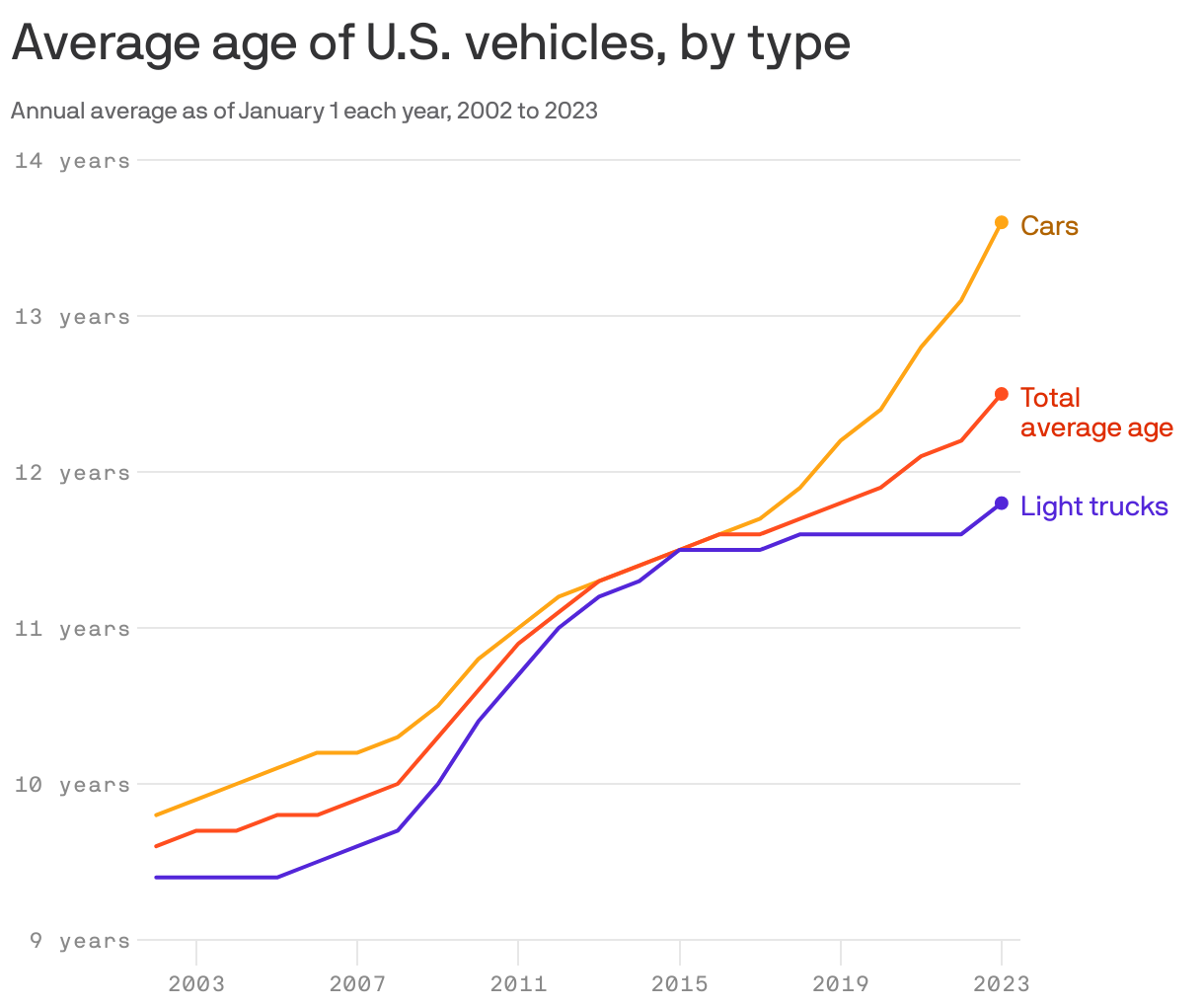
Americans are keeping their vehicles longer than ever — good news for repair shops, but bad news for anyone expecting a rapid phase-out of gas-powered cars, Nathan Bomey and Joann Muller write.
Why it matters: The longer people hold onto their internal-combustion cars, the longer it will take to replace those vehicles with newer, more environmentally sustainable technology.
Driving the news: The average age of light vehicles on the road in the U.S. is now at an all-time high of 12.5 years, up three months from 2022, according to S&P Global Mobility.
- Two decades ago, their average age was 9.7 years.
The big picture: Sticker prices for new cars are rising, and existing vehicles are lasting longer, giving owners reason to hold onto their current ride.
- Long gone are the days when your car was toast when the odometer hit 100,000 miles.
- But vehicles still need regular maintenance and replacement parts as they age.
- Aftermarket industry revenue is expected to grow at least 5% in 2023 after jumping 8.5% in 2022, according to a forecast by S&P, the Auto Care Association and MEMA Aftermarket Suppliers.
Zoom in: April's average new vehicle transaction price was $48,275, up 3.7% from a year earlier, partly because of the popularity of more expensive trucks and SUVs, according to Kelley Blue Book.
- "The prices are astronomical," says Todd Campau, associate director of aftermarket solutions for S&P Global Mobility.
- If current owners don't need a new car, they're simply not buying one, Campau says.
The impact: The transition from gas to electric cars will take decades.
- It'll likely take until at least 2050 — and possibly longer — before most gas-powered cars are off the road, Campau says.
Of note: EV longevity is going in the opposite direction.
- Their average age fell from 3.7 years in 2022 to 3.6 years in 2023, in part due to an upswing in new purchases.
By the numbers: About 6.6% of battery-powered EVs bought between 2013-2022 have left the passenger fleet, compared with 5.2% of non-EVs — but Campau says it's too early to know why.
- EVs generally come with an 8-year, 100,000-mile warranty — but early evidence suggests they last longer than that, according to an analysis by Recurrent, which tracks battery data.
- Carmakers say electric cars should last 15 to 20 years, though modern EVs haven't been around long enough to validate that claim.
The other side: While EVs run cleaner than their gas-powered predecessors, there's an environmental toll attached to mining the requisite materials and building new cars — so there's a decent argument that, all things being equal, it's better for people to squeeze as much life as possible from their old vehicles before making the switch.
Meanwhile: America's obsession with pickups and SUVs is driving passenger cars off the road.
- S&P Global Mobility projects that within the next 18 to 24 months, there will be fewer than 100 million passenger cars on the road — a low not seen since 1978.
- By 2028, at least 7 in 10 vehicles on the road will be pickups, SUVs or crossovers.
The bottom line: The future is electric, but the gas-powered past isn't fading away quickly.
(Disclosure: Kelley Blue Book parent Cox Enterprises also owns Axios.)
2. Taking the green line

Illustration: Brendan Lynch/Axios
3. 🗺️ Trees, mapped
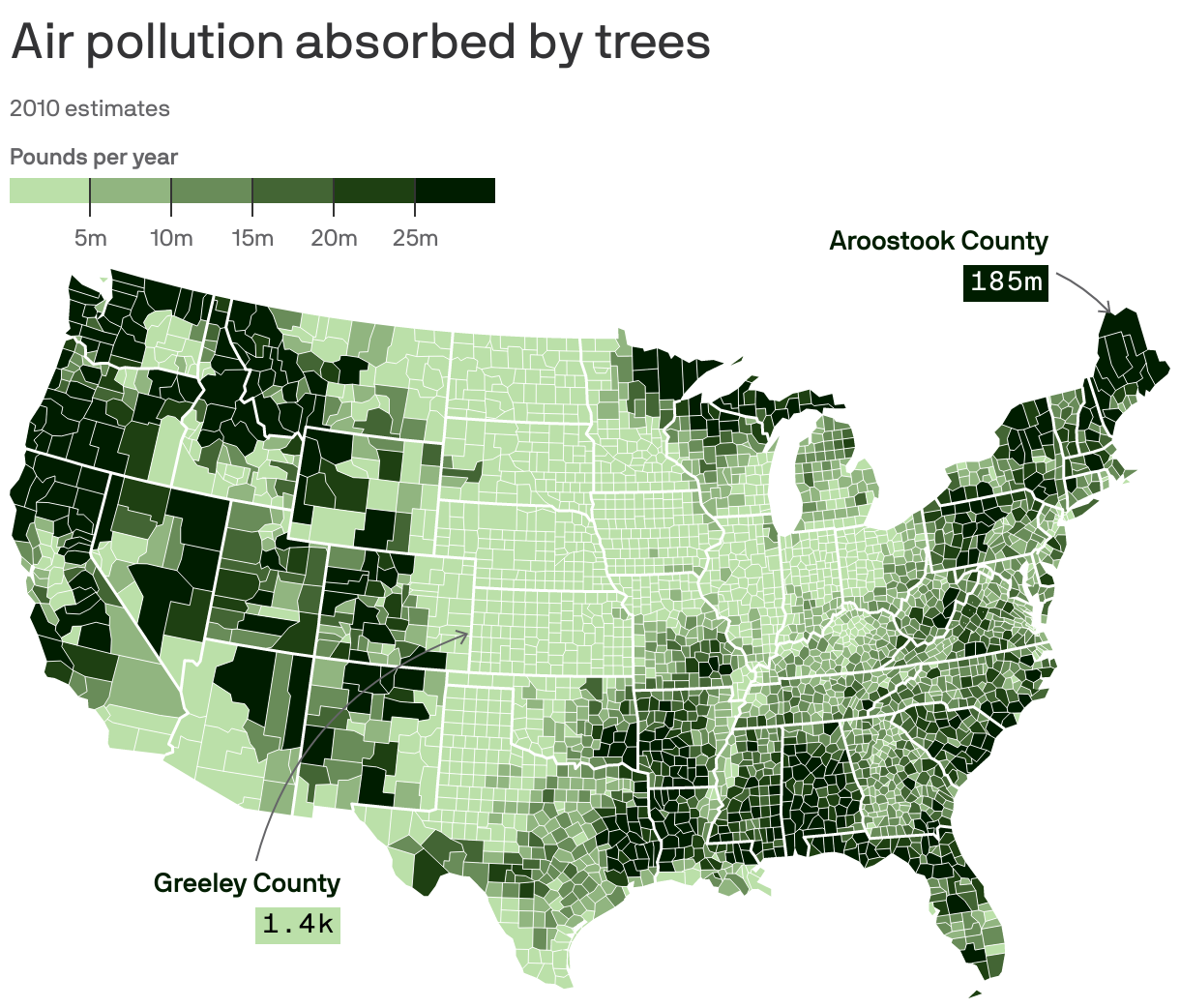
Communities in Maine, Oregon, California and Minnesota have among the country's highest rates of air pollution absorbed by trees, a new Climate Central analysis reveals, Axios' Ayurella Horn-Muller reports.
Why it matters: Trees absorb pollutants such as ozone and nitrogen dioxide.
- Urban trees can also help reduce the impacts of extreme heat and prevent stormwater runoff.
Yes, but: "Tree for tree, [urban] trees are potentially doing a lot. But [they're] not going to offset the fossil fuels which are also concentrated in cities," says Lucy Hutyra, professor of earth and environment at Boston University.
What's next: The Inflation Reduction Act included $1.5 billion in funding over 10 years for the U.S. Forest Service’s Urban & Community Forestry Program.
- That money will allow the agency to "reach more communities to help plant, replace and maintain millions of trees," says Beattra Wilson, assistant director for cooperative forestry at the U.S. Forest Service.
- The agency is focused on "equity considerations" and prioritizing underserved communities with the funding, Wilson adds.
4. Welcome to the Taylor economy

Photo Illustration: Natalie Peeples/Axios. Photo: Octavio Jones, Terence Rushin/Getty Images
Axios What's Next

The next decade of big, sweeping changes will unfold in cities and communities where new technologies like 5G, AI and drones are transforming how we work, live and play together. What’s Next will guide you through the revolution.