Axios What's Next

February 02, 2023
English, history, and a host of other non-STEM fields are showing signs of a comeback, Jennifer reports today.
- Axios is hosting our second annual What's Next Summit on March 29 in Washington, D.C., spotlighting the innovations, trends and people that are breaking boundaries and shaping our world.
- Interested in attending? Request an invite here.
Today's newsletter is 1,115 words ... 4 minutes.
1 big thing: Humanities revival
Illustration: Natalie Peeples/Axios
The pro-STEM movement has gutted high school and college humanities programs — but there's some evidence of a post-pandemic revival afoot, Jennifer A. Kingson reports.
Why it matters: In academic circles, humanities' decades-long decline is blamed for the proliferation of falsehoods on social media, crass political discourse, the rise in racism and the parlous state of democracy (not to mention our etiolated vocabularies).
Driving the news: When the University of California, Berkeley, reported an uptick in humanities majors this academic year, there was elation — and shock — at the prospect of a trend reversal.
- The number of first-year Berkeley students declaring majors in the arts and humanities — which includes English, history, languages, philosophy and media studies — was up 121% over last year.
- The number of high schoolers applying to Berkeley with the intention of studying humanities was up 43.2% from five years ago, and up 73% vs. 10 years ago.
- Some other schools — such as Arizona State University and the University of Washington — have also seen a rise in students declaring humanities majors.
What they're saying: "Students are turning to the arts and humanities as a way to make sense of our current moment," Sara Guyer, dean of Berkeley’s division of arts and humanities and director of the World Humanities Report, told the university's news service.
What's happening: Some professors, colleges and departments have been trying to boost humanities' popularity by touting their real-world utility.
- "We're seeing enrollment increases where there's actual conscious attention to giving the humanities the resources they need to make a case for their value," Paula Krebs, executive director of the Modern Language Association, tells Axios.
- The humanities "have always relied on people understanding the intrinsic value of philosophy, history, English literature and foreign language study, so we haven’t made the case distinctly enough to our students for what it does for them after they graduate," Krebs added.
Yes, but: That's starting to change at places like South Dakota State University, where a program in languages "certifies students in ways that are intelligible to employers," Krebs said.
- Similarly, at the University of Arizona, "applied humanities" is a new, fast-growing department that includes programs in business administration, fashion studies, game studies and public health.
Reality check: Experts call Berkeley's experience an outlier — but one that's opening a conversation about the value of a liberal arts degree.
Between the lines: While it's too soon to say if the students signing up to study humanities will stick with those majors, there has been a noteworthy proliferation of professors and public intellectuals whipping up concern about the state of the field.
- Professor James Engell, a stalwart of Harvard University's English department, threw down the glove in a Harvard Magazine essay.
- "By minimizing the arts and humanities, higher education exacerbates the problems confronting society," he wrote.
The bottom line: Schools have been trying to drum up interest in the humanities for years — but this time feels different, with our sensibilities and priorities reshaped by the pandemic, the Capitol insurrection and other paradigm shifts.
2. ChatGPT or not?
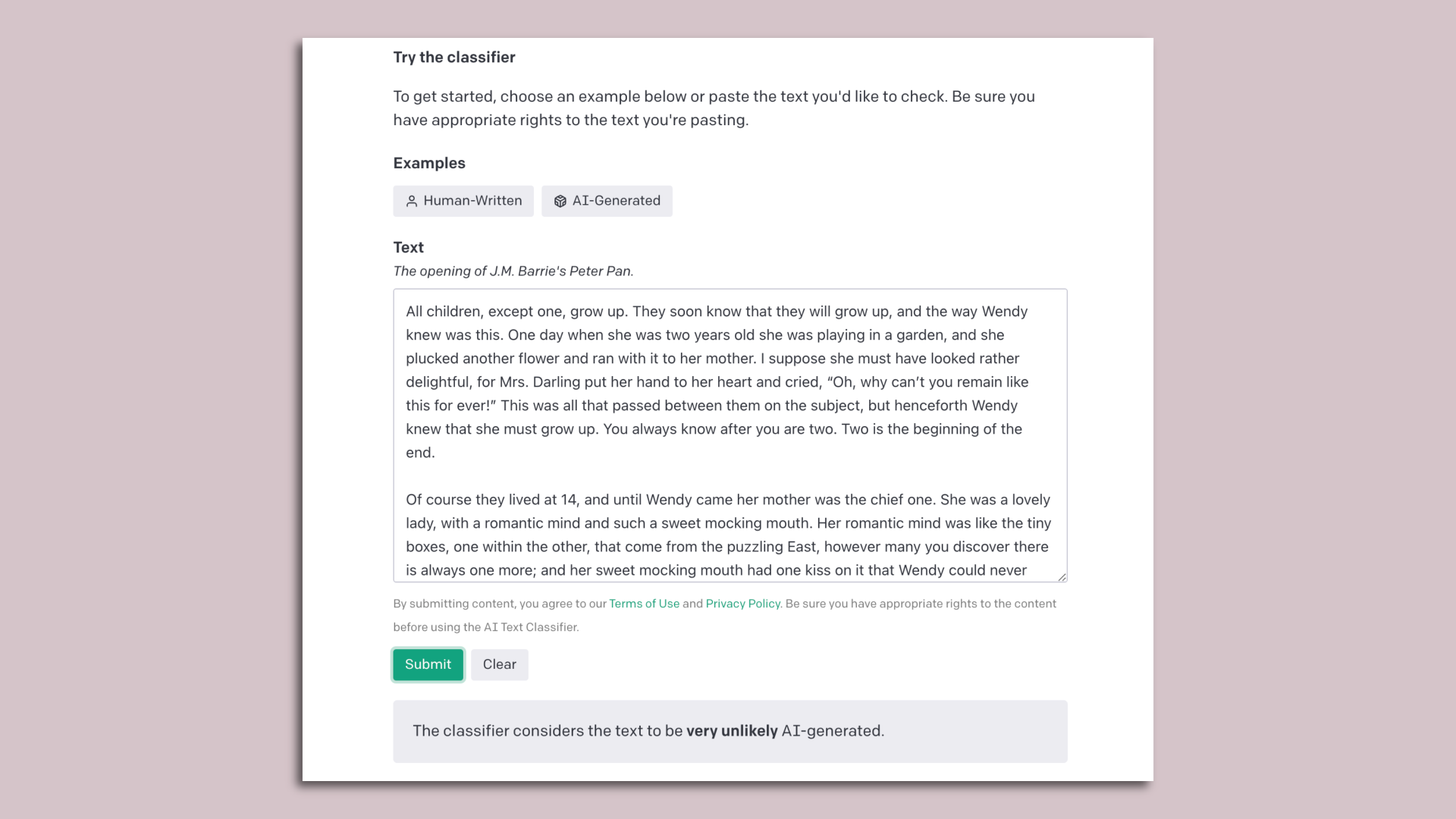
A screenshot of OpenAI's tool for detecting machine-written text. Image courtesy of OpenAI
ChatGPT creator OpenAI has released a free tool designed to suss out if a particular chunk of text was written by a human or a machine, Axios' Ina Fried reports.
How it works: Users copy a chunk of text into a box, and the tool rates how likely it is that the material was AI-generated.
- It works best on text samples greater than 1,000 words and in English.
Yes, but: The tool presents "both false positives and false negatives," OpenAI head of alignment Jan Leike told Axios.
- Leike cautions that the new tool should not be relied on alone to determine a document's authorship.
The big picture: Concerns are high — especially in education — over the emergence of powerful generative AI tools like ChatGPT.
Go deeper: ChatGPT sparks surge of AI detection tools
3. Resurrecting the dodo
Illustration: Tiffany Herring/Axios
- Colossal Biosciences, a "de-extinction" company trying to bring back the woolly mammoth and Tasmanian tiger, has closed a $150 million funding round to support a new effort to revive the dodo, Axios' Alan Neuhauser reports.
Catch up quick: Colossal's efforts to de-extinct species is its splashiest work — but it has also developed innovations for more typical lab work.
What they're saying: The dodo, a flightless bird wiped out more than 360 years ago, "is the icon for human-caused extinction," Beth Shapiro, Colossal's lead paleogeneticist, tells Axios.
- "By raising the possibility that we can create a functional dodo, we can engage more people in thinking about how these technologies can be applied to address some of the broader issues around avian conservation."
What's next: "Growing humans ex utero, full gestation, I do think at some point that technology is inevitable," Colossal CEO Ben Lamm tells Axios.
Yes, but: "We aren't focused on that — we're working on animals."
💬 Alex's thought bubble: Life, uh, finds a way.
Read the rest — and sign up for Axios Pro: Climate Deals.
4. 🗺️ Legalization nation

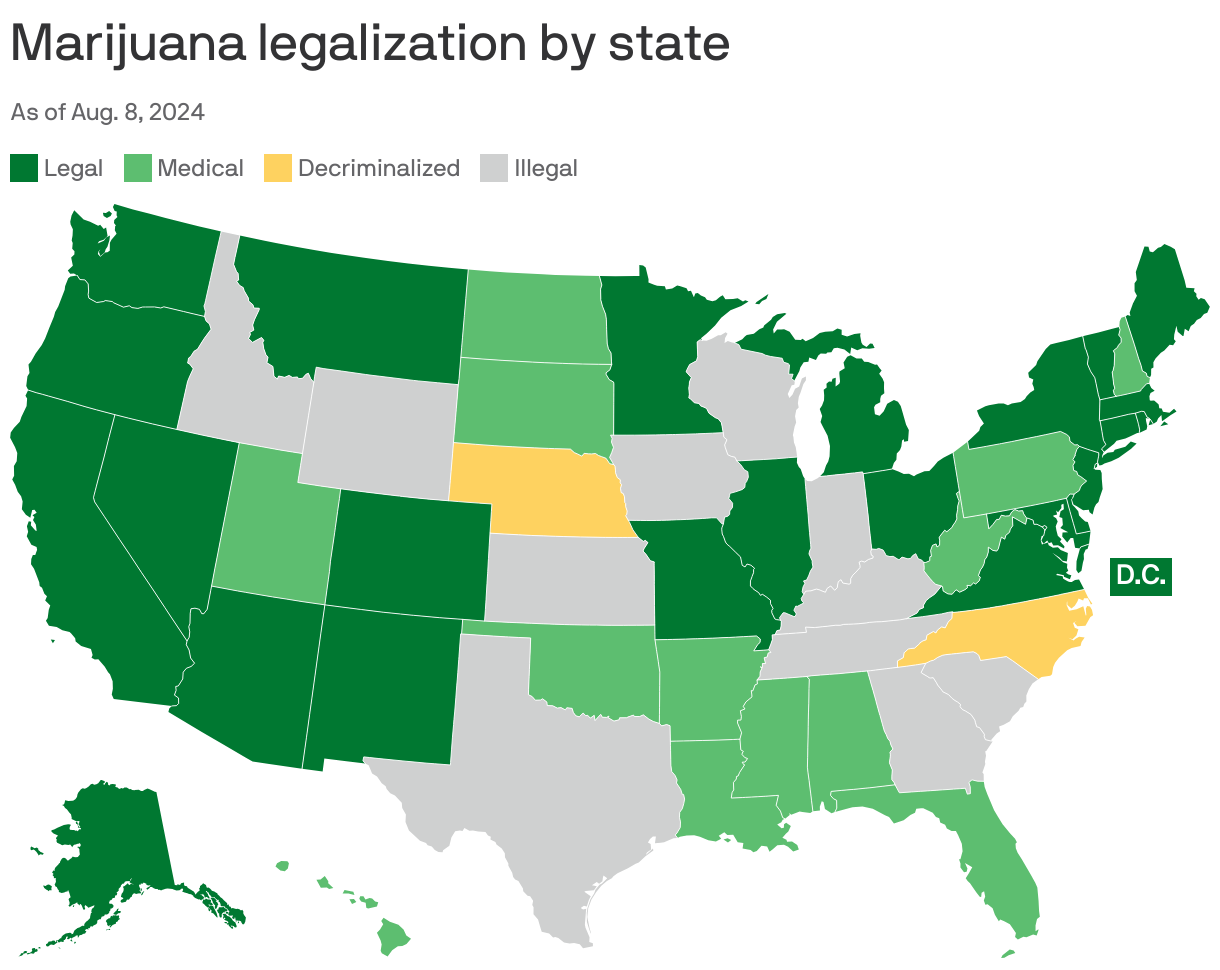
Minnesota is moving toward becoming the next state to fully legalize recreational cannabis, Axios' Torey Van Oot reports.
- A bill moving through the state legislature would green-light smokable cannabis and edibles, plus authorize sales of marijuana-infused products at breweries, liquor stores, supermarkets and through home delivery services.
- Minnesota previously legalized low-THC, hemp-derived edibles for recreational use.
The big picture: As seen in the above map, many states have legalized cannabis — often with programs that prioritize business applications from minority owners or those with previous marijuana convictions.
- Legal sales of recreational marijuana just began in New York, for instance, though only a small handful of stores have opened up across the state so far.
5. One fun thing: SETI, meet AI

Illustration: Aïda Amer/Axios
Machine learning could aid scientists in their search for signs of intelligent alien life, Axios' Miriam Kramer reports.
Why it matters: Searching for radio signals emitted by technologically advanced extraterrestrial societies requires scanning large portions of the sky with powerful radio telescopes, producing a lot of data scientists need to parse.
- Machine learning tools could make that job easier.
Driving the news: A study published in Nature Astronomy this week details the use of an algorithm that helped researchers sift through data previously analyzed in 2017.
- The machine learning tool was trained to differentiate radio signals that might originate in distant star systems from human-created sources, such as cell phones and satellites.
- The tool turned up eight new radio signals of interest — possible signs of intelligent extraterrestrial life — within the dataset. Those signals came from five different stars 30 to 90 light-years away.
Yes, but: Brief follow-up observations didn't turn up a repeat signal, and it's still possible the targets were created by chance.
Big thanks to What's Next copy editor Amy Stern.
Was this email forwarded to you? Get your daily dose of What's Next by signing up here for our free newsletter.
Sign up for Axios What's Next

The next decade of big, sweeping changes will unfold in cities and communities where new technologies like 5G, AI and drones are transforming how we work, live and play together. What’s Next will guide you through the revolution.