Axios What's Next

January 24, 2024
New restaurants are proliferating as the pandemic gets further in the rearview mirror — but many are still struggling with high costs and more.
- Axios Richmond's Karri Peifer, Axios New Orleans' Chelsea Brasted and Axios D.C.'s Anna Spiegel join us today to dig into the eatery biz.
- Want more local news from Axios? Subscribe here.
Today's newsletter is 1,346 words ... 5 minutes.
1 big thing: Restaurant boom
The restaurant industry is showing signs of life after a brutal stretch brought on by the COVID-19 pandemic, Alex and Kavya Beheraj report from new Yelp data.
What's happening: Nearly 53,800 restaurants opened their doors last year, up 10% from 2022, based on new Yelp listings.
- That figure is up 2% from 2019 — meaning there's been a slight increase in openings compared to pre-pandemic times.
- All told, there were 16.1 new restaurants in 2023 in the U.S. for every 100,000 people.
- New business listings overall were up 20% in 2023 compared to 2022, and up 40% compared to 2019.
By the numbers: Some of the fastest-growing restaurant categories include dessert shops (up 66% in 2023 compared to 2022), creperies (+63%) and hot pot joints (+53%).
- A few other intriguing data points: African restaurants are up 65% when compared with 2019, while Peruvian restaurants increased 28%.
What they're saying: "The restaurant industry has proven to be resilient throughout the pandemic, with the industry seeing higher restaurant openings in 2023 than pre-pandemic levels for the first time," says Clifford Cate, vice president and general manager, restaurants at Yelp.
- "Even through economic challenges, restaurant owners continue to delight their diners, staying responsive to shifts in consumer preferences, like the increasing demand for earlier reservation times and higher-end experiences."
Yes, but: In a poll conducted last fall by Washington, D.C.'s restaurant association, 75% of the nearly 300 establishments surveyed reported being less profitable than pre-pandemic, down by an average of 34%, Axios' Anna Spiegel reports.
- Nearly all raised prices, but they say inflation and labor costs are outpacing them.
Yes, and: It's one thing to open a restaurant. It's another to keep it open through the first week, the first month, the first year.
- Many existing establishments are struggling with high food, rent and labor costs; startups will face those same headwinds.
The bottom line: Obviously, pandemic-era restaurant closures were gut-wrenching for owners, patrons and communities.
- But if this new Yelp data is any indication, maybe COVID-19's impact on the restaurant business was something like a wildfire, clearing out space for new growth in a changed environment.
2. How some restaurants "won COVID"
Illustration: Annelise Capossela/Axios
The COVID-19 pandemic wasn't all doom and gloom for restaurants. Through ingenuity, savvy and smart pivots, some managed to find success, Axios Richmond's Karri Peifer reports.
- "The restaurants that embraced [change], especially early on, tended to do better than those that didn't," Hudson Riehle, vice president of research for the National Restaurant Association, tells Axios.
The big picture: Victory in the COVID era hinged on restaurants' willingness to make strategic changes, Riehle says.
- Examples: Adding takeout and delivery, pairing down menus, limiting schedules, finding new revenue streams (like wine and supper clubs) and embracing new laws allowing for cocktails to-go and streetside dining.
Case study: Before the pandemic, Richmond, Virginia restaurateur Patrick Stamper's two-year-old burger joint, Beauvine Burger Concept, was doing fine, but business wasn't remarkable.
- That changed in March 2020 when he and business partner Kelsey Aiken set in motion changes that helped them "win COVID," as Stamper tells Axios.
- Immediately pivoting to takeout and delivery has put them in an even stronger business position than ever: Their sales are more than double what they were pre-COVID.
Flashback: In mid-March 2020, Beauvine transitioned from a full-service, dine-in restaurant to a major takeout and delivery operation.
- They added phone lines and turned the dining room into a food packaging assembly line. Servers and bartenders became phone operators and delivery drivers — as did the co-owners.
- They hung a massive "OPEN FOR DELIVERY" banner on the restaurant and posted constantly on social media.
The result: The first Friday that dining rooms were shuttered by Virginia mandate, Beauvine set a sales record.
- They broke it the next day, then the Friday after that, and so on for the first few months of the pandemic.
The bottom line: Beauvine and other restaurants that made similar changes are now benefiting from consumer behavior shifts that have stuck around post-pandemic.
- Before COVID, off-premise dining accounted for 61% of all restaurant traffic, per the National Restaurant Association.
- During the pandemic, it was around 90%, and today it's 74% — good news for takeout-heavy joints like Beauvine.
3. The math gets harder
Illustration: Annelise Capossela/Axios
Rising food, rent and labor costs, mixed with falling post-pandemic demand, are spelling disaster for some independently owned restaurants, Axios New Orleans' Chelsea Brasted reports, with contributions from Karri.
- The result is "carnage everywhere," says Robért LeBlanc, co-owner of LeBlanc + Smith, a New Orleans restaurant and hotel group — even as new entrants try to break through.
Driving the news: Many independent restaurants have struggled to cope with declining demand and higher costs, while pandemic-era loans are coming due, says Joe Pawlak of restaurant industry consulting firm Technomic.
- As a result, restaurants are raising prices — or shutting their doors.
- "The independents," Pawlak says, "can't survive."
Yes, but: Some restaurateurs are finding clever ways to stay afloat.
- At New Orleans' Lengua Madre, chef Ana Castro found that offering a tasting menu — with its set dishes and predictable ingredient needs — could change the math on her modern Mexican restaurant's budget.
- "Our food cost was 19%," Castro says. "We were serving truffles, caviar, but we were super controlled. We looked at bookings to see how many we'd have in a week and find highs and lows on the menu, [or ask our vendors] 'Can you offer me a less-looked-at source of fish?'"
Reality check: Most restaurants are still trying to force old business models to work in a new economic and social environment, sometimes by tacking on ill-defined "service charges."
- Such charges are showing up on bills at 16% of today's restaurants, according to the upcoming National Restaurant Association's State of the Industry Report.
What's next: With little control over food and rent costs, restaurants will likely experiment with staffing.
- "We're always going to need labor in restaurants, but it's how you use it and optimize it" that can make the difference, Pawlak says.
That means there's a need for new technology to help automate menial, repetitive tasks while letting human staff focus on creating a real sense of hospitality.
- "People expect service as part of the entire experience," Pawlak says.
4. What's next? Restaurant robots
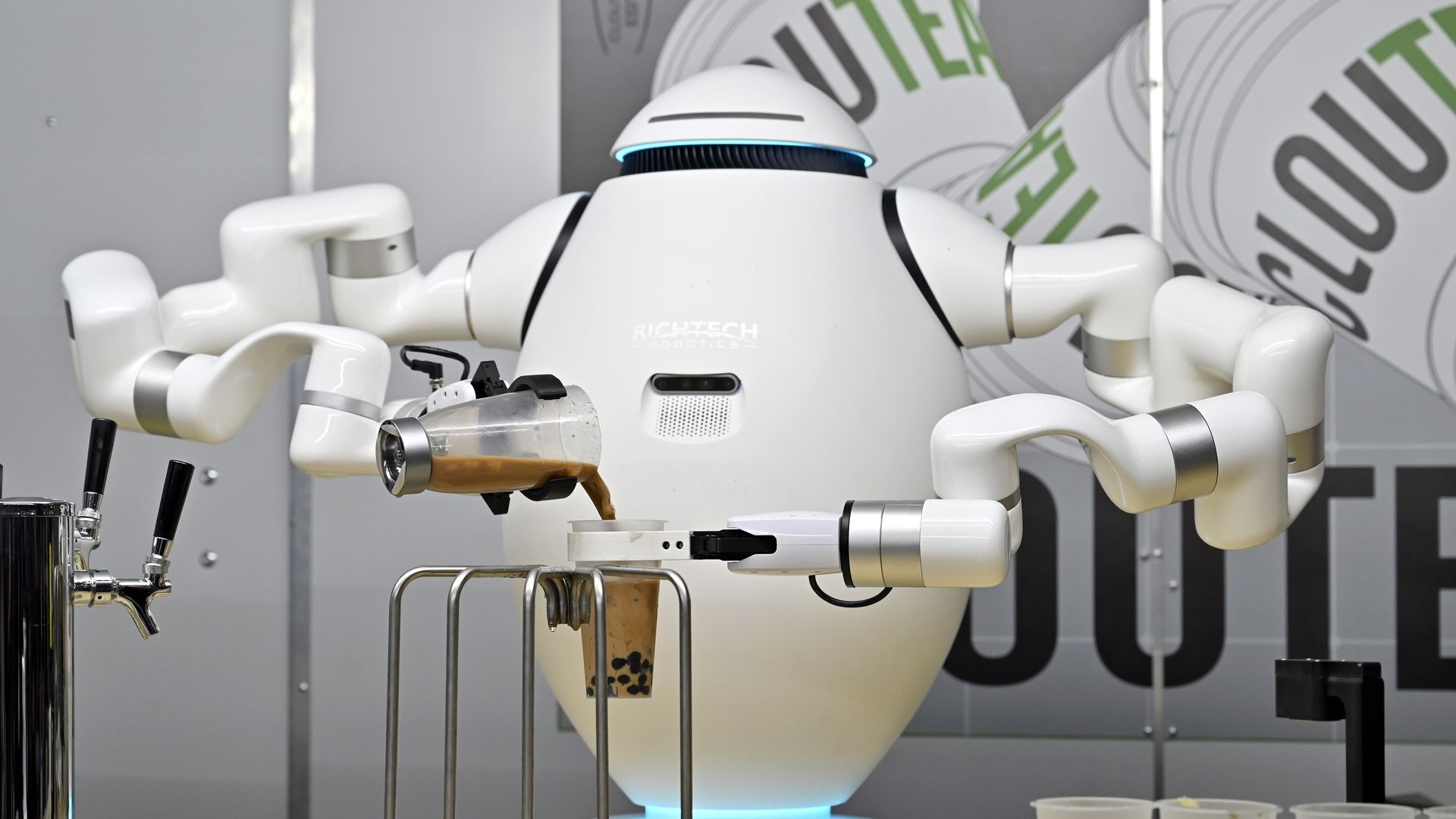
Adam, a bartender made by Richtech Robotics, pours a boba tea. Photo: David Becker/Getty Images
He can make 65-70 drinks an hour, never needs a bathroom break and doesn't ask for a tip — and soon, he'll be able to make conversation and take your order.
- Adam the robotic bartender is an example of a new breed of restaurant robots that are moving from novelty items to hospitality mainstays, Jennifer reports.
Why it matters: Ongoing labor shortages, high turnover and the persistent quest for greater efficiencies have prompted restaurants to lean in on robot servers and food prep workers.
Driving the news: Improvements in AI and robotics are fueling a renaissance in robots like Adam, which are trained to work alongside humans and relieve them of more tedious tasks.
- Adam was introduced a year ago as a countertop robot that could make cocktails, coffee and boba tea.
- Soon, he'll also be able to "engage in sophisticated conversations with customers and emulate human actions with exceptional accuracy," per its maker, Richtech Robotics.
What they're saying: "Our focus for Adam is to really have him be as versatile as possible," Richtech Robotics president Matt Casella tells Axios.
- "The idea is that Adam can be employed in every type of beverage-making solution," Casella says. (His next assignment: smoothies.)
Where it stands: A dozen Adam robots have been deployed nationwide so far, in venues such as the Courtyard by Marriott in downtown Los Angeles, the Cloutea boba shop at Caesar's Palace in Las Vegas, and the Botbar Coffee chain.
The big picture: All the big chain restaurants are testing and installing AI-infused robotics — mainly in the back of the house, but also in customer-facing roles, both tableside and at the drive-thru.
What's next: "I envision a place where we're at fully automated kitchens," Casella said.
- "I truly believe that through automation we're going to be able to get better, higher quality food closer to the consumer."
Big thanks to What's Next copy editor Amy Stern.
Was this email forwarded to you? Get your daily dose of What's Next by signing up here for our free newsletter.
Sign up for Axios What's Next

The next decade of big, sweeping changes will unfold in cities and communities where new technologies like 5G, AI and drones are transforming how we work, live and play together. What’s Next will guide you through the revolution.