Axios What's Next

February 08, 2023
The once-in-a-generation transition to electric vehicles is shifting into high gear — but many Americans are at risk of being left behind, largely because chargers haven't been equally distributed.
- Today, we're diving into the EV charging gap and what's being done to fix it.
- We'd love to hear your thoughts — give us a shout at [email protected].
Today's newsletter is 1,194 words ... 4½ minutes.
1 big thing: The EV revolution hinges on equitable charging
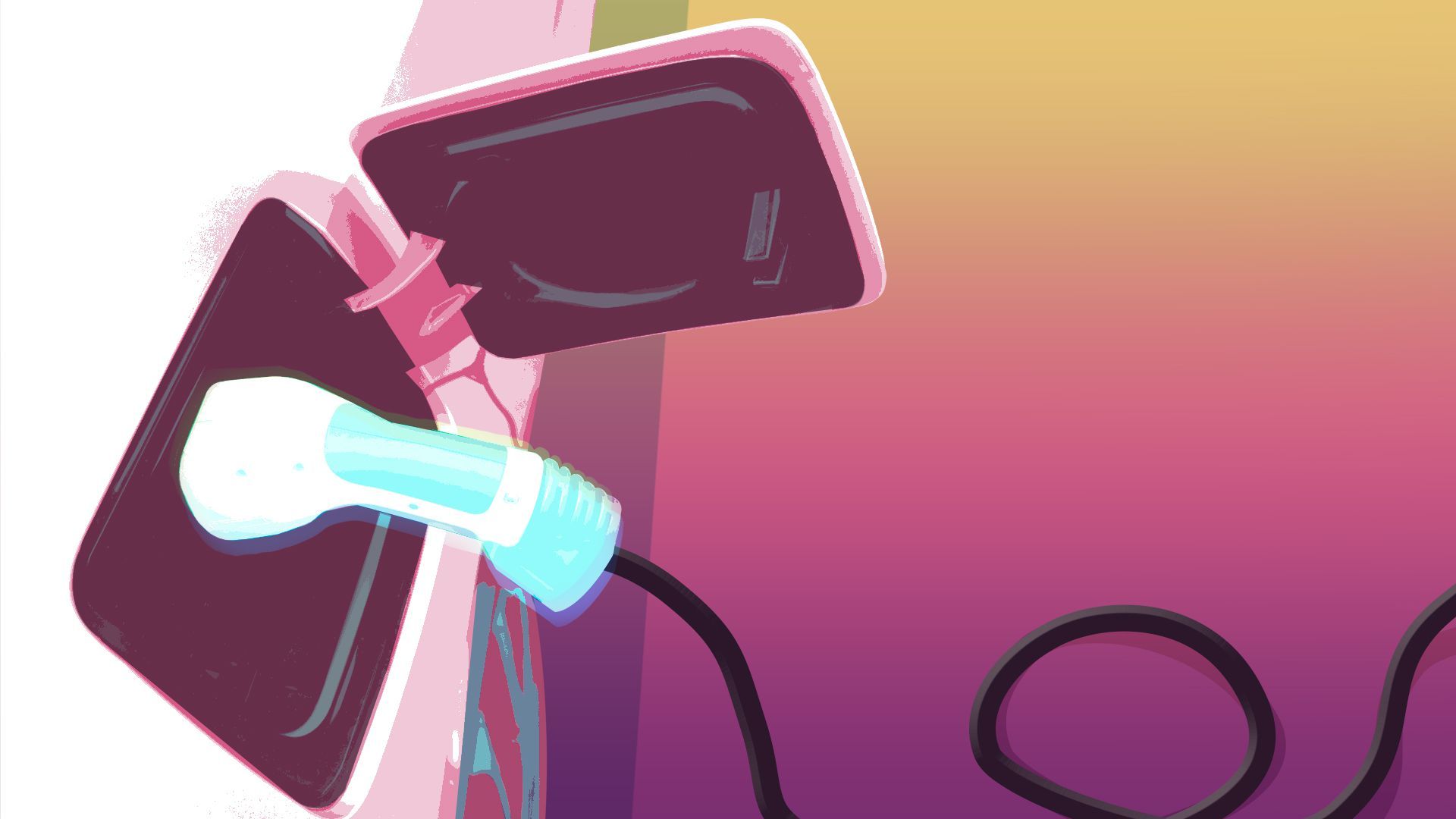
Illustration: Sarah Grillo/Axios
The electric vehicle (EV) movement is growing nationwide, but people who live in apartments, low-income neighborhoods and rural areas without easy charging access could get left behind, Joann Muller reports.
Why it matters: If the benefits of cleaner transportation — better air quality, less noise, lower energy costs — don't flow equitably to all Americans, EV adoption is likely to stall.
- In a first-of-its-kind study, University of Michigan researchers found that the lowest-income U.S. households would keep experiencing the highest transportation energy costs even if all gas-powered cars were replaced with EVs.
Where it stands: With most EVs priced like luxury cars, early adopters have typically been wealthy people who live in single-family homes where it's relatively easy to install a home charger.
- When more affordable cars, such as GM's $30,000 plug-in Chevrolet Equinox, hit the market in 2024, access to public charging will become more important — especially for those who don't have a private garage or driveway.
What's happening: The federal government aims to spur more investment in public charging with $7.5 billion allocated over five years under the 2021 infrastructure law.
- The package includes $5 billion for highway chargers and $2.5 billion for other community charging sites.
- The feds' goal is to install 500,000 EV fast-chargers across America, starting along interstate highways.
- Once a reliable nationwide charging network is established — meaning plugs every 50 miles along major highways — states can use leftover funds to install chargers in other places, including disadvantaged neighborhoods, multi-family buildings, and rural or tribal areas.
Between the lines: An executive order signed by President Biden in 2021 requires that 40% of the overall benefits of federally funded programs go to disadvantaged communities.
Yes, but: That doesn't mean 40% of all charging infrastructure must be installed in disadvantaged communities.
- Rather, it means each state must identify, prioritize and measure the total benefits that flow from federally funded EV charging infrastructure, including job growth and more.
Reality check: Installing more public chargers doesn't fully address inequity issues because it's more expensive to charge at a public station than at home.
- Residents of single-family homes have access to low-cost, off-peak rates from their regulated utility.
- Users of public chargers, however, must pay whatever fee the operator chooses — often double or more the cost of home charging.
- While recharging your EV at home might cost about $10, it's likely to cost $20 or $30 at a public charger, based on typical rates and figures.
What's needed: States should update building codes to provide metered EV charging access for all residents of multi-family homes, advocates say.
- "You can't rapidly electrify if everyone doesn't get to participate," says Marc Geller, co-founder of Plug In America.
2. A tale of two cities


Some cities are doing better on charger equity than others, as these maps from Axios' Erin Davis show, Alex Fitzpatrick reports.
- The charger divide is especially stark in Philadelphia, where majority-white tracts are nearly four times as likely to have chargers compared to other areas.
- In Dallas, meanwhile, majority-white tracts and other areas have nearly equal charger distribution.
Why it matters: Officials and companies in cities with more extreme charger disparities can look at others as examples, and learn from the approach they've taken.
The big picture: While focusing on these two cities helps bring the issue into focus, the "charging gap" is a nationwide phenomenon.
3. Cities are working on solutions

Illustration: Sarah Grillo/Axios
There's been a steady drumbeat of announcements from mayors about their plans to blanket their cities with electric vehicle charging stations — and to keep equity considerations front and center when choosing sites, Jennifer A. Kingson reports.
- "There's a sense of urgency," Denver Mayor Michael Hancock tells Axios. "We know we've got to get this infrastructure built out."
Why it matters: Ubiquitous coverage could coax more city dwellers to buy EVs, helping reduce vehicle emissions.
Driving the news: Cities are passing new building codes and zoning rules to coax — or force — developers to install rapid-charging stations (or at least reserve space for them).
- They're expediting the often-slow permitting process for charging-station applicants.
- They're working with car companies (like GM and Hertz) and charging station purveyors (like EVgo and Volta) to add public chargers at minimal cost to taxpayers.
- They're leading by example, converting municipal fleets to electric power.
How it works: Building a charger network is a complex and multifaceted process requiring local adaptations.
- Los Angeles has been attaching EV charging stations to streetlights — a boon to renters.
- Seattle is installing curbside chargers, also aimed at renters.
- Denver partnered with Hertz to jump-start the build-out of neighborhood charging stations.
- San Diego is experimenting with solar power to charge its own EV fleet.
- Hoboken, N.J. has a deal with Volta (which was just purchased by Shell) to install charging stalls that can display revenue-generating digital advertising.
- Tucson is among the growing list of cities that require certain new businesses and multi-family dwellings to provide charging stations in their parking lots.
What they're saying: Cities are focused on "rolling out these stations in an equitable manner, to try to rectify some of the historical mistakes" they've made, says Alexia Melendez Martineau, policy manager at Plug In America, a nonprofit that promotes EV use.
- But "the lion's share of the work is still left to be done."
4. How EV charging works
Illustration: Aïda Amer/Axios
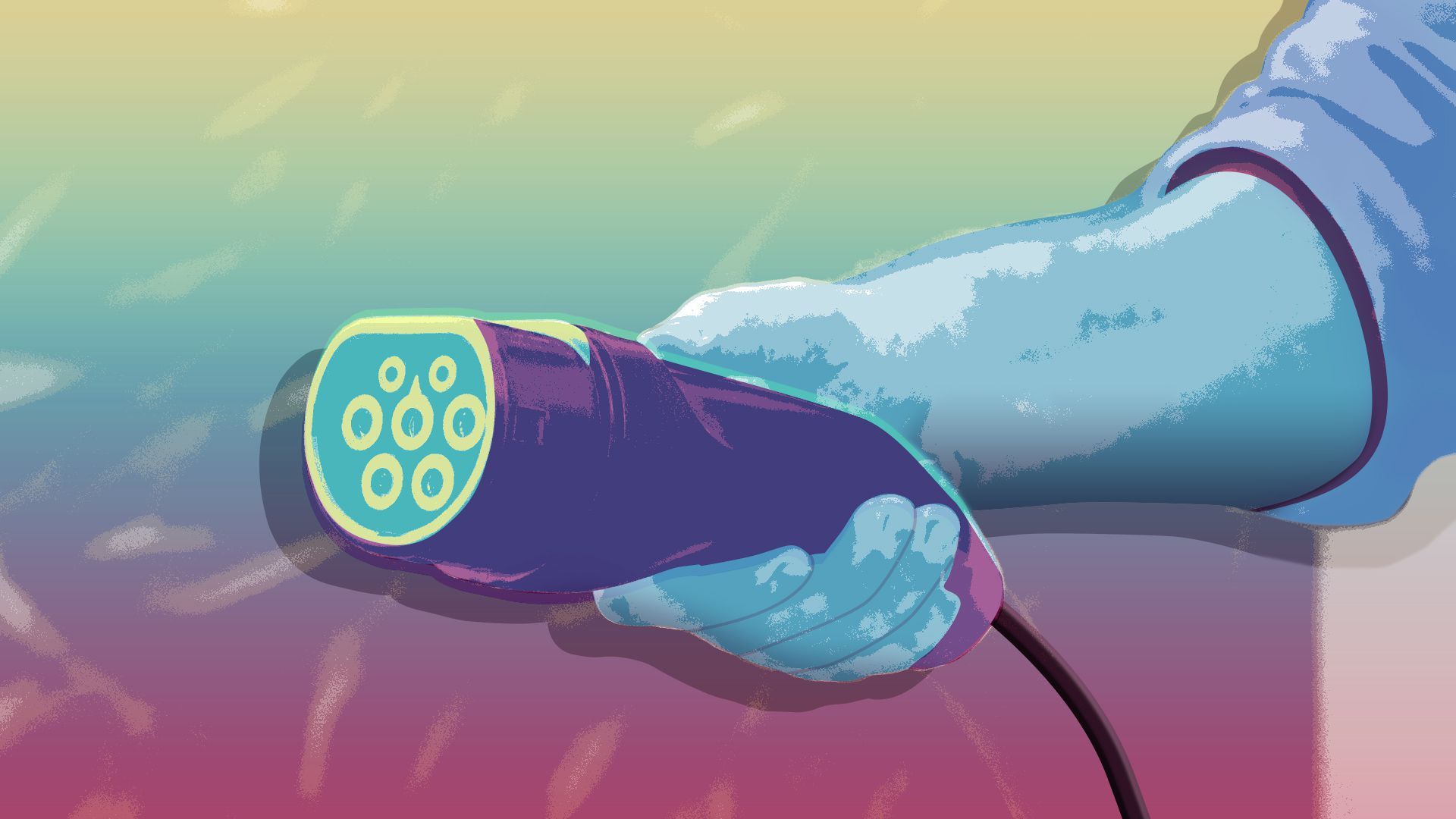
Understanding how charging works is important for anyone who drives an electric vehicle, but the process breeds anxiety for many.
- We're here to help, with this charging guide from Joann.
Why it matters: Plugs vary (depending on the car) and chargers have different power levels (which affects charging time).
- Consumer education is an important step toward charging equity.
Of note: Teslas use a proprietary network, which makes charging pretty straightforward. The tips below are for non-Tesla drivers.
Charging is easiest if you can top off at home and you don't drive long distances.
- Just plug the cord that comes with your car into a standard 120-volt outlet overnight and you'll get about 40 miles of range — enough for most daily driving.
- Recharging from empty this way, however, would take at least a day and a half.
A better option for EV owners: install a so-called Level 2 charger at home.
- It uses the same 240-volt household connection as your clothes dryer.
- You might need some electrical prep work first. Expect to pay anywhere from $500 to several thousand dollars.
- A full Level 2 recharge takes around 6-8 hours, and adds about $10 to your home's electric bill.
- Level 2 chargers are also available at many offices, shopping centers and hotels — often as a free courtesy.
On a road trip, you'll need to do some planning.
- Networks with fast chargers, like Electrify America, EVGo, ChargePoint and Blink, are proliferating — but they're still not as common as gas stations.
- These chargers can get you back on the road in 20-40 minutes, depending on their power rating and other factors.
Reality check: Even the industry's fastest-charging cars, such as the Hyundai Ioniq 5 and Kia EV6, rarely charge at their maximum possible speed — in part to prevent frying their batteries.
Go deeper: Pack up the electric car, honey! We're hitting the road
Big thanks to What's Next copy editor Amy Stern.
Was this email forwarded to you? Get your daily dose of What's Next by signing up here for our free newsletter.
Sign up for Axios What's Next

The next decade of big, sweeping changes will unfold in cities and communities where new technologies like 5G, AI and drones are transforming how we work, live and play together. What’s Next will guide you through the revolution.