Axios What's Next

June 06, 2023
It's going to be another big summer for recreational boating, Joann reports today β even if sales have fallen a bit post-pandemic.
- Join Axiosβ Joann Muller and Nathan Bomey tomorrow at 8 a.m. ET in Washington, D.C., for an event exploring the growth of the U.S. autonomous vehicle industry.
- Guests include Sen. Gary Peters (D-Mich.), Rep. Bob Latta (R-Ohio), and National Disability Institute director of health equity Elizabeth Layman. Register here to attend in person.
Today's newsletter is 1,127 words ... 4Β½ minutes.
1 big thing: Another big boating summer

Illustration: Natalie Peeples/Axios
Recreational boating, which took off during the COVID-19 pandemic, remains popular despite what industry experts call a "normalization" of boat sales in the wake of the COVID era's extraordinary growth, Joann reports.
Why it matters: It turns out that prioritizing outdoor recreation, mental health and unique experiences with close friends and family has lasting appeal for many Americans.
- The continued strong demand is good news for boat manufacturers and technicians, as well as the marinas and hospitality businesses that feed off the boating industry.
- With sales steadying, at least people shopping for a new boat are likely to have better luck finding one this summer.
Between the lines: It's not the yacht-owning one-percenters responsible for America's booming boat economy.
- Rather, it's the vast numbers of regular folks fishing, water-skiing, sailing and jet-skiing, according to the National Marine Manufacturers Association (NMMA).
- 800,000 first-time boat buyers entered the market in 2020 and 2021, NMMA senior vice president Ellen Bradley tells Axios.
By the numbers: Recreational boating saw a 35% increase in annual economic activity between 2018 and 2023, leaping from $170 billion to $230 billion, per NMMA.
- Marine industry-related jobs grew from 691,000 to 812,000 during that period, a 17.5% jump.
- Sales of powerboats, sailboats and personal watercraft peaked in 2020 at 318,654 units, totaling $50.3 billion.
Sales cooled slightly in 2021, to 305,734 units β but that's partly due to supply chain issues, which constrained inventory, Bradley notes.
- Last year, the industry sold just over 261,000 units β still strong by historical standards β and more than 1 million pre-owned boats.
- Sales are expected to remain flat, or increase slightly, this year.
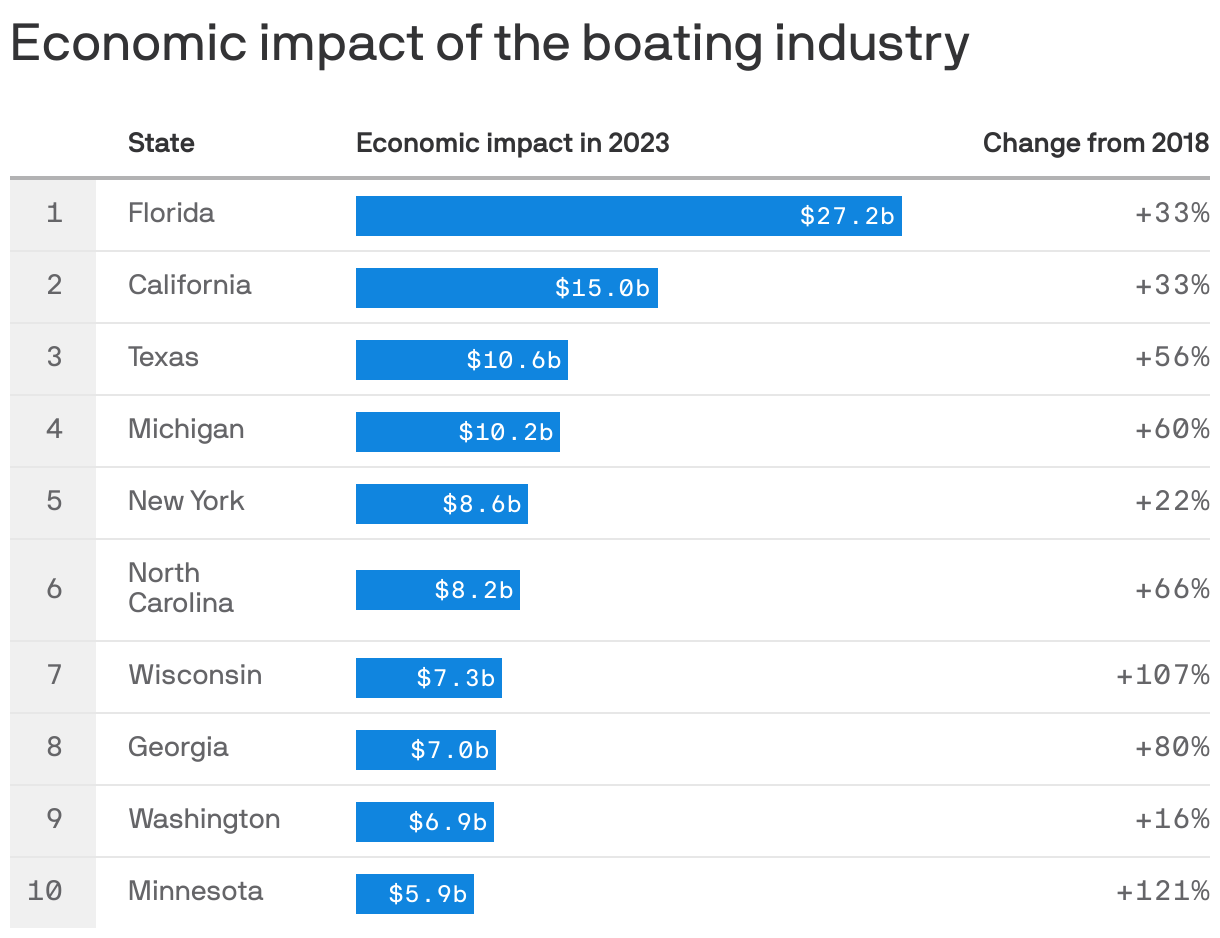
Zoom in: East and West Coast states account for a large chunk of those sales, but states the Great Lakes region β Michigan, Wisconsin and Minnesota, for example β have also seen strong demand.

What they're saying: "The profound impact the past few years have had on our industry cannot be denied as we've seen Americans seek out boating and fishing in record numbers, driving significant economic output and supporting tens of thousands of small businesses and nearly a million jobs," NMMA president Frank Hugelmeyer said in a statement.
- βWith summer on the horizon, we're anticipating healthy boating participation with more than 85 million people estimated to take to the water in the U.S. amid Americans' continued appetite for the outdoors and unique experiences."
What to watch: To help even more people get out on the water, the boating industry has been exploring new subscription-based boat-sharing clubs.
- One example: Freedom Boat Club, a division of Brunswick, maker of popular boat brands such as Bayliner, Boston Whaler and Sea Ray.
- "There are a lot of new ways to get out on the water that didn't exist a decade ago," Bradley says.
Joann's thought bubble: As a sailor, I'd personally be delighted to see boating cool off a bit. My husband and I have been wanting to upgrade our 22-foot O'Day for two years, but there aren't many good used sailboats on the market.
- Everybody's enjoying them too much, I guess.
2. Apple's "Vision Pro" revealed

Apple's Vision Pro mixed reality headset. Photo courtesy of Apple
Apple on Monday debuted its long-awaited mixed reality headset, the Vision Pro.
Why it matters: The Vision Pro is Apple's most significant new device in years β and a big bet that augmented and virtual reality are more than just a fad, Axios' Ina Fried writes.
Details: The device, which resembles a futuristic set of ski goggles, allows users to view digital content on top of the real world, and is controlled using voice, eye gaze and hand gestures.
- It's due out early next year for $3,499.
What they're saying: "It's the first device you look through and not at," Apple CEO Tim Cook said during a company event. "Your surroundings become an infinite canvas."
Yes, but: Apple's new gadget faces several headwinds, including the nascent state of the components needed for such devices and a tech world whose attention has largely shifted from VR and the metaverse toward AI.
3. AI with character
Illustration: Shoshana Gordon/Axios
The latest hot AI startup is challenging ChatGPT using the power of personality, Axios' Ryan Heath reports.
- Character.AI does what ChatGPT does, but with role-playing β so it can talk to you in the style of Madonna or let you order Elon Musk around.
Driving the news: Character.AI was built by Noam Shazeer and Daniel De Freitas, who left Google to create their own large language model.
- The service lets you converse with more than 10 million characters β fictional versions of any person living or dead β based on data scraped from the open internet.
How it works: Anyone can create or chat with a character, from Billie Eilish to Napoleon Bonaparte.
- Yes, but: What you're getting is simply the internet version of how these people might talk to you.
You can stick to humorous banter, use the characters as debate sparring partners, or turn Elon Musk into your assistant, getting "him" to draft your work emails.
- One thing you can't do: strike up a romantic or erotic relationship with the characters.
The bottom line: Character.AI's effort to meld the informational utility of ChatGPT with the enjoyment that first made social media popular has clearly struck a chord.
- The app could become a staple β or the novelty could wear off.
4. Diablo's long-awaited return
Screenshot courtesy of Activision Blizzard
Diablo IV launches this week, Axios' Stephen Totilo writes, extending a classic gaming series that makes as many headlines for its quality as for the drama perpetually surrounding it.
Why it matters: For the past decade, Diablo's creators at Blizzard and parent corp Activision Blizzard have used the massively popular franchise to test new business models.
- Some experiments have failed; others have become industry standard.
Details: For 2012's Diablo III, Activision Blizzard required a then-novel persistent online connection, even when played solo.
- Unpopular then, it's become standard now. More modern games, including Diablo IV, are built to keep players connected to each other and to in-game stores.
Diablo III also previewed the NFT craze β and backlash β with the launch and failure of its real money auction house.
- It let players sell their in-game loot for real money, which many players said ruined the spirit of the game. Blizzard eventually agreed and removed it in 2014.
Diablo fans howled again in 2018, when Blizzard announced plans for a mobile spinoff β though such a move has since become the norm.
What's next: The biggest drama for Diablo IV may be yet to come, as Blizzard attempts to fully convert the series into the live service format.
- The game's June launch will be followed by the July rollout of quarterly in-game seasons, designed to entice players to start up new characters, go on new adventures and, presumably, pay extra to have a better time.
Big thanks to What's Next copy editor Amy Stern.
Was this email forwarded to you? Get your daily dose of What's Next by signing up here for our free newsletter.
Sign up for Axios What's Next

The next decade of big, sweeping changes will unfold in cities and communities where new technologies like 5G, AI and drones are transforming how we work, live and play together. Whatβs Next will guide you through the revolution.