Axios What's Next

May 16, 2023
Got a bird problem? Call in the (hawk) drones, Alex reports today.
- Join Axios tomorrow at 8 a.m. ET in Washington, D.C., for an event exploring innovations in technological and financial support for small businesses.
- Guests include Rep. Roger Williams (R-Texas), Sen. John Hickenlooper (D-Colo.) and National Economic Council deputy director Bharat Ramamurti. Register here to attend in person.
Today's newsletter is 1,039 words ... 4 minutes.
1 big thing: Anti-bird drones
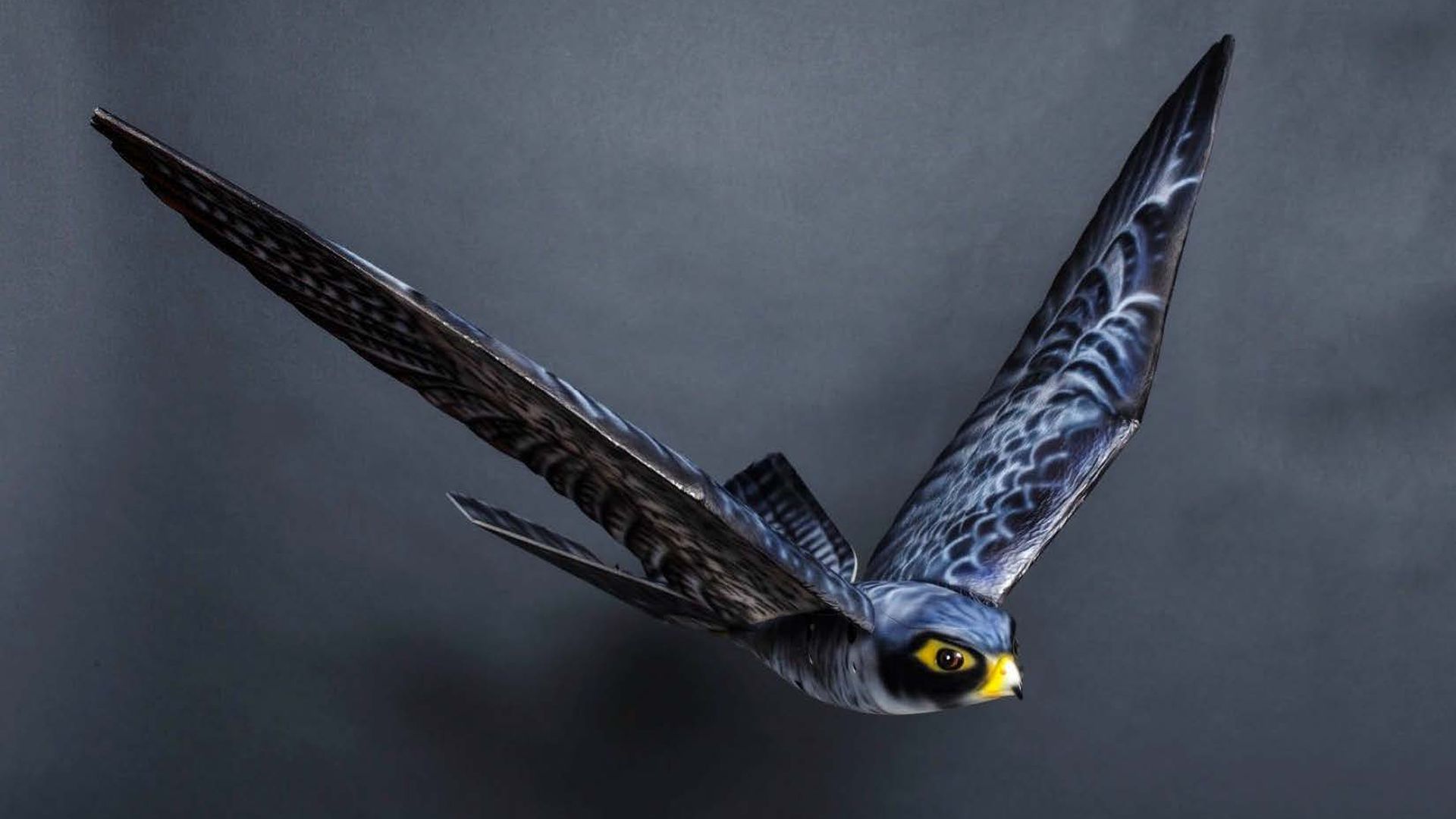
One of the Drone Bird Company's models. Photo courtesy of The Drone Bird Company
Farmers, airport operators, pipeline operators and others looking to shoo away unwanted avian pests are turning to a suite of new high-tech tools, Alex reports, including drones designed to look like threatening hawks and lasers meant to humanely disperse crop-eating or airplane-threatening flocks.
Why it matters: Birds are a major economic threat to farmers — some of whom use anti-bird netting that can unintentionally trap or harm birds — a hazard for aircraft, and a nuisance to industrial sites.
- The spread of avian flu, meanwhile, is giving some farmers and others new cause to keep wild birds at bay.
Driving the news: The Drone Bird Company has developed a fleet of partially 3D-printed drones that look like birds of prey, and are meant to scare away unwanted smaller birds.
- While some of the company's models have flapping wings to simulate predators' movements, further testing revealed that they simply needed to match predators' speed and silhouette to be effective.
- The company's birds can fly autonomously, but CEO Jan-Willem van den Eijkel says flying them manually is more effective — and users can even corral flocks in the desired direction.
- "If you really want to chase birds — if you're just loitering, it's not enough, because the birds will know, 'okay, what's he doing?'" he says.
Case study: The company was recently hired by a blueberry farmer in Germany who lost about half of his 240 acre crop to starlings. But that loss dropped to about 5% after using the company's drone.
- "We were flying for him because he wasn't sure it was really worth his time and money," says van den Eijkel. "So I said, 'okay, we'll do this as a service for you.' But it's not scalable for me because I need too many pilots, et cetera."
- "So I made the bird really user friendly. I teach people to fly in three to four days, and then they can fly themselves."
Yes, but: Some airport managers are still skittish about flying a drone around their runways, opting instead for air cannons and other anti-bird measures.
The intrigue: Bird-shaped drones could also be useful as military or espionage tools — harkening back to the days of wartime carrier pigeons.
- The company's bigger birds "can carry a payload, like a thermal camera and RGB camera," says van den Eijkel. "And we use this as an unobtrusive espionage [device] ... basically because there is no [radar] signature."
- "You operate at an altitude of like 500 feet. So if you would look up, you really have to stare at it for a long time to pick it out."
Meanwhile: Companies such as Bird Control Group and Bird-X have also developed high-tech lasers meant to annoy birds until they leave the area.
The bottom line: The era of the high-tech, 21st century scarecrow is here.
2. AI: Loneliness boon or bane?
Illustration: Aïda Amer/Axios
The advent of ubiquitous AI-driven chatbots could make actual human contact even scarcer amid our ongoing loneliness crisis, Axios' Ryan Heath writes.
What's happening: In the long haul, experts worry that AI might further cocoon people from the relationships and conversations they need.
- But in the short term, AI-powered companions, pets and mental health support services are being drafted to fight the loneliness epidemic.
Driving the news: Advocates point to a list of applications where AI can provide some loneliness relief, including virtual therapy, AI conversations and 24/7 AI-based support.
Yes, but: More than 10,000 apps claim to provide mental health services, per the American Psychiatric Association — but few are certified by professional bodies or governments.
- AI tools trained on the open internet or released without guardrails have allegedly played a role in at least one suicide.
What's next: Look for startups to combine machine learning and behavioral psychology to data-mine our emotions.
- Nirit Pisano, chief psychology officer at Cognovi Labs, told Axios that helping AI better read how we're inclined to think and act in certain emotional states opens the door to 24/7 support, greater self-understanding, and systems that can nudge us toward useful behaviors or emergency services.
- But a public already wary of ad-driven digital surveillance and biased AI algorithms might think twice before sharing state-of-mind data with profit-driven chatbots.
3. 📊 Sports betting's big winners


In the five years since the Supreme Court overturned the Professional and Amateur Sports Protection Act, Americans have legally wagered over $220 billion on sports, Axios' Jeff Tracy writes.
- That's good for over $17 billion in sportsbooks revenue and $3 billion in state and local taxes.
State of play: 33 states (plus Washington, D.C.) have live, legal betting markets, four states have legalized betting but haven't begun operations, and another six have active legislation or ballot initiatives.
What to watch: The three most populous states — California, Texas and Florida — still aren't on board.
- That could eventually change, but it might be a while, given shaky support among state lawmakers and others.
The bottom line: Five years ago, legal sports betting was largely limited to Las Vegas. Now, over half of American adults can legally place wagers — often from the comfort of their couch.
4. VR takes on racism, xenophobia

A screenshot from "Barnstormers: Determined to Win." Photo courtesy of Derek Ham
A new crop of virtual reality (VR) experiences has players confronting segregation, racism and xenophobia in hopes of encouraging understanding and empathy, Axios' Russell Contreras reports.
- The simulations go well beyond previous similar VR offerings, which were more like short films.
Zoom in: In "Barnstormers: Determined to Win," users travel back to the 1940s as a player in baseball's Negro Leagues, experiencing the segregation of the era both on and off the field.
- Players talk about their struggles, and users can see poverty and inequality in the urban areas around them.
Meanwhile: MIT researchers recently developed a VR role-playing project called "On the Plane," which simulates an episode of discrimination against a Malaysian American air passenger.
- Players can take on the role of characters from various backgrounds while interacting and talking with others about what's happening.
- "Our hope is that [players] move away from the experience with an understanding of how xenophobia and other forms of discrimination may play out in everyday life situations," co-author and co-designer Caglar Yildirim tells Axios.
Yes, but: Plenty of well-intentioned VR projects aren't widely experienced because relatively few people have the right gear.
Big thanks to What's Next copy editor Amy Stern.
Was this email forwarded to you? Get your daily dose of What's Next by signing up here for our free newsletter.
Sign up for Axios What's Next

The next decade of big, sweeping changes will unfold in cities and communities where new technologies like 5G, AI and drones are transforming how we work, live and play together. What’s Next will guide you through the revolution.