Axios Vitals

August 15, 2023
Good morning, Vitals readers. Today's newsletter is 909 words or a 3.5-minute read.
1 big thing: Hospitals battle DSH cuts

Illustration: Natalie Peeples/Axios
Hospitals are scrambling to halt a nearly $1 billion cut the Biden administration made to their Medicare payments for treating low-income and uninsured patients, Axios' Maya Goldman writes.
Why it matters: The reduction to fiscal year 2024 payments announced earlier this month was far larger than what Medicare had originally proposed, catching hospitals by surprise. And though Medicare already finalized the cuts, hospitals say the agency must reconsider its decision to avoid jeopardizing care for disadvantaged patients.
Catch up fast: Medicare disproportionate share hospital payments, or DSH payments, are given to hospitals to offset the charity care they provide. The program's formula generally means that payments decrease as more people have health insurance.
The latest: The Centers for Medicare and Medicaid Services originally proposed a $115 million decrease in DSH payments but decided to finalize a $957 million cut, citing new data from its actuaries showing a lower uninsured rate next year.
- Even though Medicaid enrollment is shrinking as states unwind pandemic-era coverage protections, CMS estimates that many people losing Medicaid coverage already have or will get coverage from other sources, STAT reported.
Yes, but: Hospitals say the CMS data doesn't reflect the reality of what's happening with the Medicaid unwinding.
- The uninsured rate hit an all-time low in early 2023, but millions have lost Medicaid coverage since states began redetermining eligibility in April.
- The American Hospital Association asked CMS to keep the fiscal year 2023 uninsured rate in place for next year and to pause scheduled DSH cuts until the Medicaid redetermination process plays out.
Between the lines: CMS does have the authority to walk back the safety-net cuts, even though they've already been finalized.
- "If CMS is really convinced that they ought to take another hard look at this, what they could do is they could come up with a new proposed rule to delay the effective date" of the DSH cuts, said Rob Wanerman, a lawyer at Epstein Becker Green.
- CMS has the option to use a different data source aside from its own actuaries to estimate the uninsured rate, Wanerman added.
2. Addiction's broad toll

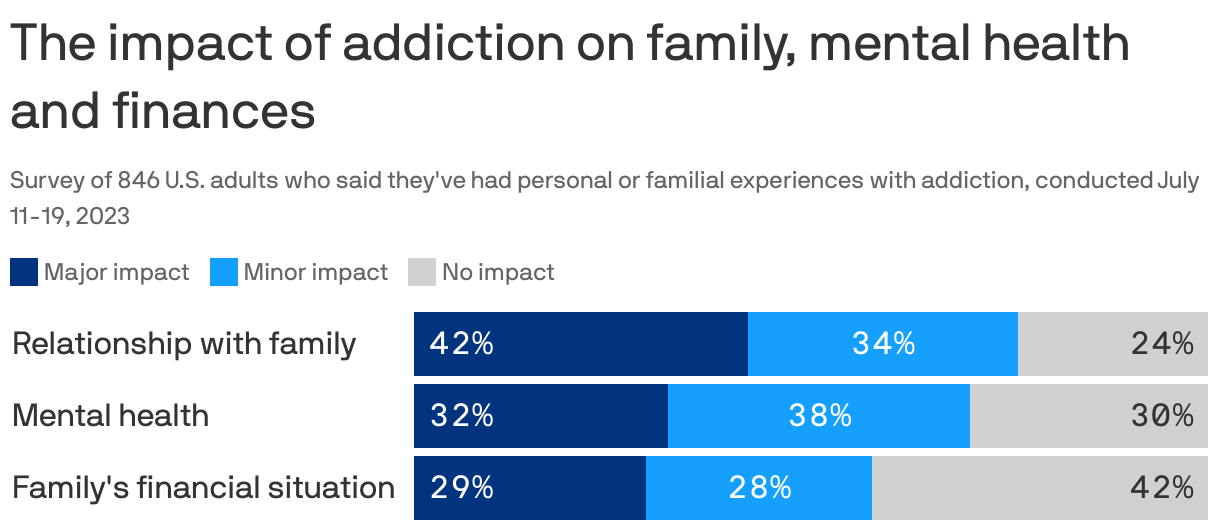
Addiction is affecting the family relationships, mental health and finances of most adults in the U.S., according to a new KFF poll.
Why it matters: The findings help reveal how the worsening substance use crisis is weighing on people's lives, regardless of whether they're personally experiencing addiction, Axios' Sabrina Moreno writes.
By the numbers: 66% of American adults have a personal or familial experience with alcohol or drug addiction. That includes homelessness due to addiction or a drug overdose that resulted in an emergency room visit, hospitalization or death.
- About 1 in 4 of respondents who have had a relative with an alcohol or drug addiction (but have not experienced addiction themselves) say their mental health was significantly affected by it.
- About 1 in 3 say they or someone in their family has been addicted to opioids.
3. Colorado IDs meds for possible price caps
Illustration: Rebecca Zisser/Axios
A Colorado board tasked with pushing down drug costs has identified the first batch of medicines that could be subjected to new state-mandated price limits.
Why it matters: Colorado's Prescription Drug Affordability Review Board, created in 2021, is among a host of recent state efforts to take a more active role in reducing drug costs — and appears to be the first to name drugs whose prices could be capped.
Details: Out of hundreds of medicines, Colorado's review board chose five that will get closer scrutiny, per the Denver Post. These include:
- Genvoya, a combination pill for HIV; Enbrel, for rheumatoid arthritis; Cosentyx, for psoriatic arthritis; Stelara, for Chrohn's disease; and Trikafta, for cystic fibrosis.
- The list prices range from about $4,000 per month for Gilead's Genvoya to $26,000 per month for Vertex's Trikafta.
State of play: This kicks off a months-long review of whether the drugs should officially be deemed "unaffordable," and if so, whether their prices should be capped. An answer is expected in December or January, per the Post.
Catch up fast: More states embrace drug price boards to curb health costs
4. Full-body scan debate redux
Illustration: Gabriella Turrisi/Axios
One of the most successful biotech VCs ever, Robert Nelsen, is also a thyroid cancer survivor who credits early detection to a full-body scan, Axios Pro Rata's Dan Primack writes.
Why it matters: There is a simmering medical debate over the value and risks of full-body scans, while a growing cohort of venture-backed startups are providing them.
- Advocates argue that such scans can find abnormalities that would typically be missed by a standard physical exam, including conditions that could lead to catastrophic events like aortic aneurysms.
- Opponents argue that such pricey scans have not been shown to be cost-effective, particularly because they can give false positives that result in unnecessary follow-up care and/or interventions.
The bottom line: One knock on full-body scans is that it's mostly a concierge service being utilized by venture capitalists, celebrities and other wealthy health hackers.
- But if venture capitalists maintain their interest in the technology, Dan writes, then costs might get subsidized to the point where there are enough scans done to determine whether it's a useful technology for the broader population.
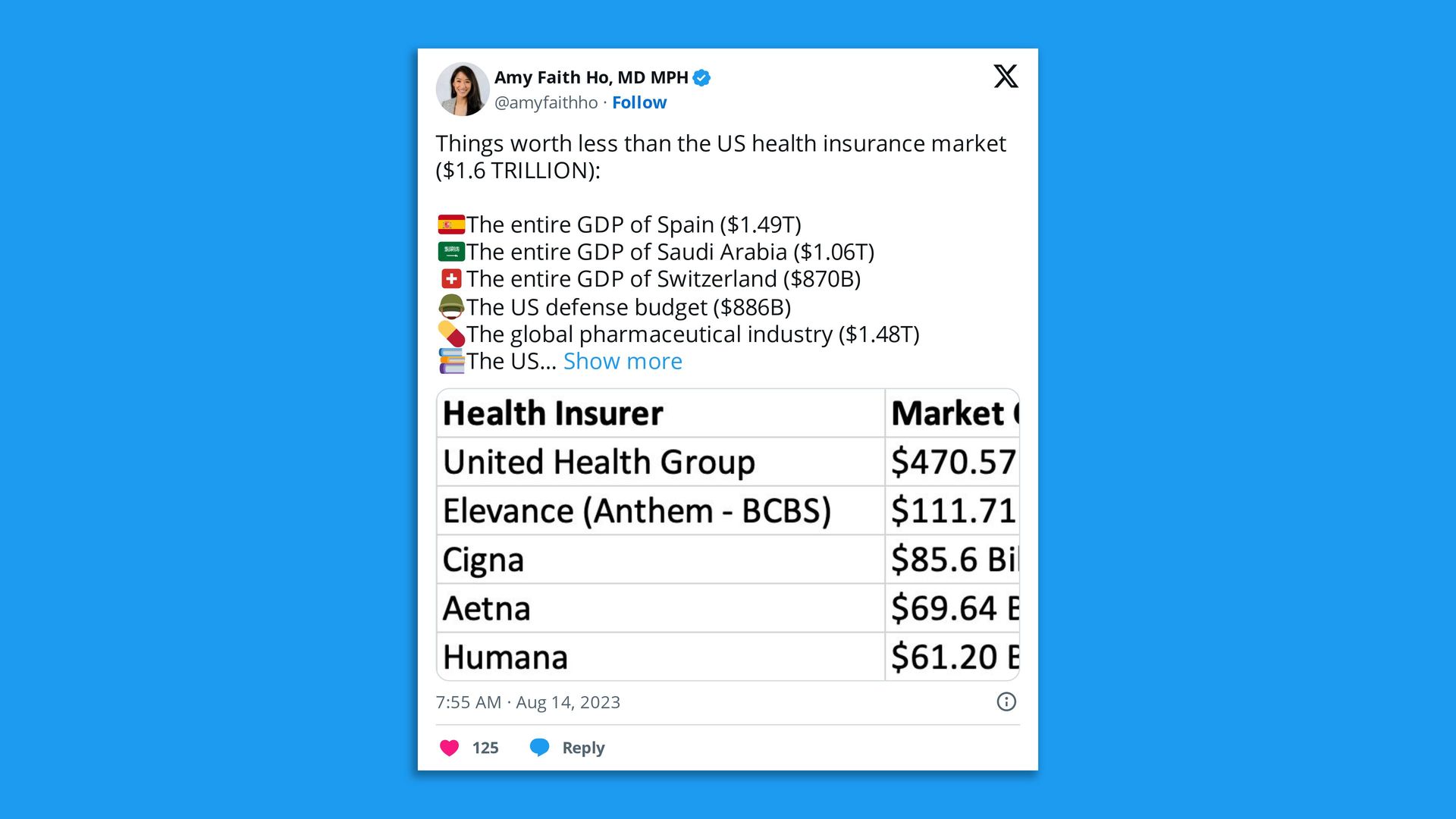
5. Post du jour: Market cap
Screenshot: @amyfaithho (X)
6. Catch up quick
💊 Pfizer received accelerated approval for the multiple myeloma therapy Elrexfio, setting up competition with Johnson & Johnson's Tecvayli. (Fierce Pharma)
🧠The success of new weight-loss drugs shows how much obesity is affected by brain chemistry, rather than willpower. (Wall Street Journal)
🚬 Most adults incorrectly believe that inhaling marijuana smoke is safer than inhaling cigarette smoke. (CNN)
Thanks for reading Axios Vitals, and to health care editor Jason Millman and copy editor Nick Aspinwall. Please ask your friends and colleagues to sign up.
Sign up for Axios Vitals

Healthcare policy and business analysis from Tina Reed, Maya Goldman, and Caitlin Owens.