Axios Vitals

August 02, 2023

Happy Wednesday, Vitals gang — we've made it to mid-week. Today's newsletter is 1,060 words or a 4-minute read.
Situational awareness: The FDA and DEA heads called on manufacturers of prescription stimulants like Adderall to increase production, saying they're below federal quotas as the drugs have been in shortage the past year.
1 big thing: Pfizer's waning COVID demand

Illustration: Sarah Grillo/Axios
Pfizer is eyeing cost-cutting measures to manage potential losses from low uptake of its COVID-19 vaccine and antibody treatment — a sign of how the market for COVID products has weakened, even as hospitalizations and cases tick up again.
Why it matters: The pharmaceutical giant's disclosure on a quarterly earnings call Tuesday reflects both the public's apathy for booster shots and declining support from governments for its COVID products.
- It may also call into question the demand for producing more effective COVID treatments and vaccines as we continue to live with the virus.
By the numbers: Pfizer projected in January that about 60 million of its shots would be administered in the U.S. this year.
- However, only 12.4 million doses of any COVID vaccine were administered in the U.S. in the first six months of 2023.
- Pfizer's COVID vaccine revenue is expected to be down 64% compared to last year, while revenue from its Paxlovid antiviral therapy is expected to be down by 58%.
- Americans have been eager to move on from COVID and get back to pre-pandemic activities. And just 17% of the country has received the bivalent booster authorized almost a year ago, per the CDC.
What they're saying: The third quarter, timed to the expected availability of the updated COVID shot, is critical for forecasting booster demand in the coming years, CEO Albert Bourla said.
- Pfizer is also closely watching the performance of products like its new RSV vaccines for older adults.
- It's also still interested in exploring a combination flu-COVID vaccine, Bourla said.
What's next: Moderna, the other leading COVID vaccine maker, releases earnings on Thursday.
2. Giving birth in America keeps getting deadlier

Illustration: Aïda Amer/Axios
Giving birth is getting ever more dangerous in America, especially for Black women, older women and those living in rural areas, according to a pair of new reports from March of Dimes and Milken Institute.
Why it matters: The dismal U.S. maternal health statistics are usually a sidebar in the abortion wars, but many experts believe that increasing the number of births by further restricting access to abortion will only worsen the situation, Axios' Caitlin Owens writes.
Driving the news: More than 5.6 million women live in counties with little to no access to maternity care services, according to March of Dimes. More than 300 hospital birthing units have closed since 2018.
- Milken's analysis found that racial disparities in maternal mortality exist across age groups, but that risk increases earlier for Black women, potentially a sign of faster aging.
- Nationally, the maternal mortality rate in 2021 was 32.9 deaths per 100,000 live births — nearly double the 17.4 deaths per 100,000 live births in 2018, according to the CDC.
Between the lines: Many of the states with the highest mortality rates are ones with poor access to care — and where some of the strictest abortion restrictions are in place.
The big picture: Rural communities writ large are struggling with health care access issues that go well beyond maternity care. And many obstetrics unit closures are about money, not politics.
3. A case for covering obesity meds
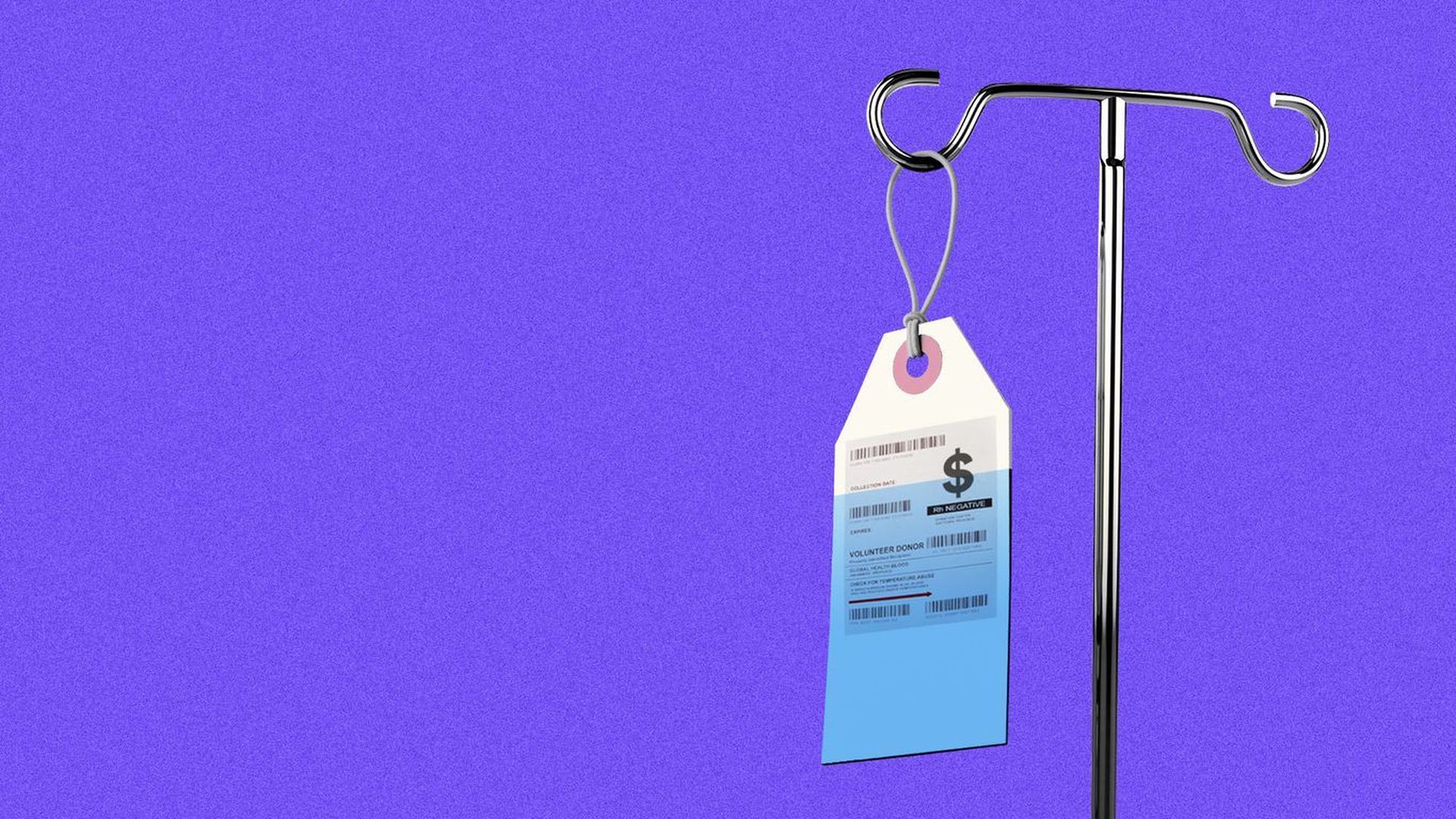
Illustration: Sarah Grillo/Axios
Medicare coverage of obesity drugs could save taxpayers as much as $245 billion over a decade by reducing demand for hospital care and skilled nursing.
Why it matters: A study from the USC Schaeffer Center for Health Policy and Economics attempts to put a price tag on the public health benefits from expanding coverage as a new class of obesity drugs hits the market.
- Medicare and most private insurers don't cover obesity drugs due to concerns over safety and effectiveness. Just 1% of Americans eligible for a number of treatments have access to them because of coverage limits.
What they found: Medicare coverage of weight-loss therapies would save the program $175 billion to $245 billion, depending on whether private insurance also covers the treatments.
- Most of the savings would be in Medicare Part A through reduced hospital inpatient care and skilled nursing care. Savings would also come from reducing the incidence of related conditions like heart disease and diabetes.
4. Hospitals get Medicare pay bump
Illustration: Tiffany Herring/Axios
Hospitals secured a $2.2 billion increase in Medicare payments for inpatient services next year under a final rule issued Tuesday, Axios' Maya Goldman writes.
Why it matters: The 3.1% overall increase is slightly higher than the rate the Centers for Medicare and Medicaid Services proposed in April. But CMS estimates payments to offset the charity care hospitals provide will decrease by about $957 million next year, much higher than the $115 million decrease proposed in April.
- Hospital groups argued the final rule falls short of recognizing the financial pressures their members face from inflation and increased costs of labor, supplies and drugs.
5. ChatGPT vs. Google, medical edition
Illustration: Sarah Grillo/Axios
When it comes to playing online doctor, who does a better job: ChatGPT or Google?
The answer isn't so clear-cut, according to new research pitting the popular AI chatbot against the search engine giant.
ChatGPT provided more accurate and reliable results on medical information than Google, which researchers attributed to the quality of websites it was trained on. Meanwhile, Google searches churned out more current information.
The details: The study was led by computer scientists at University of California-Riverside who submitted 60 queries to ChatGPT and Google related to Alzheimer's disease and other dementias. Half of the questions were about how the disease affects patients, and the other half sought information about services that could help patients and families.
- Each platform had strengths and weaknesses. Although ChatGPT had better information, users aren't able to see how answers are sourced. And while Google can provide the most updated developments on medical research or clinical trials, users may have to sift through ads and other clutter to get the best information.
- Researchers also noted that results from both ChatGPT and Google may be difficult to understand for people with less education or low health literacy.
What they're saying: "If you pick the best features of both, you can build a better system, and I think that this is what will happen in the next couple of years," said lead author Vagelis Hristidis.
6. Catch up quick
🏛️ The Labor Department sued UnitedHealth Group, alleging a company division improperly rejected thousands of emergency care and drug screen claims. (Modern Healthcare)
💻 Amazon's virtual clinic is now available in all 50 states and D.C. (CNN)
🔬 Henrietta Lacks' estate settles lawsuit over use of her cells. (Axios))
💰 Health insurers don't want you to know where your money is going. (Bloomberg)
Thanks for reading Axios Vitals, and to senior editor Adriel Bettelheim and senior copy editor Bryan McBournie. Please ask your friends and colleagues to sign up.