
Axios Vitals

June 06, 2023
Good morning, Vitals readers. Today's newsletter is 993 words or a 3½-minute read.
1 big thing: More states embrace drug price boards to curb health costs

Illustration: Sarah Grillo/Axios
More states are pushing their own plans to lower drug costs, viewing it as an extension of efforts to set payment rates for utilities, transportation and other essential services.
Driving the news: Colorado authorized a state prescription drug affordability board in 2021 and is rolling out a dashboard this week that will show which drugs are the likeliest to have price caps.
- While it's still early, experts say the state boards' work could augment federal efforts like the drug price reforms in the Inflation Reduction Act — if legislators give them enough funding and regulatory muscle.
What they're saying: "Think about what the legislation did. In the end, it was all about Medicare," Mark Miller, executive vice president of health care at Arnold Ventures and former executive director of Medicare Payment Advisory Commission, told Axios.
- "What the states could do is begin to move out into other channels," Miller said, pointing to commercial plans or state employee health plans.
- Beyond price caps, options include capped co-pays and reference pricing.
- The National Academy for State Health Policy has developed model legislation for state-based PDABs, likening it to the regulation of consumer rates for essential services, per a Center for American Progress policy summary.
State of play: Maryland was the first state to establish such a board in 2019 and will conduct cost reviews after getting the authority to set upper price limits, NPR reports.
- It's been joined by a handful of other states including Washington.
- Maine, New Hampshire, Ohio, and Oregon also have boards. But they lack the power to limit drug payments, KFF Health News explains.
Between the lines: This is part of a broader landscape of efforts by states to get health care costs under control, including hospital pricing and site-neutral payments.
- "Drugs are often very obvious or first on the list," Miller said. "[Consumers] can see at the counter issues arising before their very eyes where some of the other stuff gets buried in your premiums."
Yes, but: Legal challenges could take up such questions as whether federal patent law preempts a state setting an upper payment limit and if efforts to regulate prices for in-state transactions improperly affect out-of-state sales, because of the complexity of the drug supply chain.
- The industry group PhRMA says PDABs evaluate whether certain medicines and treatments are "worth" paying for, putting bureaucrats between patients and the treatments their doctors prescribe. "This spells disaster for patients as they could face barriers to obtaining life-saving medication," the group argues.
2. Appeals court to weigh preventive care rule fate

Illustration: Sarah Grillo/Axios
A federal appeals court will hear arguments today on whether to lift a freeze on a decision halting the Affordable Care Act's requirement that employers fully cover the cost of specified preventive health care services, Axios' Oriana González writes.
Driving the news: If the New Orleans-based U.S. 5th Circuit Court of Appeals affirms the ruling, it could eliminate cost-free coverage for certain cancer screenings, behavioral counseling, HIV prevention and other services recommended by the U.S. Preventive Services Task Force.
- Legal experts say a ruling could come as soon as this week.
State of play: The three-judge panel that will preside over the court hearing is comprised of Judges Edith Brown Clement and Leslie Southwick, two George W. Bush appointees, and Judge Stephen Higginson, an Obama appointee.
- The Justice Department argues the public will be harmed unless the lower court ruling is stayed.
- Regardless of the outcome, the decision is expected to be appealed to the Supreme Court.
Catch up quick: The 5th Circuit last month froze a U.S. district court ruling that struck down the ACA's preventive health care coverage requirement nationwide.
3. Same-sex marriage ruling boosted LGBTQ coverage

Illustration: Allie Carl/Axios
Health insurers responded to the 2015 Supreme Court decision recognizing same-sex marriage with more equitable coverage for LGBTQ couples, including spousal benefits, according to a new Health Affairs study, Axios' Arielle Dreher writes.
What they found: The percentage of all LGBTQ adults with a usual source of health care access increased from 64% to 75% from 2013 to 2019.
- Disparities in coverage started to decline in 2014, when the main coverage provisions of the Affordable Care Act took effect.
- By 2017–2019, coverage rates for LGBTQ adults were comparable to those of non-LGBTQ adults, although significant disparities in access remained.
- Partnered LGBTQ adults were slightly more likely to have health insurance coverage than single individuals by 2019.
Even with expanded access to care, LGBTQ adults "were still more likely to report having trouble paying medical bills and going without necessary medical care because they could not afford it," researchers wrote.
4. Data du jour: Non-profit hospital charity care drops
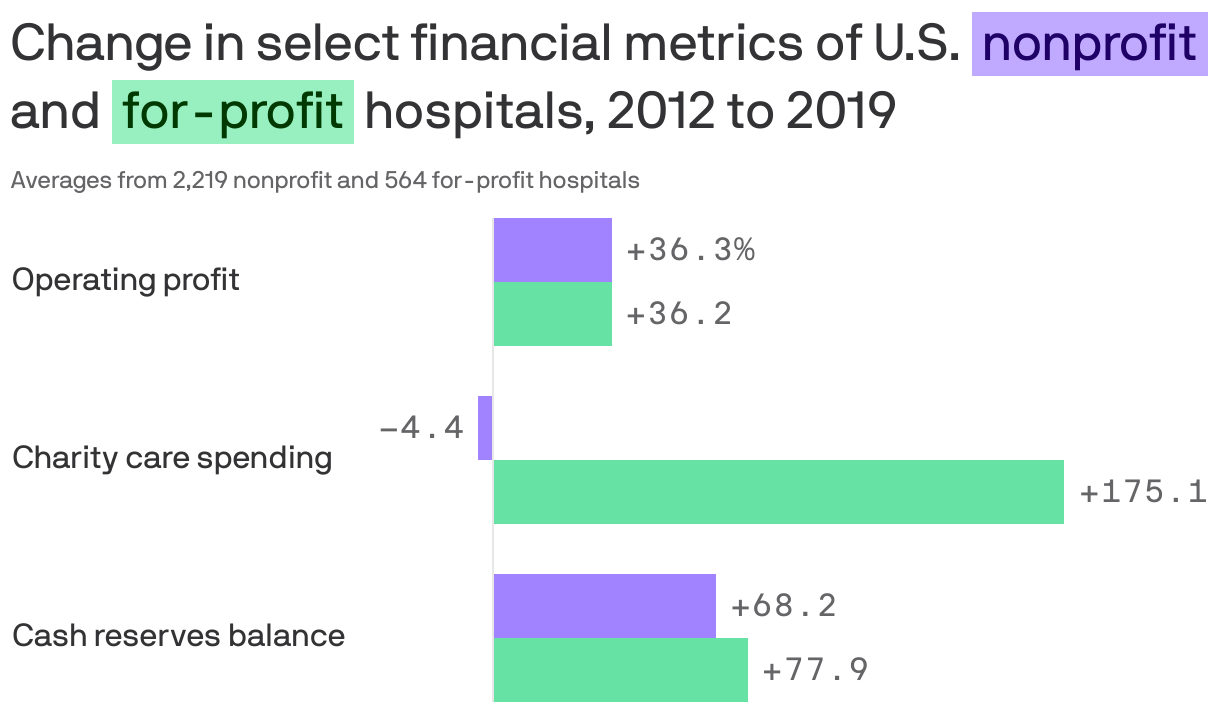
Non-profit hospitals are required to provide charity care and other community benefits in order to maintain their tax-exempt status.
- But though they saw substantial growth in operating profits and reserves between 2012 and 2019, there was no corresponding increase in their giving, a new study published in Health Affairs shows.
By the numbers: The study estimates non-profit and for-profit hospitals in a sample from 2012 had mean operating profits of roughly $43 million and $32 million, respectively. Those profits increased to about $59 million and $43 million, respectively, by 2019.
- Nonprofit hospitals' spending on charity care decreased from $6.7 million in 2012 to $6.4 million in 2019. For-profits increased their charity care spending from $2.3 million to $6.3 million during the same period.
5. Catch me up
⌚️ While Apple's long-awaited mixed-reality headset stole the show Monday, the company also debuted a few health-related updates, including mental health features for its iPhone, iPad and Apple Watch that allow users to track their moods and screen for depression.
🚭 On the final day of the U.S. Conference of Mayors annual meeting on Monday, the organization adopted a resolution "to support urgent and increased federal enforcement and public health interventions to address the fentanyl crisis and to support bans for flavored tobacco products.
📇 Leaders of the EU have called for a "no-pay" academic publishing model which would open free access to readers or authors, Nature writes. Publishers have panned the idea, questioning how it would be funded.
Editor's note: The first story in yesterday's newsletter was corrected to note Ted Okon is the executive director of the Community Oncology Alliance, not the Cancer Oncology Alliance.
Thanks for reading Axios Vitals, and to senior editor Adriel Bettelheim and senior copy editor Bryan McBournie. Please ask your friends and colleagues to sign up.
Sign up for Axios Vitals

Healthcare policy and business analysis from Tina Reed, Maya Goldman, and Caitlin Owens.


