Axios Sneak Peek

November 03, 2024

1 big thing: 😊 Schumer's hard edge
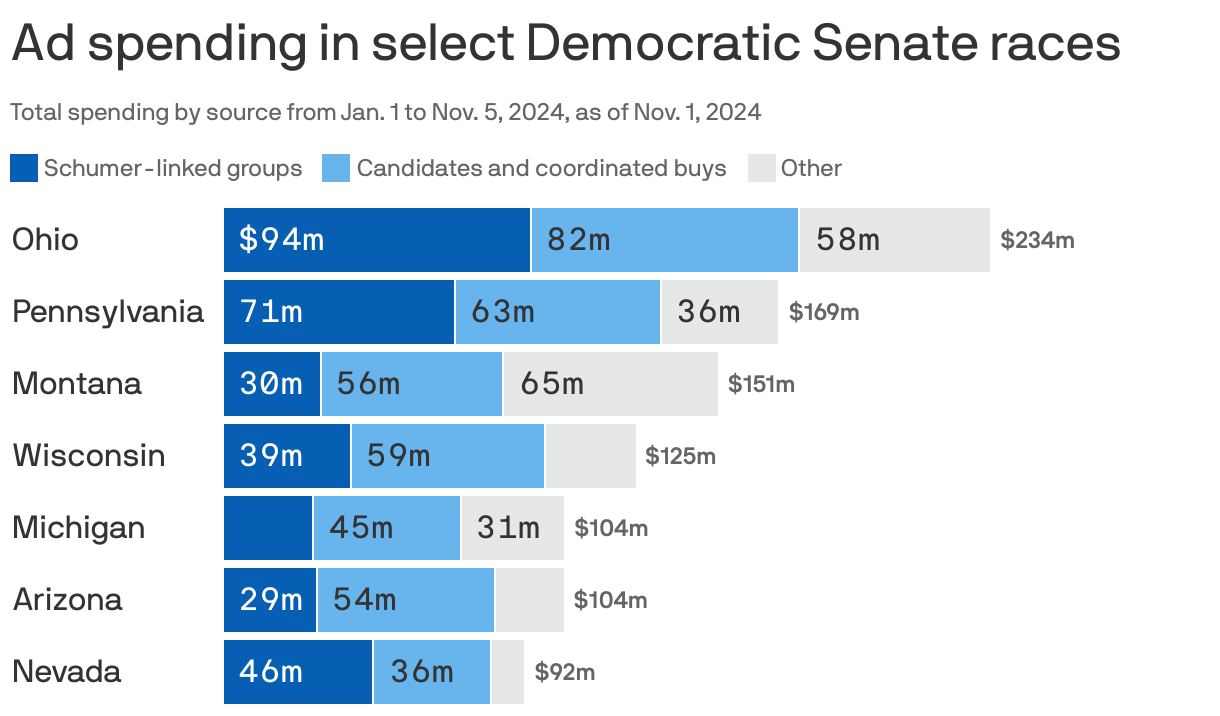
Senate Democratic campaigns have outspent Republicans with the one currency that both parties value the most.
Why it matters: Democrats' advantage with hard dollars has forced Republicans to rely on GOP leader Mitch McConnell's outside super PACs.
- Hard dollars are raised in smaller increments and are controlled by campaigns, versus outside super PACs. They get more bang for the buck on TV ad rates.
- That dynamic is also in play in the House. Minority Leader Hakeem Jeffries' Democrats trounced their opponents in hoovering up hard dollars in the third quarter, and the DCCC has consistently outraised the NRCC.
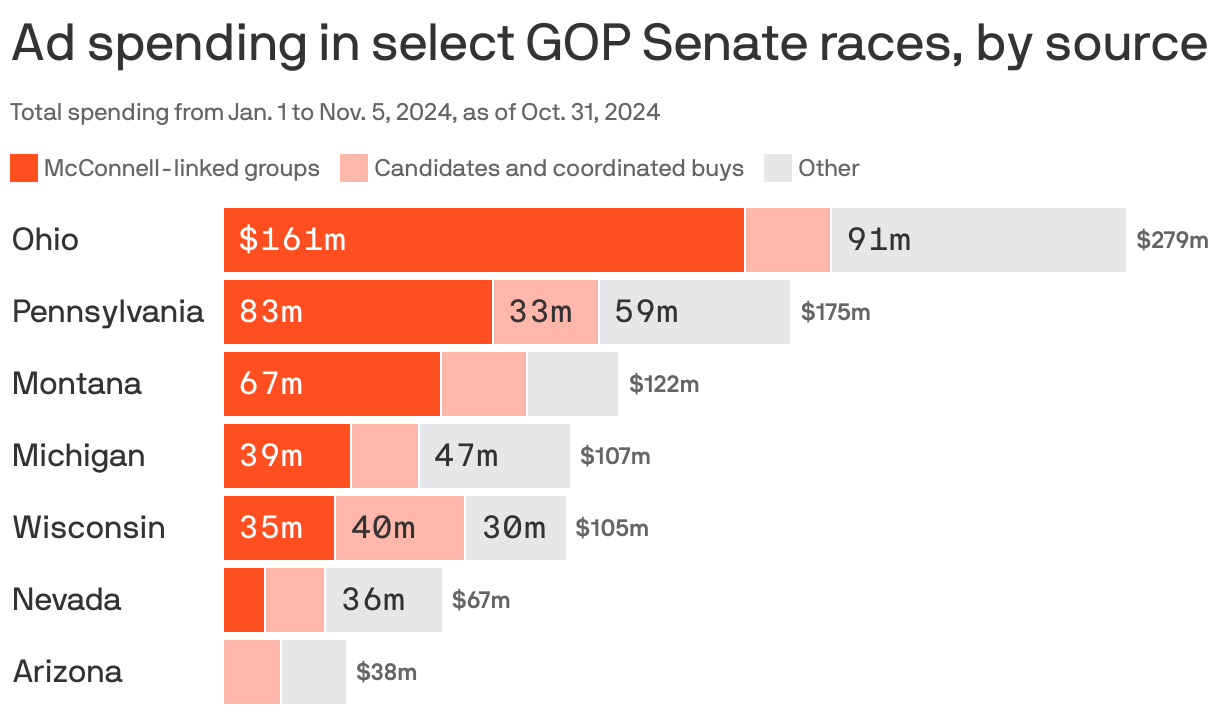
Zoom in: Democratic campaigns have spent more hard dollars on TV and digital ads this year than Republicans in every one of the most competitive Senate races.
- That's also true when counting coordination with each party's Senate campaign arm and joint fundraising committees, according to AdImpact.
- Chuck Schumer-linked groups have still spent heavily in key races — with their top ad investments in Ohio, Pennsylvania and Nevada.
- But Democratic super PACs trail McConnell's groups in Ohio, Pennsylvania and Montana.
The intrigue: Sen. Jon Tester (D-Mont.) is by far the most vulnerable Senate Democrat.
- Schumer's affiliated groups have spent $30 million on Tester's behalf, roughly half the $56 million in hard dollars from Tester's own account.
- That hard-dollar advantage helped Schumer-aligned money flow to Wisconsin and Nevada.
- Democrats spent cash more efficiently by placing ad reservations much earlier in the cycle, capitalizing on lower rates further out from the election, sources tell us.
The bottom line: Republicans say they face a structural disadvantage on the fundraising front. Democrats are simply better, the GOP says, at convincing grassroots donors to part with small dollar amounts.
- Incumbents have an advantage because they have established donor relationships, giving Democrats another leg up in the spending war.
- But this year, even Democrats running for open seats, like Rep. Elisa Slotkin, outspent their opponents.
— Hans Nichols, Stephen Neukam and Stef Kight
2. 📏 Exclusive: GOP measures drapes
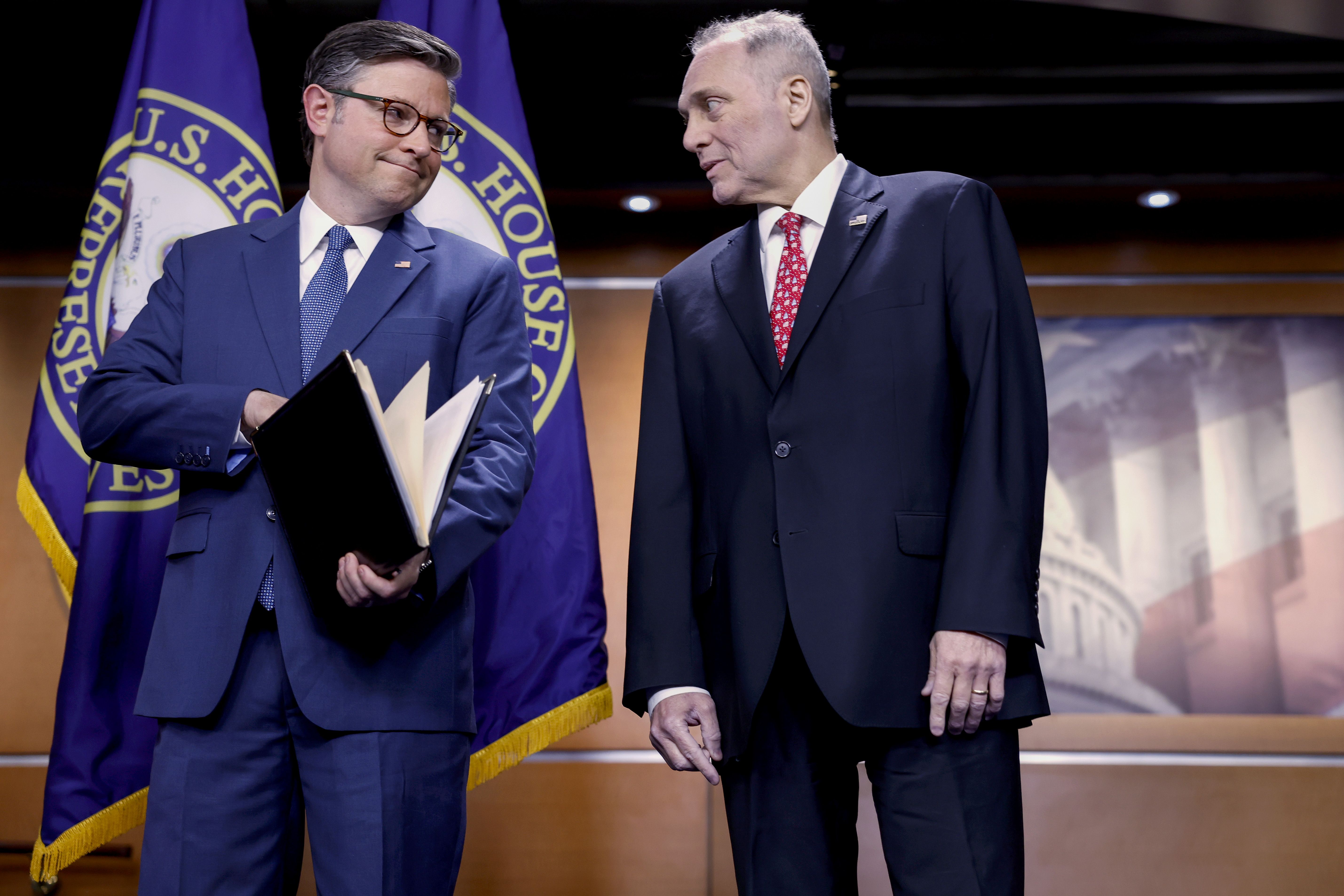
Mike Johnson's House Republicans have a second reason to want a bigger majority: If Trump wins, they'll need the cushion when members get poached.
Why it matters: Multiple GOP members have been angling for senior posts in a potential Trump administration, House Majority Leader Steve Scalise told us in an exclusive interview last week.
- "I've heard from a number of members that have been having conversations whether they're on a short list or a long-short list. We've got really talented members in the House that could end up in the administration," he said.
- "Hopefully we have a large enough majority where that option is available to them, but that's going to be up to President Trump."
The bottom line: Scalise said a margin of 8-12 seats could help them avoid some of the chaos seen during the current Congress.
- "With the way redistricting is, these aren't the days we can get a 30-seat majority anymore. So whatever majority we have is going to be slim."
— Juliegrace Brufke
3. 🎯 Blue state deciders
Keep your focus on New York and California if you want to know who'll control the House next year.
Why it matters: Each state contains enough battleground House districts to determine control of the chamber. Republicans currently have a 5-seat edge.
New York alone contains seven districts rated as some degree of competitive by Cook Political Report.
- GOP Rep. Brandon Williams' race is rated "lean Democrat," while GOP Reps. Anthony D'Esposito and Marc Molinaro are both in toss-up seats.
- The other two Republicans, Reps. Mike Lawler and Nick LaLota, are rated "lean" and "likely" Republican, respectively.
- Democratic Reps. Pat Ryan and Tom Suozzi are rated "lean" and "likely" Democratic, respectively.
Zoom in: California will be one of the last states to fully report its results.
- The state has 10 competitive seats, seven held by Republicans and three by Democrats.
- Five of those Republican seats — held by Reps. John Duarte, David Valadao, Mike Garcia, Ken Calvert and Michelle Steel – are rated toss-ups by Cook.
— Andrew Solender
4. 🥵 Schumer sweats Nevada
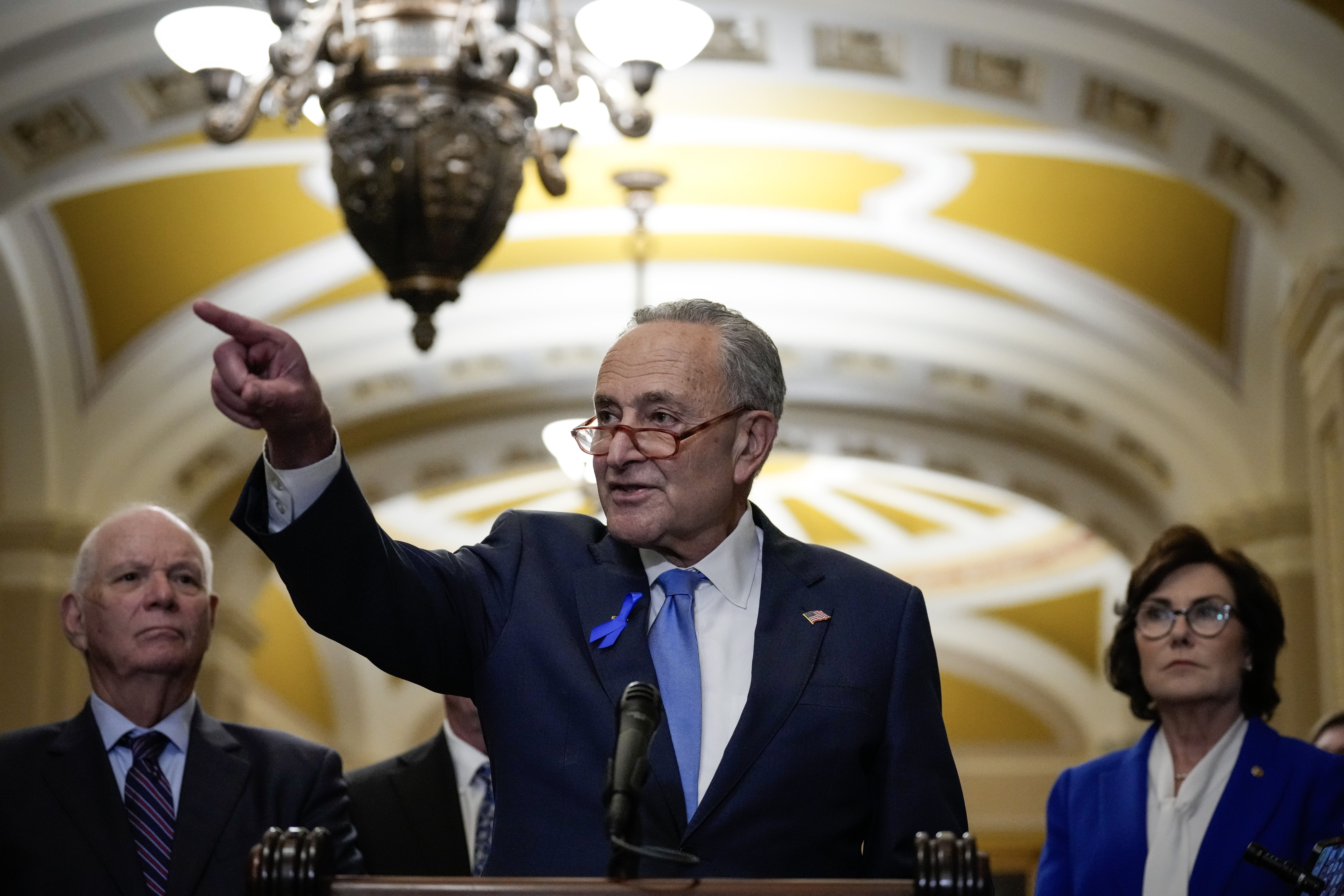
Democrats are worried that the Nevada Senate race has tightened significantly in its final days, sources tell us.
Why it matters: A surprise loss in Nevada would doom Schumer's outside hopes of keeping a Senate majority.
- Republicans hold a rare early vote lead over Democrats, with the data showing a motivated GOP base in the state.
- Sen. Jacky Rosen (D-Nev.) held a polling lead for essentially the entire campaign.
The big picture: Republicans have cast 45,000 more early votes in Nevada than Democrats, according to state data updated Saturday.
- Republican Sam Brown, challenging Rosen, is trying to tie himself to Trump, hoping the top of the ticket will help him across the finish line.
- A PAC linked to McConnell recently blitzed the state with over $6 million in new ads, with one commercial saying: "President Trump and Nevada need Sam Brown in the Senate."
Between the lines: The Rosen campaign and national Dems are hoping the GOP early voting push is followed by a lackluster election day turnout.
- Around a third of Republicans in Clark County (the state's most populous), who voted on Election Day in 2020, have already voted early.
— Stephen Neukam