Axios Media Trends

August 04, 2026

1 big thing: ⚖️ Substack's legal win

2. 📨 Exclusive: NBC's Kornacki subscription

3. 👋 Exclusive: New Business Insider CEO

4. 🏔️ Ellison says CNN holding up his deal
5. 🔊 Spotify joins Netflix in the 300M club


Spotify said Tuesday it topped 300 million paid subscribers, joining Netflix as the only major global streaming platforms known to have reached that milestone.
🎙️ Why it matters: It underscores the company's yearslong strategy to shift from a music streaming app into a broader platform for personalized audio and fan experiences.
- New premium offerings, including tiered subscription products and AI-driven personalized experiences, are what's helping drive subscriptions.
The big picture: Once criticized for thin margins, Spotify has proved it can build a consistently profitable business.
- Gross margin hit a record 33.4% last quarter, moving the company closer to its long-term 35%–40% margin target.
- Free cash flow also hit a record high of €797 million ($918 million) in Q2.
🤖 The big picture: After years of expanding beyond music into podcasts and audiobooks, Spotify told investors in May that it's now entering its next phase of using AI and personalization to deepen engagement.
- It believes leveraging AI to build a "large taste model" around user preferences, rather than building its own LLMs, will allow it to innovate without spending billions of dollars on AI infrastructure costs.
What to watch: While Spotify's ads business remains challenged, the company believes it will see stronger gains in the second half of the year as it expands automated ad-buying tools globally.
- Ad-supported revenue grew 1% year over year, compared to 15% for premium subscription revenue growth.
6. 🦾 GenAI comes for advertising
Six months ago, the conversation about AI in advertising revolved around generating creative. Now, it's becoming an autonomous campaign operator across every major channel.
Why it matters: With agentic advertising spreading across every major channel, brands can now operate at a scale previously unimaginable.
- With search and commerce, Google released AI Max to automate more targeting and optimization and introduced Ask Ads Advisor, Yahoo created a DSP agent network, and Amazon is bringing agentic ads to Alexa+.
- Across the social platforms, Meta released connectors linking external AI systems with its advertising tools, Snap launched Smart Assistant, TikTok built an agentic hub, and Pinterest introduced Business Assistant.
- TV networks, including NBCUniversal, Disney, Fox, Netflix and Paramount, are rolling out agentic workflows. They all joined WPP Media's agentic standards initiative for video buying.
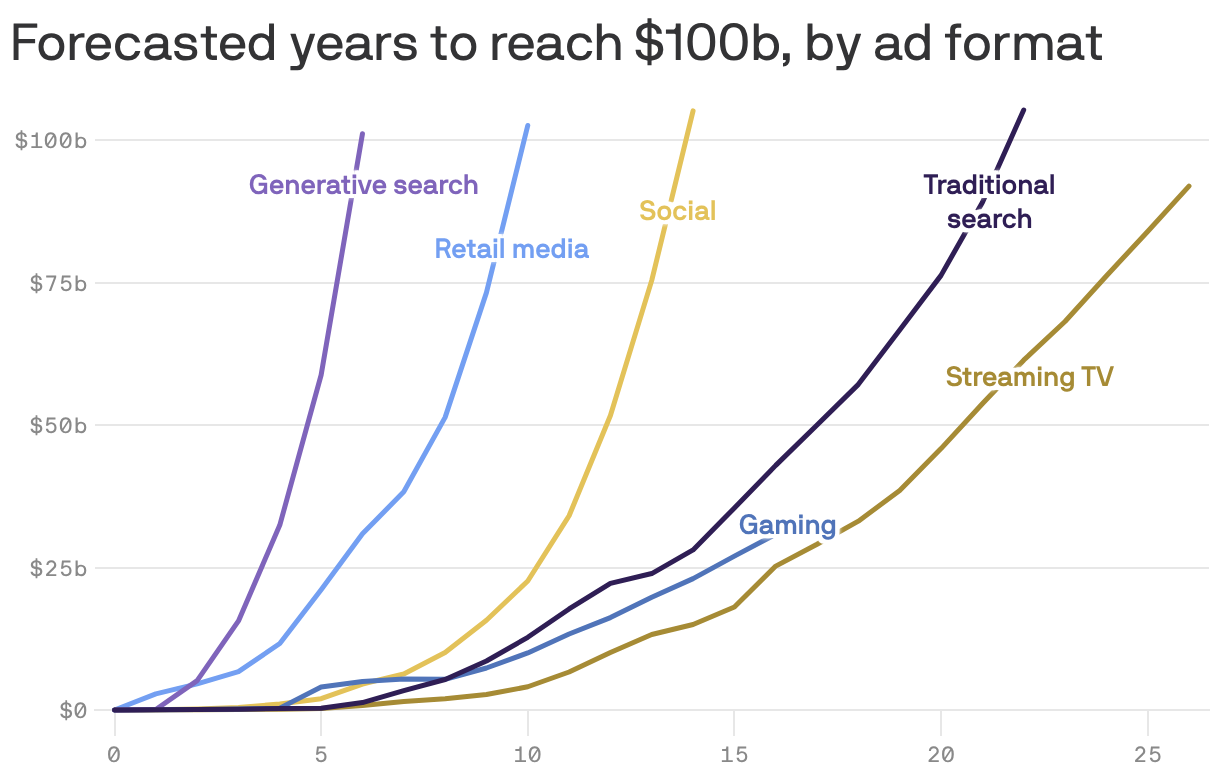
By the numbers: Generative AI search ad revenue is expected to reach $100 billion globally by 2030, according to WPP Media, representing the fastest-growing ad medium in history.
The big picture: The next phase of AI advertising includes ads created specifically for AI agents.
- Time, in partnership with Mobian, has begun placing sponsored content in text-only versions of its webpages for AI systems to read and retrieve.
The big picture: Each quarter, Axios Media Trends Executive members get access to exclusive reports spotlighting the macro and micro trends shaping the industry, in addition to a comprehensive list of updates across each major platform.
Trends highlighted in our Q2 2026 Advertising Economics report include:
- 📺 TV ads get vertically integrated
- 🎯 Connected TV moves deeper into performance
- 🎟️ Live events drive new ad demand
- 🏢 Agency giants remake themselves for AI era
- 🤝 Buyers circle ad tech
- 🛍️ Product feeds power personalized shopping
- 🎬 Brands bet on social shows
- ✨ Creator marketing's glow-up fuels deal boom
- 🪧 Digital OOH ads to surpass physical by 2029
- 🎮 Gaming ads level up
- 🎙️ Audio's programmatic push
Go deeper: Join Media Trends Executive today to unlock the insights and receive an invite to our live webinar tomorrow at 3pm ET, where we'll discuss the report and answer questions exclusively with members.
7. 🔒 Trump's presidential paywall




For years, Truth Social was President Trump's money-losing megaphone.
- Now his company is charging Wall Street up to $1.2 million a year for a "Truth API" than gives a split-second edge on posts that can — and frequently do — jolt global markets.
Why it matters: Trump has transformed his second term into the most lucrative venture of his entire career, raking in more than $2.2 billion in 2025 from his family crypto empire, legal settlements and various licensing deals.
- Truth API is the logical endpoint of that profiteering: the presidency's unrivaled power to move markets, packaged and sold as a subscription.
💨 Catch up quick: The new real-time feed from Trump Media & Technology Group (TMTG) went live Aug. 1, delivering Truth Social posts directly to institutional clients in milliseconds.
- Truth API gives trading algorithms a direct, machine-readable feed that they can act on before most investors receive a push alert or refresh their screens.
- A source familiar with the matter tells Axios that access to the platform's 10 top-trending accounts costs between $60,000 and $100,000 per month. Customers seeking a broader range of accounts could pay more.
Zoom in: The product offered a live demonstration of its value almost immediately.
- Hours after Truth API launched, Trump announced that he had canceled massive planned strikes on Iran. Oil prices fell nearly 5% when markets reopened.
🥊 Reality check: TMTG says the posts are already public when they reach the API. What the company is selling is the latency gap — the brief interval between publication and widespread awareness.
- The company explicitly markets the service to firms for which "the cost of a delay in information" is highest.
- A TMTG spokesperson told Axios: "Senate and House Democrats continue to mischaracterize Truth API either out of ideological opposition to free markets or a failure to grasp the distinction between public and nonpublic information."
Disclosure: In 2023, TMTG sued 20 media organizations, including Axios, for defamation. Litigation is ongoing.
8. 🕷️ Spidey swings past Hollywood's biggest franchises



"Spider-Man: Brand New Day" delivered the biggest domestic opening in box office history this past weekend, extending its decadeslong run as one of Hollywood's most reliable characters.
Why it matters: The success stands in contrast to the so-called "superhero fatigue" that's weighed on other comic book franchises since the pandemic.


Zoom in: According to an Axios analysis, the 11 Spider-Man films have generated an average domestic opening of roughly $135.8 million per movie, second only to the four Avengers films' average of $253.4 million.
- Spider-Man outranks other long-running franchises' average opening weekends, including Jurassic Park at $109.1 million, the nine-film Star Wars Skywalker saga at $103.1 million and Harry Potter at $103 million.
- Even excluding "Brand New Day," the previous 10 Spider-Man films averaged about $113.4 million domestically on opening weekend, which would still rank the franchise behind only Avengers.
- Six of the 11 Spider-Man films debuted above $100 million domestically, starting with 2002's "Spider-Man."
🍿 The big picture: "Brand New Day" joins a slate of successful debuts this year that are bringing the box office closer to pre-pandemic levels. Premium screens have played a major role.
- Domestically, theater revenues are pacing 15.9% ahead of the same time last year and 5.2% ahead of 2023, which holds the post-pandemic box office annual record, per Box Office Mojo.
- "Brand New Day" generated more than $11 million across 177 Dolby Cinema locations, marking the format's highest-grossing weekend.
Axios Media Trends

Sara Fischer’s inside look at the forces reshaping media.