Axios Media Trends

March 01, 2022

Today's Media Trends is 1,438 words, a 5.5-minute read. Sign up here.
1 big thing: Inside the Smiths' hunt for cash

Photo Illustration: Annelise Capossela. Photos: Aniruddha Chowdhury/Mint, Drew Angerer/Getty Images
Justin Smith, the former head of Bloomberg Media, and Ben Smith, the former New York Times media columnist, have approached some of the biggest names in media in an effort to raise $20-30 million to launch a news organization by fall of 2022, according to people they've pitched.
Why it matters: The Smiths, who tell investors they'll burn through $50 million in cash before breaking even, have approached Bob Iger, Michael Bloomberg and Laurene Powell Jobs' Emerson Collective, sources tell Axios.
Details: The Carlyle Group's David Rubenstein, often mentioned as a potential investor, is seriously looking at it but has yet to decide, per a source familiar with his thinking.
- The Smiths have told several people they've discussed the project with that they're trying to avoid raising cash from Silicon Valley venture funds, and have instead targeted mostly wealthy individuals and family offices.
- The pair has decided on a name for the company, which for now they're calling "Project Coda."
Ben Smith is telling people he plans to go all-in on the 2024 presidential campaign. He's planning a 2024 newsletter, hoping to ride public interest in the campaign, much like Politico did in the run-up to the 2008 race.
Between the lines: The model — and pitch — sounds to some investors like Puck but with global ambitions.
- Two people who were asked to invest said the Smiths' plan is too vague to throw money at right now.
- The Smiths contend they'll need to raise $80-100 million in coming years to spread across different regions around the world.
- Justin Smith talks up creating an internal talent management arm to help elevate the brands of the company's top reporters.
2. War brings surge of news traffic

Illustration: Brendan Lynch/Axios
News traffic and social media engagement is surging globally in response to Russia's war with Ukraine, according to new data.
The big picture: The conflict has brought people's attention back after many months of news engagement decline from COVID news fatigue.
- In the U.S., audiences have latched onto stories about Ukrainian heroism and resilience, as well as those that describe the human toll of the war.
- One topic that's received a lot of traffic via web articles, according to Taboola, a global content recommendation company, has been the city of Kharkiv, which was hit by an attack and where civilians died.
Traffic spiked dramatically when Russia first invaded Ukraine on February 24th.
- Global traffic to the top 65 largest news websites by monthly traffic grew 44% on average that day, per SimilarWeb, a web traffic analytics company.
On social media, Ukraine is currently the biggest topic by far in English-language media, in terms of engagement with news articles, per NewsWhip.
Yes, but: Traffic booms during intense breaking news situations don't always result in increased revenue for news sites.
- Advertisers are pulling their ads from news content in an effort to avoid aligning their commercial messages with devastating images and storylines.
What to watch: Ukraine has for now drowned out news coverage and engagement around COVID-19.
- The top 10 highest-trending topics in the U.S. are all about Ukraine, with the exception of coronavirus, which ranks 9th, per Taboola.
3. Walls closing in on Russia's propaganda machine

Illustration: Aïda Amer/Axios
Russia's brutal invasion of Ukraine has finally pushed Western institutions to crack down on Russian state-backed media outlets like RT, Sputnik and TASS, which have long served as a propaganda arm of the Kremlin.
Why it matters: Russia seeded the war through disinformation spread by its state-backed media channels. It relies on those networks to spread disinformation beyond its borders and to sell the war domestically as a success.
Driving the news: The European Commission has said it will ban "the Kremlin's media machine" in the EU.
- Several companies, including Facebook, Google, TikTok and Microsoft, are already carrying out that ban and are restricting access to Russian state-owned media within the EU.
- The U.K.'s media regulator, Ofcom, said Monday it's launching 15 investigations into RT, Russia's state-backed television channel.
What we're watching: Crackdowns from private tech companies may prove even more potent, given how much Russian state media has relied on social networks to spread disinformation.
Yes, and: Google, YouTube, Microsoft, Twitter and Facebook have all restricted or banned Russian state media organizations from selling ads.
What to watch: TV distributors in the U.S. are facing pressure to remove Russian state media from their platforms.
- Roku is removing RT in Europe from the Roku Channel store.
- Dish said in a statement it's "closely monitoring the situation."
- DirecTV did not respond to request for comment.
4. Exclusive: Disney inks major new measurement deal

Photo Illustration by Avishek Das/SOPA Images/LightRocket via Getty Images)
Disney on Tuesday will announce a new deal with Samba TV, a digital measurement company, to provide alternate data to Disney advertisers looking to better understand how their content is viewed in real-time via streaming.
Why it matters: Samba is the first third-party vendor that Disney has officially named as a partner, as it looks to broaden the types of measurement solutions it offers its advertisers in the digital world.
- Disney has been testing new measurement solutions with nearly 100 vendors for years, including iSpot.tv, LiveRamp, VideoAmp, Viant and Moat.
- Samba tracks viewership via proprietary technology that's embedded directly into smart TVs, said Ashwin Navin, co-founder and CEO of Samba TV. That's different from other measurement providers that gather streaming data from set-top boxes.
Be smart: Around 40% of Disney's TV advertising supply is now streaming, said Disney's Lisa Valentino.
- Most of Disney's ad streaming inventory comes from Hulu, and some from ESPN+.
The big picture: The pandemic-driven shift to streaming forced TV companies to find new measurement alternatives faster than expected.
- NBCUniversal made a splash when it announced iSpot.tv as its first alternate partner for measurement ahead of the Olympics and the Super Bowl.
5. Insider and Axel Springer launch new investment fund

Illustration: Eniola Odetunde/Axios
Insider and its parent, German publishing giant Axel Springer, are investing in a new podcast company called Spooler, Insider CEO Henry Blodget tells Axios.
- Spooler will co-produce a new podcast with Insider called "The Refresh from Insider" using proprietary tech that makes it easier for producers to update podcast content with new segments after it's been published.
The big picture: The new company will be the first of several joint investments from a new fund called "Axel Springer Insider Ventures" (ASIV) that's focused on innovation in media.
- "We are likely to help start several new startups that will focus on different aspects of innovation in journalism," Blodget said.
- "And this is the first, but there will likely be others and we will put both some capital into them and give them operating guidance and strategic partners."
Spooler is the brainchild of Blodget and podcast industry veterans Andy Bowers and James Boggs. Spooler investors include its founders, as well as Axel Springer Insider Ventures.
- Blodget says they decided it would be better to create a separate company to build the platform, but Insider will work closely with Spooler on its own podcasts.
6. CNN to dull its liberal edge
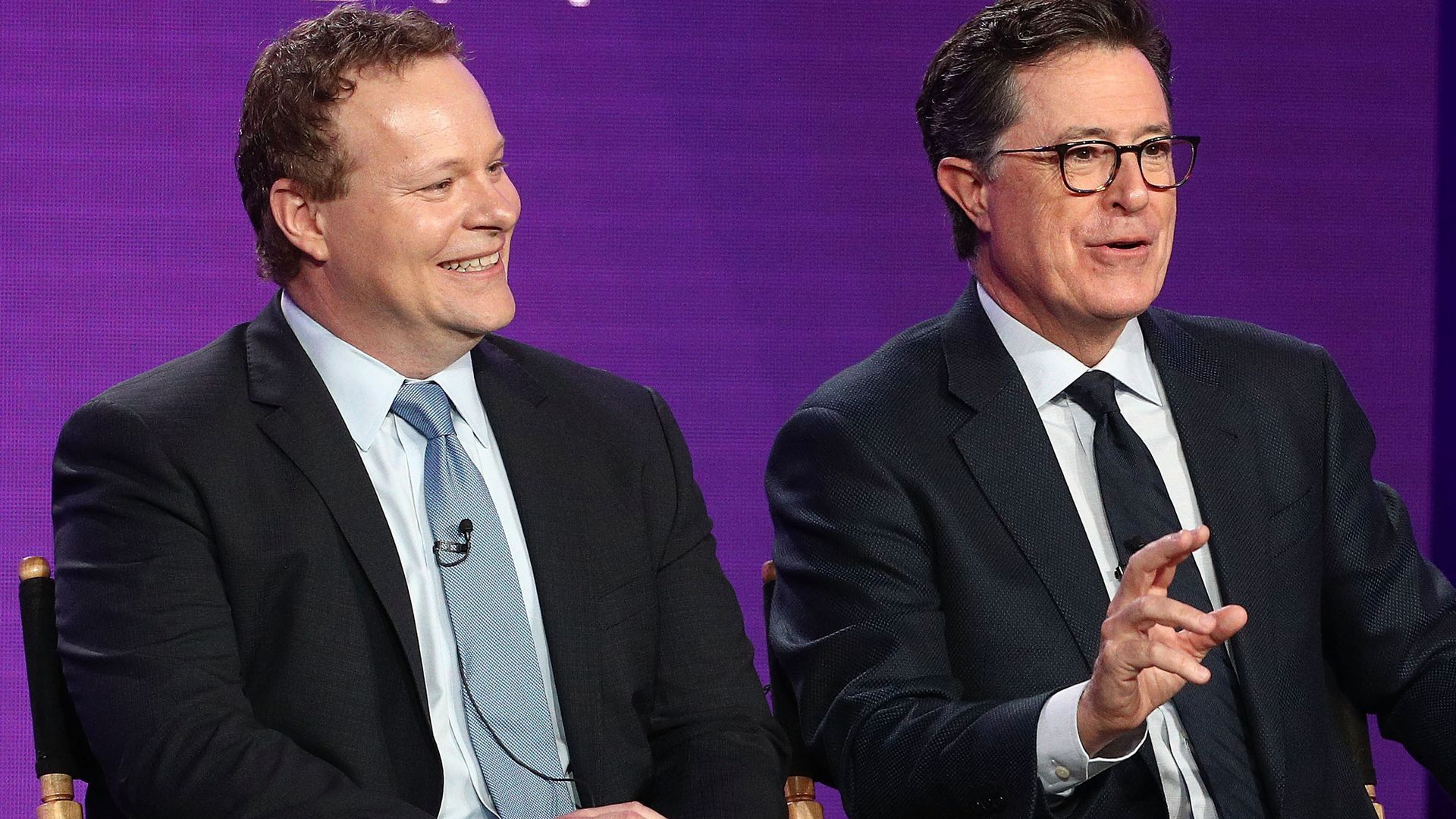
Chris Licht with Stephen Colbert in 2018. Photo: Frederick M. Brown/Getty Images
Under new chief Chris Licht, CNN will dial down the prime-time partisanship and double down on the network's news-gathering muscle, top sources tell Axios' Mike Allen.
Why it matters: Ratings are secondary to credibility, in the view of Warner Bros. Discovery CEO David Zaslav, who's taking over CNN.
Jeff Zucker's successor at the CNN helm will be Licht — showrunner of "The Late Show with Stephen Colbert" and a popular, pioneering news producer who knows his way around America's top control rooms.
- The selection of Licht was reported first by Puck News' Dylan Byers.
What's happening: Zaslav, at the urging of mentor John Malone, is likely to push CNN back to hard news, and away from red-hot liberal opining.
- Taking on a second hallmark of the Zucker regime, the incoming Discovery team has expressed skepticism about the roster size for CNN+, the streaming service Zucker had been stocking with expensive talent.
- Executives have discussed moving HLN, formerly Headline News, under the purview of a current Discovery executive, Kathleen Finch.
7. 1 fun thing: Coming to a city near you ...

Map: Danielle Alberti/Axios
Axios on Monday named Jamie Stockwell, a local news veteran, who most recently served as a deputy national editor at the New York Times, as the executive editor for Axios Local.
- Why it matters: Stockwell will oversee Axios' plan to expand its coverage to 25 local cities by the summer, and 50 by the end of 2023. Eventually, it hopes to be in over 100 cities and every state.
By the numbers: Around 50 people work for Axios Local. Over 400 people work at Axios, up from ~25 at launch in 2016.
- About 1/3 of Axios' editorial staff is local.
Sign up for Axios Media Trends

Sara Fischer’s inside look at the forces reshaping media.