
Axios Media Trends

January 13, 2026

Good afternoon. Today's Media Trends, edited by Christine Wang and copy edited by Sheryl Miller, is 2,364 words, a 9-minute read. Sign up.
🐣 Programming note: This newsletter will be off for the next few weeks, returning in March.
- Axios Media Trends Executive, our paid membership, will continue to publish regularly during that time, with Axios' Kerry Flynn and Christine Wang at the helm. Join here.
🔎 If you read one thing today: How news has changed over 20 years, via Axios' Mike Allen and Jim VandeHei.
1 big thing: 🎥 Micro-drama boom


Micro dramas — short, serialized stories built for binging on mobile — are gaining traction in the U.S.
Why it matters: Hollywood has long chased the zeitgeist around short-form storytelling but struggled with the economics and audience appetite.
By the numbers: The percentage of Netflix, TikTok, Instagram and YouTube users in the U.S. who are also spending time on the most popular micro-drama apps — ReelShort and DramaBox — grew over 2025.
- 📈 About 11% of Netflix app users in the U.S. were also using DramaBox or ReelShort, or both, in December, up from 8% last January, according to new data from Apptopia provided exclusively to Axios.
The big picture: The now-infamous downfall of Quibi cast a shadow over short-form videos. The startup had raised a whopping $1.75 billion, only to shutter shortly after launch.
- 🎭 While Quibi bet on high-production, celebrity-driven shows, today's micro dramas thrive on low-budget, high-volume productions.
- 📱 Viewer habits have since shifted, too, with more people creating and consuming short-form videos across TikTok, Instagram and YouTube.
- 🎬 Micro dramas are also providing jobs to underemployed workers in Hollywood, though the productions are nonunion.
State of play: A new wave of apps is bolstering the market, pursuing strategies pioneered in China that make stories faster and cheaper to produce, easier to discover, and monetizable through ads and micropayments.
- DramaBox, part of Singapore-based StoryMatrix, participated in Disney's accelerator program in 2025 and is now seeking $100 million in funding from U.S. investors at a $500 million valuation, Business Insider reported.
- My Drama's Ukrainian parent company Holywater received an equity stake investment from Fox Entertainment, the companies announced in October.
- GammaTime, led by former Miramax CEO Bill Block, launched in October after raising $14 million from vgames, Pitango, Alexis Ohanian, Kris Jenner, Kim Kardashian and Traverse Ventures.
- ReelShort, backed by Beijing-based COL Group, has led the market for in-app revenue, securing $130 million in the first quarter of 2025, according to SensorTower.
- TelevisaUnivision debuted micro dramas in its Spanish-language streaming platform, ViX, last summer and announced plans to release 100 titles in 2026.
🍫 The intrigue: TikTok is also investing in the micro-drama boom. Last month, it launched a "Minis" section that samples episodes from apps like SnackShort, Stardust TV and HoneyReels.
Follow the money: Micro dramas generated an estimated $3 billion in revenue globally in 2025, excluding China — nearly triple the prior year — with the U.S. as the biggest market at $1.3 billion, according to Owl & Co.
- "That's small next to Netflix or YouTube, but it marks something we've never had before: a functioning market for short form scripted storytelling," said Owl & Co founder Hernan Lopez, who hosted a summit on the format last month.
Go deeper with Media Trends Executive
2. 🧑🧑🧒🧒 Exclusive: The Atlantic adding family subscription

The Atlantic today soft launched a new friends and family subscription plan called Premium Plus, its chief growth officer Megha Garibaldi told Axios.
Zoom in: The new plan, which costs $199 annually, will allow sharing across one paid subscription for up to four accounts.
- 🔐 Each account linked to the plan will have its own login credentials and the ability for personalization.
- 👜 The primary account holder will get access to a few special perks, including a keepsake coffee-table book and a tote bag.
Zoom out: The Atlantic's subscriber growth has been a huge part of the company's path to profitability following a challenging transition for many media companies during the pandemic era.
- 🎉 The company doubled its subscriber base from 700,000 in 2020 to more than 1.4 million by the end of 2025.
- 📰 That figure includes subscribers who access The Atlantic's plan through Apple News, as well as a small sliver of newsstand sales.
- 🗣️ It credits new subscription offerings — such as its subscriber-only feed of narrated articles called The Atlantic Out Loud, and virtual subscriber-only events — for helping to supercharge growth.
The big picture: Taking a page from the streaming world, more news companies are eyeing subscription bundles and sharing plans as a way to maximize subscriber engagement and grow their paid audiences.
- The New York Times, for example, introduced an All Access Family plan in September.
What to watch: It's unclear how The Atlantic will count the number of new subscribers added to its total with the sharing plan. It will follow the guidance of the Alliance for Audited Media to audit its figures.
3. 🎰 Newsrooms' risky bets
Major newsrooms are partnering with prediction market companies, hoping that the deals will boost audience engagement and open a new stream of licensing revenue.
Why it matters: The anonymity of some prediction markets, particularly those backed by crypto, could be easily exploited or mishandled by journalists with exclusive or forward-looking information.
- "There is definitely some risk," said Melinda Roth, a professor at Washington and Lee School of Law with expertise in insider trading, as well as business, sports and corporate finance.
Zoom in: While most newsrooms have explicit policies meant to prevent insider trading, the real-time nature of prediction platforms coupled with the anonymity granted by crypto transactions can make existing rules harder to enforce.
- 🚫 Business journalists, for example, often receive embargoed financial information and many newsrooms already bar reporters from owning individual stocks or require disclosures.
- 🤔 But prediction markets expand the scope and ease of what nonpublic information could be considered tradable.
- 🇻🇪 An anonymous trader recently stood to win $400,000 from betting on Venezuelan leader Nicolás Maduro's exit.
Yes, but: Journalists for decades have obtained exclusive and forward-looking information without compromising their integrity.
- In theory, prediction markets shouldn't change their ethics, but Roth argues there's more that government officials and newsrooms could do to ensure proper oversight as these markets become more mainstream.
🏛️ Between the lines: Rep. Ritchie Torres (D-N.Y.) last week introduced new legislation meant to crack down on insider trading related to prediction markets among government officials and employees, but the bill doesn't cover oversight of private citizens or professionals outside of the government.
- There's also some ambiguity around who should be governing prediction markets.
- The Commodity Futures Trading Commission has the authority to enforce insider trading laws at the federal level. Unlike sportsbooks, which operate under state jurisdictions, prediction market companies argue they should be regulated by the CFTC.
- For now, oversight has mostly been contested in state courts.
🤝 State of play: In recent months, several newsrooms have introduced new partnerships with prediction markets meant to help readers interpret the news cycle, similar to how they've relied on polls for decades.
- Dow Jones and Yahoo Finance inked deals with Polymarket.
- CNN and CNBC both have exclusive deals with Polymarket-rival Kalshi.
- Sports Illustrated and Time both launched prediction market data deals with Galactic last year.
- The Golden Globes and its co-owner Penske Media also inked a major deal with Polymarket to integrate its modules during the show on TV and throughout Penske Media's coverage.
⛹️♂️ Zoom out: Sports newsrooms set the tone for prediction market deals with betting partnerships years before the prediction market craze took hold.
- Companies like Disney's ESPN long approached such deals with caution, fearing betting deals could exploit their brands.
- Now, such partnerships are considered commonplace. But as major betting scandals erupt within the sports world, there's more pressure on news companies to ensure they are handling betting integrations responsibly.
The bottom line: Like polling data, newsrooms need to exercise caution in how they present prediction market results so as not to mislead audiences in a way that manipulates event outcomes.
- "When we say newsrooms should behave responsibly, I think the nuance is that they behave responsibly by indicating very clearly that this is a prediction and not the truth," Roth said.
4. 🥊 Paramount sues WBD, mounts proxy fight


After numerous bid rejections, Paramount Skydance is officially waging a proxy fight against Warner Bros. Discovery's board.
Why it matters: Paramount has refused to increase the price of its offer for WBD, arguing its bid is financially superior to Netflix's. It's now become clear that it believes its best path to winning WBD is through legal pressure.
📝 State of play: Paramount sent a letter to WBD shareholders yesterday saying it intends to nominate directors for WBD's board and that it filed a lawsuit to force the company to disclose "basic information" about the bidding process to enable shareholders to "to make an informed decision as to whether to tender their shares into our offer."
- Paramount argued WBD's board has not been transparent "regarding basic financial matters" throughout the bidding process.
- Specifically, it says WBD "has failed to include any disclosure" about how it valued the stub equity of its cable networks.
- Paramount, in its most recent statement reaffirming its bid, said it now believes those cable networks should be valued at zero, down from the $1 per share it appraised them at in December.
😒 The other side: WBD called the lawsuit "meritless" and a "distraction."
- "Despite six weeks and just as many press releases from Paramount Skydance, it has yet to raise the price or address the numerous and obvious deficiencies of its offer," it said in a statement,
The big picture: WBD has given many reasons why it believes Paramount's bid is worse for shareholders. Paramount is essentially saying those reasons aren't good enough.
- WBD took issue with Paramount's equity backstop financing, until Paramount addressed that concern.
- Last week, it said Paramount's debt financing was risky.
- It continues to maintain that Paramount's $30-per-share offer undervalues its cable networks.
What's next: Paramount says it's committed to seeing its tender offer through.
- But unless it gets more engagement from WBD's board, the company plans to nominate a slate of directors who "will exercise WBD's right under the Netflix Agreement to engage on Paramount's offer and enter into a transaction with Paramount."
- Paramount also says it will propose an amendment to WBD's bylaws "to require WBD shareholder approval for any separation of Global Networks."
- The nomination window for the board of directors opens up in three weeks.

5. 🤖 AI agents come for advertising
The advertising industry is entering a new era of growth fueled by AI agents that can more efficiently buy and sell ads on behalf of human marketers.
Why it matters: The rise of agentic advertising has helped offset economic uncertainty that was initially predicted to slow ad growth in 2025 and 2026.
How it works: Marketers have relied on programmatic, or automated, ad buying and selling for years. But programmatic is still mostly governed by humans who make predetermined decisions on how, when and where ads are optimized.
- With AI agents taking over decisions, there is almost no need for human intervention during transactions. But there will be a much greater need for humans to define the standards and protocols to train agents.
🦾 Driving the news: Major ad giants used last week's CES to showcase new AI and agentic ad tools.
- Yahoo launched new agentic AI capabilities within its demand-side platform, connecting its agents and clients' agents to support campaign activation, troubleshooting and audience discovery.
- Disney announced an AI tool to support media planning, mapping objectives, audience intent, timing and constraints.
- Reddit unveiled an AI-powered media buying tool — Max campaigns — that automates targeting, creative selection, placements and budget allocation along with an AI reporting feature.
Zoom in: Agency holding groups, including Havas, Omnicom, WPP and Stagwell, are also building AI systems to support their workforce and clients.
The big picture: Without clear industry standards and national privacy laws, marketers face uncertainty over how agents use consumer data and transparency of their decision-making.
- 😬 Automation could lead to more fraud, including unintentional mistakes and scams from bad actors.
What to watch: Beyond media planning and ad creation, AI agents are expanding to online shopping.
- 🛍️ Google announced a new open standard for agents yesterday, in partnership with Shopify, Etsy, Wayfair, Target and Walmart, that will power online checkout in AI mode.
Go deeper with Media Trends Executive
6. 📉 Chatbot traffic dilemma


Global news referral traffic from Google Search and Google Discover, a mobile-first article feed within the Google app and Chrome, fell 33% and 21%, respectively, between March 2023 and November 2025, according to a new report from the Reuters Institute, citing Chartbeat data.
🫣 Zoom in: In the U.S., the declines are steeper.
- Traffic from Google Search and Discovery has fallen 38% and 29%, respectively.
Why it matters: Traffic referrals from AI chatbots is nowhere close to offsetting the referral losses from major platforms like Google — as well as Facebook and X, which have both changed their algorithms to rely less on links and more on video.
- "Google delivers 500 times as many referrals as ChatGPT from search alone; 1,300 times as many if you take into account Discover traffic," the report found.
7. 🇮🇷 Trump leans on Musk to address blackout in Iran
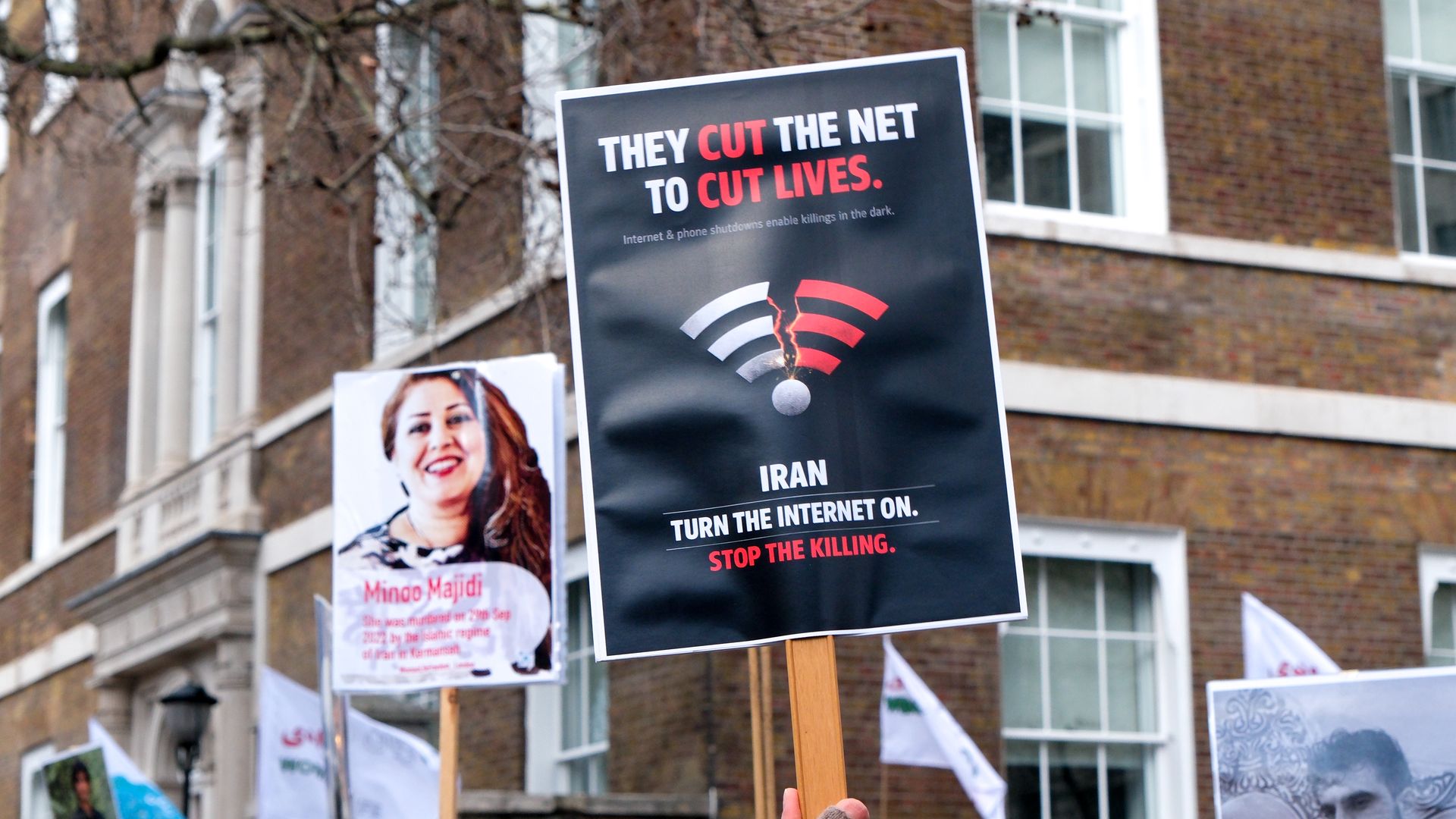
A days-long internet blackout in Iran is putting more pressure on the Trump administration to find ways to support internet freedom as it considers further intervention in the region.
Why it matters: Amid efforts to trim government spending last year, the Trump administration cut funding for programs designed to promote internet access globally.
- Now, as it looks to support Iranian protestors, the administration has signaled interest in supporting internet freedom.
Zoom out: The internet blackout has made it difficult for the outside world to fully assess the scope of major anti-government protests in the region.
- The death toll could be at least 5,000, Axios' Barak Ravid reports.
🛜 State of play: The Iranian government is accused of blocking internet access for 90 million people as a way to quell anti-regime protests.
- White House press secretary Karoline Leavitt said yesterday President Trump had spoken to Elon Musk about using Starlink — which is not authorized in the region — to provide internet access to protesters.
🛰️ What to watch: Reports suggest Iranian officials have started using military-grade GPS jammers to cut Starlink access.
- Experts say most of the information and media coming out of Iran to date during the protests has come from those illegally accessing Starlink connections.
Sign up for Axios Media Trends