Axios Media Trends

November 05, 2024

Today's Media Trends, copy edited by Sheryl Miller, is 1,986 words, a 7½-minute read. Sign up.
🗳️ Happy Election Day: Follow this Axios page for results.
😰 Last-minute nerves: Tech companies are scrambling to get ahead of today's election, after easing content moderation policies over the past few years.
1 big thing: 🎯 Trump's media playbook
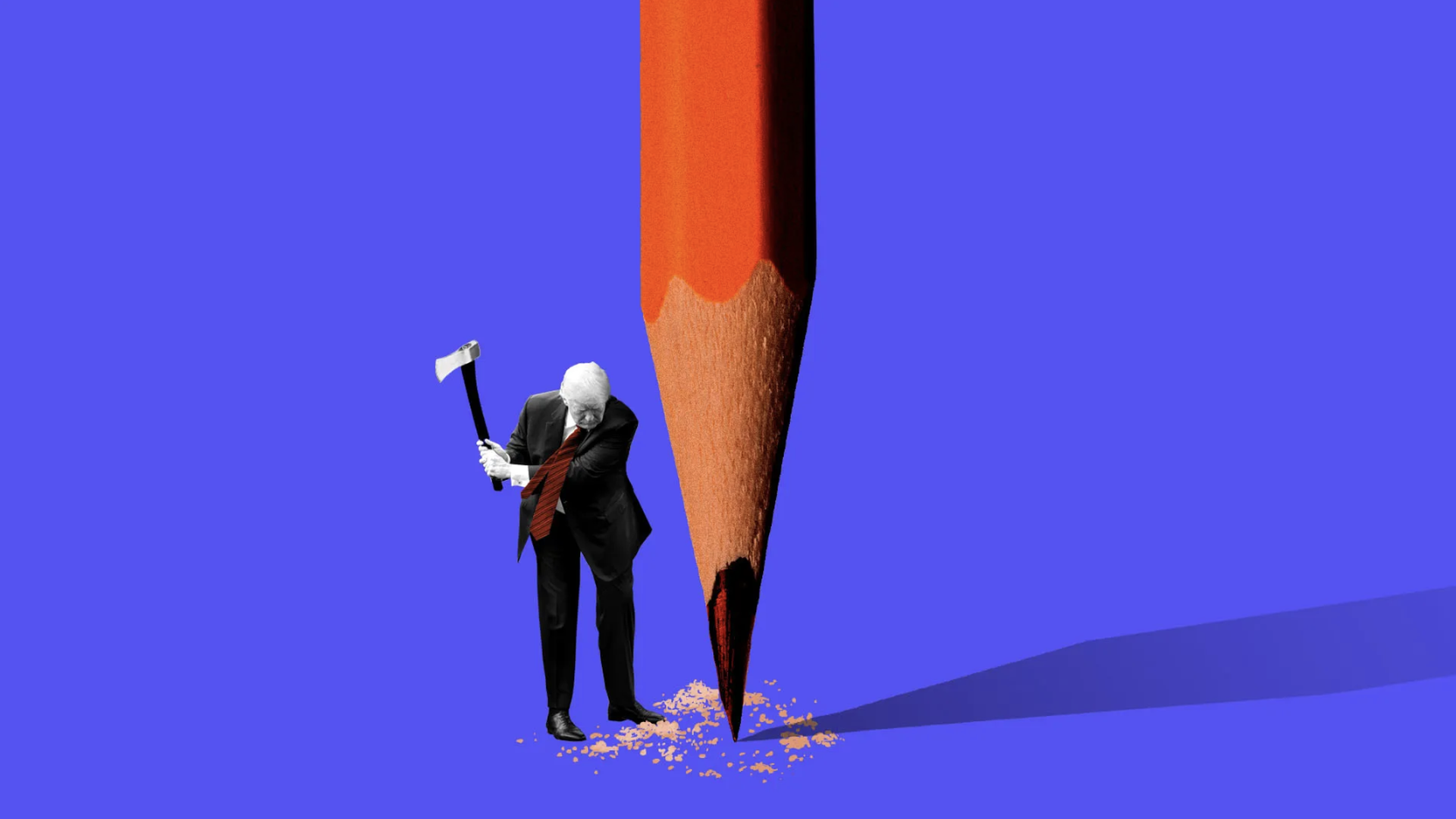
Former President Trump and his allies have vowed to go after the media in a second presidential term, but a strong U.S. legal and regulatory framework means bullying and harassment campaigns would probably be more effective than leveraging presidential powers.
Why it matters: Are there political levers the former president could pull to target media companies he doesn't like? Yes. But harassment campaigns and lawsuits that drain companies of time, money, resources and trust are much easier and can be just as punitive.
- "The regulatory threat is on the edges at most," said Andrew Jay Schwartzman, a veteran communications lawyer.
- "What he can do is make their lives miserable by hassling them," Schwartzman said. "He can do things to make them unhappy, but not anything that is an existential threat."
Case in point: If Trump were to lose his $10 billion lawsuit filed against CBS last week over allegedly doctoring its "60 Minutes" interview with Vice President Harris, the case would still likely cost the network money and time to litigate.
- Trump has suggested regulators should pull CBS' broadcast license, but national broadcast networks aren't licensed, their local affiliates are. Pulling broadcast licenses from local affiliates is an incredibly cumbersome process that experts say is very unlikely.
How it works: Trump could appoint Republican allies to oversee the Federal Communications Commission, but convincing those commissioners to abandon staunch conservative principles around deregulation would be tough.
- The FCC under the first Trump administration, for example, rolled back decades-old media ownership rules. That benefitted large local TV owners and introduced a new wave of local broadcast consolidation.
- Trump's former FCC chair Ajit Pai stood firmly with the First Amendment, even when pressured by Trump to go after NBC in 2017.
Reality check: A conservative FCC could be empowered to advocate for Trump within the boundaries of the law, but bending the law in favor of his efforts to undermine certain outlets is much harder and less likely.
- For example, NBC aired a message from Trump last Sunday after conservative FCC commissioner Brendan Carr criticized the network for not upholding an FCC rule that requires broadcasters to give candidates equal air time.
2. The levers Trump could pull
There are regulatory loopholes Trump could exploit to go after the media, and he has already teased some of those ideas.
- Agency independence. Last year, Trump vowed to bring the independent regulatory agencies, such as the FCC and the FTC, "back under Presidential authority, as the Constitution demands," which could make it harder for those agencies to act independently of the Executive Branch.
- War emergency powers. Former FCC chair Tom Wheeler, who served during the Obama administration, has warned that a war emergency provision within the Communications Act of 1934 could empower the president to suspend or change regulations governing broadcasters and broadband companies for purposes concerning national security or defense.
- Deal scrutiny. Trump has already shown a willingness to go after media companies by pressuring regulatory agencies to apply more scrutiny to certain mergers and acquisitions. He famously encouraged the Justice Department to probe AT&T's acquisition of Time Warner, the parent to CNN.
The big picture: Trump could try to undermine the press through some of those regulatory openings, but the U.S. court system has a strong track record of protecting First Amendment freedoms should a media firm fight back.
- The last Trump administration lost several key legal battles against the media, including pulling press credentials for reporters he doesn't like, blocking people online, and deleting online posts that are considered official presidential records.
- Attempts by the Trump administration last cycle to undermine the government-funded media arm, USAGM, were also checked in court. A Superior Court judge ruled in 2020 that former USAGM CEO Michael Pack acted unlawfully in taking control of a fund that supported internet access.
The bottom line: Trump's most dangerous weapon against the media is his words, which press freedom advocates have warned do have a significant chilling effect both at home and abroad.
- Reporters Without Borders estimates that Trump has escalated his war on the free press leading up to the campaign, verbally attacking the media more than 100 times over the past two months.
3. 🗞️ Newspapers back down

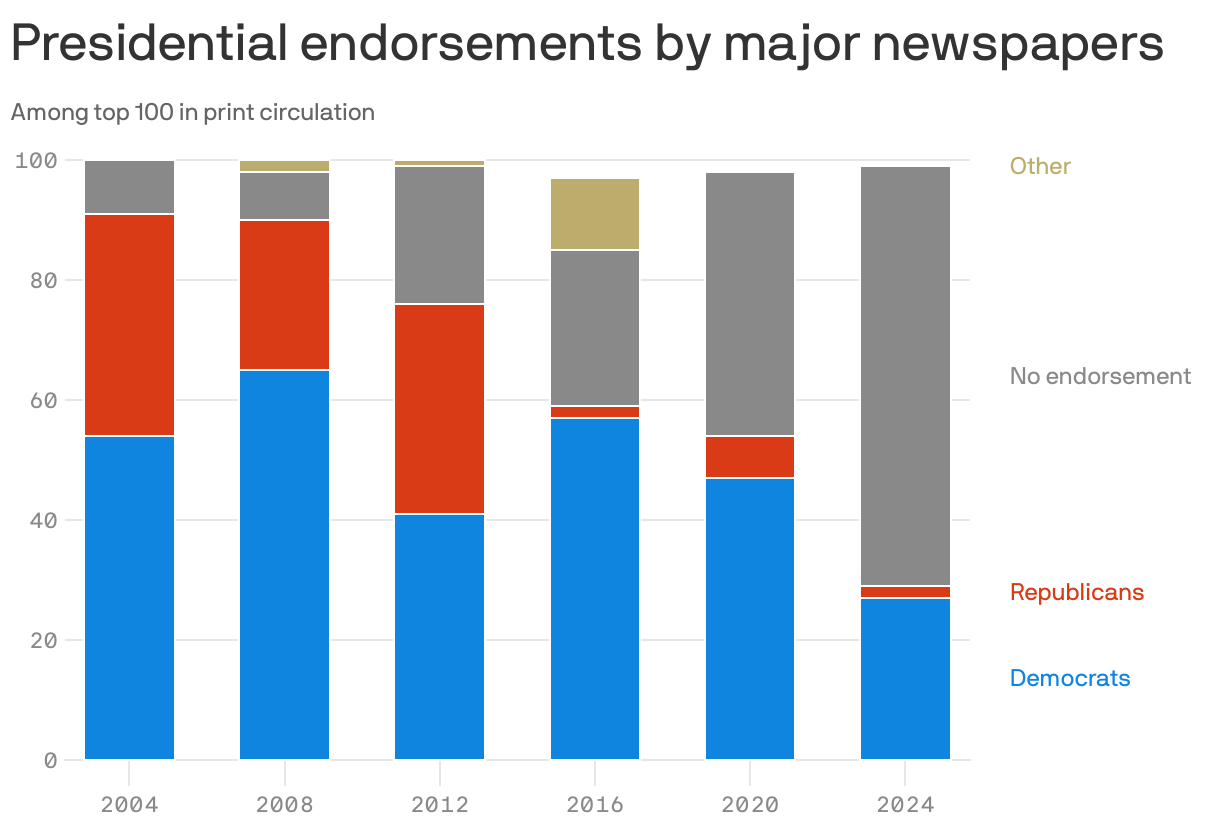
The vast majority of America's largest newspapers aren't endorsing a presidential candidate this year, marking a stark departure from previous election cycles.
By the numbers: The only two endorsements former President Trump received from the top 100 newspapers by print circulation were from the New York Post and the Las Vegas Review-Journal, both owned by Trump allies.
- Trump received seven endorsements last cycle. Some of the papers that endorsed him then, such as the Arkansas Democrat-Gazette and the Boston Herald, didn't publish endorsements for president this year.
Between the lines: Many U.S. newspapers that used to be independent or family owned now belong to large newspaper groups whose owners — often hedge funds or private equity groups — have decided to pull the plug on endorsements, fearing backlash and political retribution.
What to watch: The social media era has placed a heavier premium on celebrity endorsements that can reach millions of people online. Joe Rogan officially endorsed Donald Trump last night.
4. Dems outspend GOP
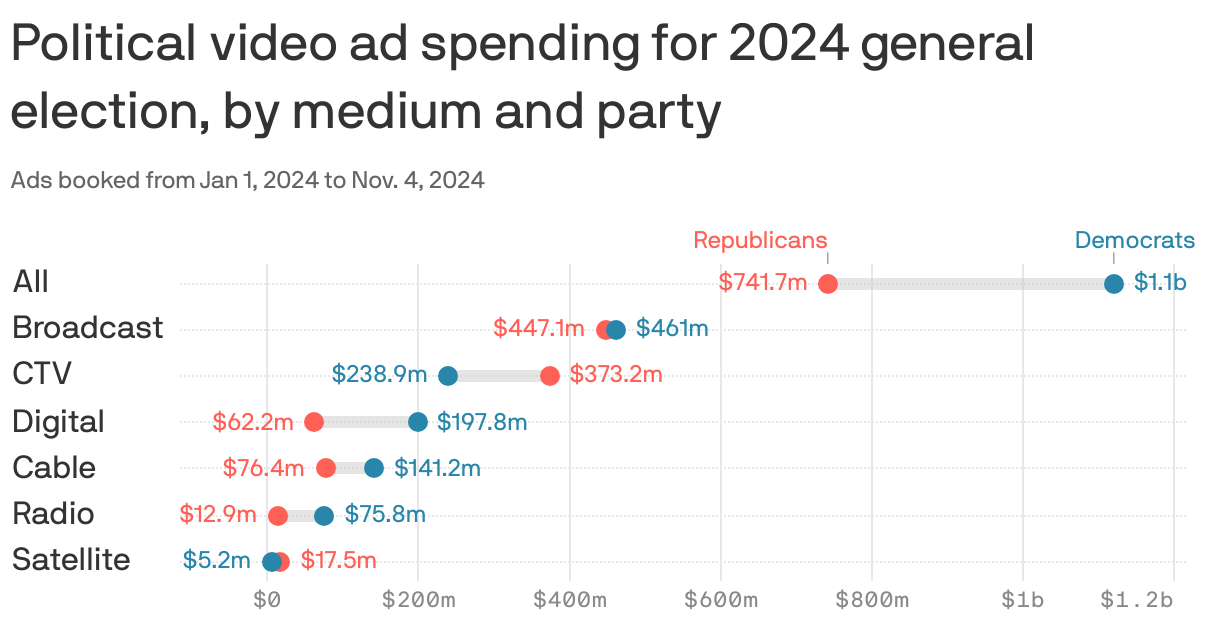
Vice President Harris' campaign and outside groups supporting her election bid have outspent Republicans by 48% this year on video advertising, which makes up the bulk of campaign ad spend.
By the numbers: Spending for the presidential general election is projected to grow 17% this cycle to $2.1 billion, per AdImpact.
- Seven key states — Pennsylvania, Arizona, Georgia, Michigan, North Carolina, Nevada and Wisconsin — are expected to make up the vast majority (76%) of all presidential general spending.
- Florida is projected to fall to eighth place this cycle, down from first in 2020.
- The only area Republicans have outspent Democrats in the general election is on CTV, or streaming, and satellite TV.
Zoom out: Including down-ballot elections for Congress and local races, Democrats roughly doubled their national ad spending advantage against Republicans during the last month or so of the campaign.
The big picture: Overall, AdImpact projects that the 2023-2024 election cycle will total $10.2 billion in political video ad spending.
- Estimates from GroupM, which include advertising outside of video such as out-of-home ads, direct mail, print placements and more, project all political and issue ad spending in the U.S. this cycle will reach over $17 billion, easily a historic spending record.
5. 🚨 NYT Election Day strike
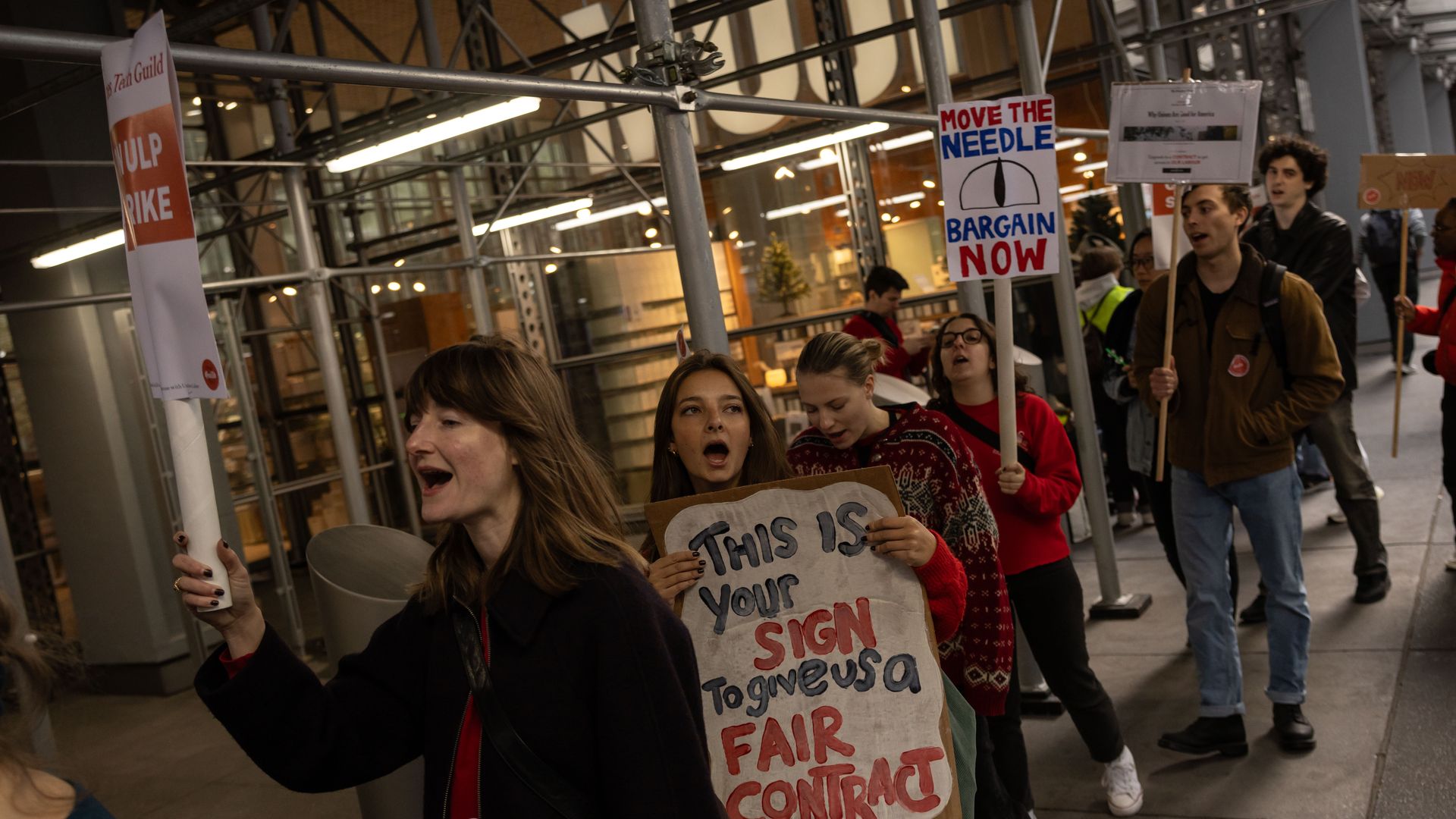
Hundreds of members of the New York Times Tech Guild walked off the job this morning in protest of stalled contract negotiations and alleged unfair labor practices by the Times' management.
The big picture: The strike marks the first strike by a union represented by the NewsGuild-CWA to coincide with a presidential election in 60 years.
- The Tech Guild represents roughly 600 workers across engineering, product, tech and design roles.
Why it matters: Striking workers help power editorial products critical for election coverage, including mobile push alerts, app and website maintenance, and the Times' real-time election result infographics.
- The Times has already warned that the strike could impact its ability to publish a live version of its infamous Election Day needle.
What they're saying: "The Tech Guild leadership's intent to strike is misguided and unproductive," Times executives told staffers in a note Sunday.
- "Let us be clear: A strike will not bring us closer to a deal or result in a better contract. It will only lead to lost wages for those who choose to participate."
Zoom out: Union organizers at the tech guild are looking to set a precedent for other tech unions via contract negotiations with the Times.
- That effort has pushed the guild to fight for more protections in its contract beyond wages, including remote work rights and unique just cause protections.
6. New data: AI firms need media more than they admit
Leading AI companies such as OpenAI, Google and Meta rely more on content from premium publishers to train their large language models (LLMs) than they publicly admit, according to new research from executives at Ziff Davis, one of the largest publicly traded digital media companies.
Why it matters: While AI firms generally do not say exactly what data they use for training, executives from Ziff Davis say their analysis of publicly available datasets makes it clear that AI firms rely disproportionately on commercial publishers of news and media websites to train their LLMs.
- The paper finds that for some LLMs, content from a set of 15 premium publishers made up more than 10% of the datasets used for training.
- It also indicates that a few public datasets used to train older LLMs that disproportionately relied on premium publisher content are still being used today to train newer models.
Zoom out: Unlike most of its biggest publishing competitors, such as Dotdash Meredith and Condé Nast, Ziff Davis has yet to strike a big data licensing or content sharing deal with a major AI firm.
The big picture: Most news companies that are making deals with AI firms aren't focusing on data training deals anymore, since they tend to be one-time windfalls.
- Instead, they are cutting longer-term deals to provide news content for generative AI-powered chatbots to answer real-time queries about current events.
7. Digital ad market booms for Big Tech
The world's biggest digital advertising companies saw significant sales growth last quarter, driving momentum for the U.S. stock market ahead of the 2024 election and foreshadowing a lucrative holiday season.
The big picture: After years of pandemic-driven volatility, the global ad market is finally starting to stabilize this year.
Zoom in: Investments in generative AI ad products, an influx of political ad dollars tied to the U.S. election, and healthy consumer spending drove strong revenue and profit growth for the world's biggest tech giants last quarter.
- Google's advertising revenue jumped more than 10% year over year, thanks in part to election-related ad spend, especially on YouTube.
- Meta sales increased by 19% year over year, while profits ballooned 35% in the same period.
- Snap Inc.'s revenue grew 15% year over year, thanks to AI and AR ad product investments.
- Reddit's advertising income grew 55% year over year, helping to drive its first-ever profitable quarter.
- Roku earned more than $1 billion in revenue last quarter for the first time, thanks to strong growth (16% year over year) in its platform business, which includes advertising.
Yes, but: Some ad categories continue to face pressure, which could have an outsized impact on some companies.
- Retail: Meta said revenue growth in the Asia-Pacific region slowed significantly last quarter, due to the deceleration of ad spend from major Chinese advertisers, such as Temu and Shein.
- Health: Roku said health and wellness verticals continue to face pressure.
- Media: Broadly, media companies that spent big on ads promoting their streaming services over the past few years have pulled back on marketing to boost profits.
What to watch: Ad growth isn't expected to benefit traditional media companies this earnings season the way it has for Big Tech, except for local U.S. broadcasters and some cable news channels, which are seeing political advertising windfalls.
8. 📺 Comcast cuts its own cord
Comcast has hired a bank to evaluate breaking out NBCUniversal's cable networks into a separate, publicly traded company.
Why it matters: The move could give it more flexibility to focus on scaling its streaming service, Peacock, which still isn't profitable.
- A possible spinoff wouldn't include NBC, the broadcast network.
- NBCU's suite of cable networks includes MSNBC, CNBC, Oxygen, Bravo, USA Network and others.
Of note: Comcast declined the opportunity earlier this year to explore a merger with rival Paramount.
- Comcast president Mike Cavanagh implied during an earnings call Thursday that the company would rather consider partnerships in streaming, "despite their complexities."
The big picture: Comcast's TV peers like Disney and Warner Bros. Discovery have similarly weighed separating or divesting their linear assets from their portfolios. None have actually made the move.
- Cable television — while facing heavy viewership declines due to cord-cutting — is still mostly very profitable. Despite investor angst around the declining medium, those profits are critical for streaming investments.
Sign up for Axios Media Trends