Axios Media Trends

November 12, 2024

Today's Media Trends, copy edited by Sheryl Miller, is 1,809 words, a 7-minute read. Sign up.
Situational awareness: 📲 Meta is offering EU users a new option to use its apps with less personalized advertising as a concession to regulators.
- 🥊 The New York Times Tech Guild ended its Election Week strike without a contract, frustrating newsroom staffers whose work was impacted.
- 💼 Disney is considering outsiders to replace Bob Iger as CEO.
1 big thing: MAGA media mapped
The media power brokers in the new Trump administration are different and in some ways more powerful than those during the first Trump presidency.
- They are younger, more visual, less established in Washington, and lean more toward MAGA conservative principles over traditional Republican ideals.
Why it matters: Americans' rejection of soft liberalism at the polls was also a rebuke of the media forces that powered it.
- While Trump appeared regularly on Fox News in the run-up to the general election, his lack of investment in most traditional TV and print outlets didn't hurt his campaign.
The big picture: Up until this point, much of the MAGA media machine has thrived without corporate America's blessing, relying on direct subscription dollars from mega-fans and direct response advertisers that sell lifestyle goods and services, such as coffee, gold, debt services and supplements.
- But a historic election shift right could push institutional investors and corporate advertisers to reconsider MAGA media's reach.
What to watch: If they don't, Republicans — who will soon control the White House, Senate and, likely, the House of Representatives — will ramp up their pressure campaign.
- Conservatives on Capitol Hill have already held a hearing on ad industry bias and published a report over the summer arguing marketers have engaged in a yearslong effort to collude against conservative media.
- The ad industry's longtime brand safety coalition, GARM, disbanded this summer following a lawsuit from Elon Musk's X.
2. ✅ Who's in
💉 1. RFK Jr. influencers: One of the biggest shifts that propelled the second Trump campaign online was the adoption of RFK Jr.'s social media following.
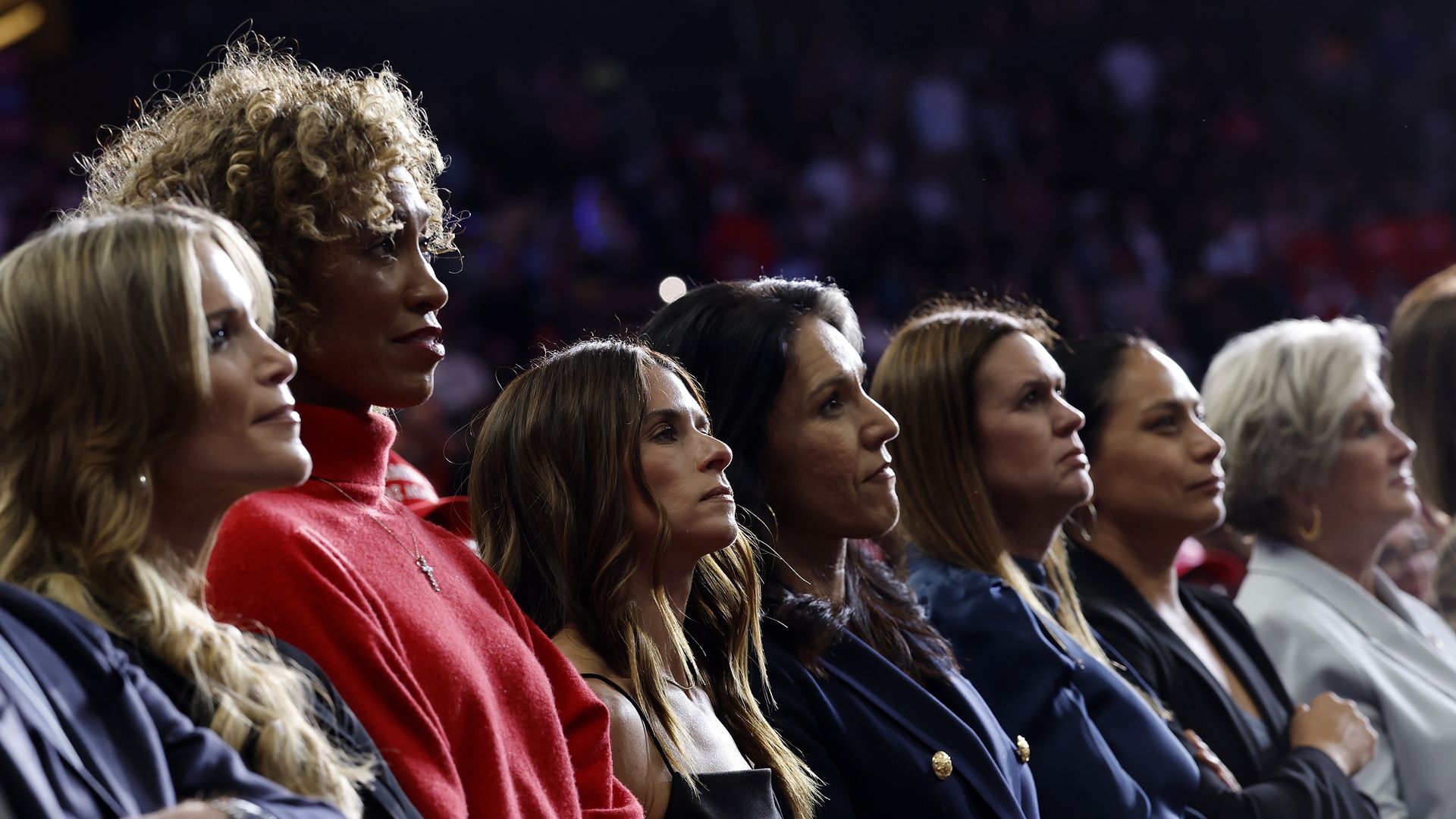
- RFK Jr.'s anti-Big Pharma worldview attracted a crop of female celebrities and influencers that turned to MAGA politics after RFK Jr. backed Trump, including fitness personality Jillian Michaels, former ESPN host Sage Steele, former race car driver Danica Patrick and former Democrat-turned-Republican Tulsi Gabbard.
- In embracing some of RFK Jr.'s health positions, such as vaccine skepticism, the Trump campaign was able to tap into an audience of women and mothers concerned about health.
📣 2. The outrage gurus: While the Harris campaign spent millions to promote their message through paid online influencers, the Trump team relied on the megaphones of personalities with large online followings like Charlie Kirk and Jack Posobiec to help amplify Trump's message organically, especially on X.
🎙️ 3. Independent podcasters and streamers: Tucker Carlson, Megyn Kelly, Steve Bannon and other independent voices with video podcasts and streaming platforms are poised for growth in a second Trump administration, said Howard Polskin, founder of TheRighting, a newsletter that tracks right-wing media.
- Kelly is "poised to make a major leap forward as a more influential podcast," Polskin said. With a consistently growing audience and subscription base, she has become "the most influential right-wing female podcaster out there."
- Bannon, in an interview with Axios, said his "War Room" podcast and streaming shows are now supported by nearly 30 employees. He plans to double down on "War Room" town halls and continue to stream his show on Real America's Voice, a conservative cable network.
💬 4. Elon Musk and free speech techies: X continues to be the dominant social discourse app in America, despite efforts from new entrants like Threads to Truth Social, according to data from Similarweb.
- Substack recently raised money from a broad range of strategic investors, including conservative media backer Omeed Malik. Conservative streamer Rumble said it set records on Election Day.
🍿 5. Conservative entertainers: "Art of the Surge," a docuseries inside the Trump campaign produced by Carlson's media company, was the top show for purchase on Apple TV last weekend.
- The Daily Wire's feature "Am I Racist?" was the highest-grossing documentary at the U.S. box office in the past six years.
- Fox Nation, the subscription streaming service from Fox News, plans to release a new Kevin Costner show in the first quarter of 2025. Fox Nation recently announced a deal with Martin Scorsese to bring a faith-based series to the service this fall.
🦊 6. The New York Post and Fox News: The Post was one of two newspapers in the top 100 by circulation in the U.S. that endorsed Trump this year. It was one of the only print outlets to land an interview with the former president this cycle.
- Trump's love-hate relationship with Fox News didn't stop him from making nearly 20 appearances on the network between August and the November election. Cable is still important to the 78-year-old.
- Before Trump launched Truth Social, many of his email and website links were to fringe right-wing blogs and sites. Today, Trump relies mostly on link-outs from his website and Truth Social to the NY Post and Fox News, per an analysis from Polskin.
What to watch: While Trump leaned into podcast hosts with massive young male followings during the election, such as Joe Rogan and Theo Von, those personalities aren't expected to join the MAGA pack.
- Their commitment will continue to be to disaffected young men broadly who hate establishment media, not just MAGA believers
3. ❌ Who's out
💻 1. Fringe websites: Outlets that saw traffic surges during the first Trump administration, such as Breitbart, Gateway Pundit and Infowars, have seen significant traffic declines following the decline of news distribution on Facebook. (Infowars has struggled amid legal problems and bankruptcy.)
- "Newsmax is the only one that's been consistently up since February compared to four years ago," Polskin said, noting the network is "poised to be much stronger and influential." Newsmax has said that it plans to go public this year or in 2025.
💻 2. Republican radio: A slew of conservative radio hosts, such as Dana Loesch, Erick Erickson and Mark Levin, who have tried to fill the void left by the late Rush Limbaugh don't have the same access and viral prowess as the new-age MAGA podcasters.
- While radio is still the top medium in America in terms of weekly reach, the new MAGA media powerhouses mostly aren't radio personalities.
🚨 3. Drudge Report: Once the biggest distributor of news traffic on the internet, Drudge Report has seen its internet traffic decline significantly. (Drudge famously turned on Trump after 2016.)
- Citizen Free Press, a similarly formatted conservative news distribution blog, is gaining steam, Bannon said.
📱4. Conservative X rivals: Conservative social media sites that gained traction following the Jan. 6 Capitol siege have struggled to break through amid competition from X and Truth Social.
- Usage of apps like Gab, Gettr and Parler pale in comparison to X, as does the usage of most social discourse platforms, like Bluesky, Mastodon and Threads.
4. Scoop: Substack quietly raises more cash


Newsletter platform Substack has quietly raised around $10 million from a broad range of strategic investors, including Omeed Malik and Nate Silver, a source tells Axios.
Why it matters: Substack has more than 3 million paid subscriptions, but it's not profitable.
- Substack's original value proposition of empowering writers to connect directly with their audiences has attracted a diverse set of writers, but its "free speech" commitment has sometimes ruffled feathers.
- In January, for example, the company agreed to remove some publications that expressed support for Nazis.
- Nonetheless, it's continued to attract new writers, despite taking a larger cut than do rival platforms like Ghost and beehiiv.
Catch up quick: Substack had raised more than $80 million prior to the most recent funding round, including Series A and Series B rounds led by Andreessen Horowitz. The Series B was at a $650 million valuation.
- It tried to raise a series C round in 2022, but pivoted instead to cutting costs.
- Substack then opened up an oversubscribed community investment round in 2023 to raise money from its writers.
- Substack has spent the last year focused mostly on product development. The platform now supports video, podcasts and paywalled chats.
Zoom in: Participants in the new $10 million round include Malik, whose investment fund 1789 Capital also backed Tucker Carlson's new media venture, alongside Substack writer Silver, Rocket Money CEO Haroon Mokhtarzada, Zynga founder Mark Pincus, and AngelList co-founder Naval Ravikant.
- "We had inbound interest from strategic people, so we made space for them," said a spokesperson, who added that Substack wanted backers that represented a diverse set of views.
- The spokesperson confirmed the investment, but declined to comment on the $10 million total.
5. Musk wins the attention war
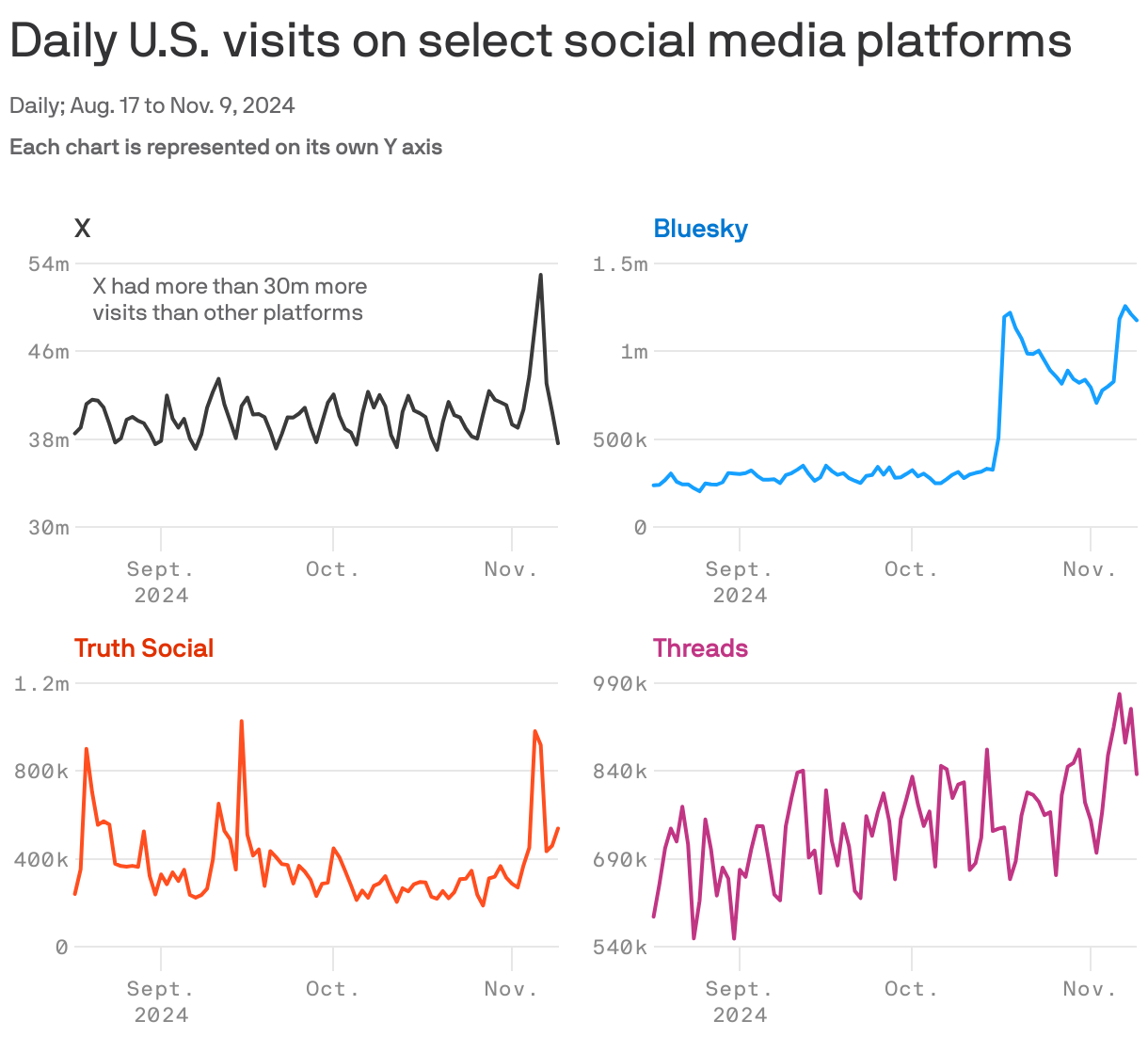
Elon Musk's X platform continues to be the dominant social discourse app in America, garnering 30 times more daily visits in the U.S. on average during the general election than rival platforms, according to data from Similarweb.
- X also saw a larger usage bump on Election Day than its rivals.
Why it matters: The relationship between Musk and Trump is growing closer by the day, Axios' Mike Allen and Jim VandeHei report.
- Trump has already begun to leverage Musk's authority on the platform to successfully amplify his demand for Senate Republicans to allow recess appointments for his Cabinet picks.
What to watch: Trump's publicly traded social media platform Truth Social is currently valued at over $6 billion, but still barely makes money.
- It's unclear how Trump plans to leverage the platform as president, but his posts typically garner more interactions on X.
6. Mainstream media's new reality

In the new Trump era, mainstream news organizations are not only struggling with access, but they're facing significant business headwinds and a historic trust deficit.
Why it matters: The first Trump administration propelled legacy media businesses to new heights with record traffic and subscription gains. But changes to the media ecosystem over the past few years have made it harder for news outlets to sustain that engagement.
- 📉 Social media traffic has plummeted on Facebook. Search traffic is being upended by generative AI platforms. News fatigue persists following record engagement during the pandemic.
🥊 State of play: Some news outlets are leaning even heavier into resistance coverage — a business move that proved effective in 2016.
- Slate said daily subscription sign-ups were seven times higher the day after the election compared to normal.
- The Guardian raised $2.4 million in two days after the Los Angeles Times and the Washington Post pulled their Vice President Harris endorsements last minute.
⚠️ Meanwhile, other news companies are playing it safe. The vast majority of America's largest newspapers by circulation didn't endorse a presidential candidate this year, marking a stark departure from previous election cycles.
- CNN's election night ratings fell to MSNBC for the first time this year amid a broader pivot to more centric coverage.
The big picture: A broader trend of news fatigue following the first Trump administration and the COVID era suggests the resistance bump that fueled media organizations in the past may not be as strong going forward.
- MSNBC and CNN ratings fell in the days following the election, while Fox News' grew.
- While the New York Times' business continues to flourish, subscription growth last quarter slowed.
Go deeper: The old media grapples with its new limits via Semafor's Max Tani and David Weigel
Sign up for Axios Media Trends