Axios Media Trends

October 22, 2024

Today's Media Trends, copy edited by Sheryl Miller, is 1,931 words, a 7½-minute read. Sign up.
🗓️ Today at 2:30pm in NYC: I'll be interviewing Dude Perfect co-founder Coby Cotton and its new CEO Andrew Yaffe, as well as Washington Spirit owner Michele Kang at Dan Primack's annual Axios BFD conference. Watch here.
Situational awareness: Disney will name Bob Iger's replacement in early 2026, it said yesterday. It announced ex-Morgan Stanley CEO James Gorman, who has been overseeing the board's succession planning committee, as its new board chair starting in 2025.
1 big thing: 🎯 Exclusive... Microsoft, OpenAI go local

OpenAI and its minority owner Microsoft are funding a $10 million AI collaborative and fellowship program operated by the Lenfest Institute, a nonprofit that supports local journalism.
Why it matters: The partnership represents the largest local news development collaborative working on AI specifically, per Jim Friedlich, executive director and CEO of the Lenfest Institute.
Zoom in: The deal will fund an AI collaborative and fellowship program for five U.S. metro news organizations to start, including Chicago Public Media, the Minnesota Star Tribune, Long Island Newsday, the Philadelphia Inquirer, and the Seattle Times.
By the numbers: OpenAI and Microsoft will equally contribute $5 million in grant funding to power the project and $5 million in enterprise credits for selected newsrooms to experiment with generative AI projects that can bolster local news.
- Each outlet will receive $500,000 in grant money to cover the cost of hiring a two-year AI fellow to work on projects that focus on driving sustainable businesses for local news. (Three more newsrooms will be awarded fellows in a second round of grants in the coming months.)
- The outlets can use OpenAI and Microsoft Azure credits they receive as part of the project to experiment and develop tools for local newsrooms.
Between the lines: The deal only includes funding of the collaborative and AI fellows. It does not include any sort of licensing terms or real-time data exchanges to train and serve large language models at OpenAI and Microsoft.
What to watch: OpenAI has taken the lead among the major AI companies in striking licensing deals with news outlets, but Microsoft recently said it would pay news outlets for content surfaced by its AI Copilot assistant.
- Microsoft is funding the project through its Democracy Forward initiative, with engineering resources and software support coming from the office of its CTO.
2. 🤖 Exclusive: TollBit raises $24M
TollBit, a two-sided marketplace for media publishers and AI companies, has raised a $24 million series A round led by Lightspeed Venture Partners, executives told Axios.
Why it matters: TollBit hopes its marketplace can reduce the legal and business friction that's made data-sharing between the media industry and AI firms tense and complicated.
- The marketplace allows publishers to monitor AI bot traffic and monetize when it scrapes their verified content.
Zoom in: The new round will help TollBit hire more people and expand internationally, co-founder Toshit Panigrahi told Axios.
- S32, a venture firm, also participated in the new round, alongside investments from Google AI lead Jeff Dean and Roblox product chief Manuel Bronstein.
- The Series A round follows a $7 million seed round in March, bringing the startup's total funding to $31 million. No valuation was publicly disclosed during either funding period.
State of play: The new funding round coincides with the official launch of TollBit's marketplace out of beta.
- TollBit also said Tuesday that it has struck deals with its first set of publishing partners, including Penske Media Corporation, Time, Mumsnet, Trusted Media Brands, Candr Media Group and AdWeek.
- Fittingly, the first piece of content to be licensed out using TollBit as a platform was Time's 100 Most Powerful People in AI list, Panigrahi said.
The big picture: OpenAI, Microsoft, Perplexity and other AI firms are brokering licensing deals with publishers where they pay upfront for the right to use a publisher's content.
- Panigrahi believes a marketplace solution is more sustainable and scalable because it allows AI companies to pay a fair market value for access to the content they need, rather than try to negotiate hundreds of subjective deals with many different publishers simultaneously.
What to watch: On Monday, the Wall Street Journal and New York Post parent News Corp. sued generative AI search engine Perplexity for copyright infringement. The New York Times sent a cease and desist letter to Perplexity last week.
3. Scoop: Spotify launching an ad exchange


Spotify is piloting an ad exchange, or a supply-side platform (SSP), to help scale its automated ad offerings, three sources familiar with the effort told Axios.
- The focus will be on video to start.
Why it matters: Those improvements will help the Swedish audio giant compete against bigger platforms like Meta and Google for ad dollars from small and medium-sized businesses.
Zoom in: The new exchange, internally called Spotify Ad Exchange or SAX, can be plugged into various demand-side platforms (DSPs) to help connect advertisers directly to their inventory.
- Spotify's first DSP partner is The Trade Desk, one of the largest publicly traded ad tech companies in the world. It hopes to broker similar deals with other ad tech firms in the coming months to expand its automated offerings further.
Between the lines: The partnership, for now, is focused on connecting The Trade Desk's North American advertising clients to Spotify's video ad inventory. Audio ad inventory will soon follow.
- Spotify will become one of the largest audio publishers to use OpenPath, a technology from The Trade Desk that connects inventory from its most premium publishers to advertisers faster.
- As part of the partnership, Spotify will also join Universal ID 2.0, a cookie-less ad-targeting framework that was incubated by The Trade Desk years ago amid the deprecation of third-party internet tracking cookies.
The big picture: The Spotify Ad Exchange will be Spotify's first major foray into scaling its automated ad business.
- To date, most of Spotify's programmatic, or automated, ad solutions have only been accessible via programmatic direct, or a method of buying automated ads through Spotify's sales team and not through an ad auction.
What to watch: Spotify's annual ad revenue is expected to exceed $2 billion this year.
4. Kamala's media blitz
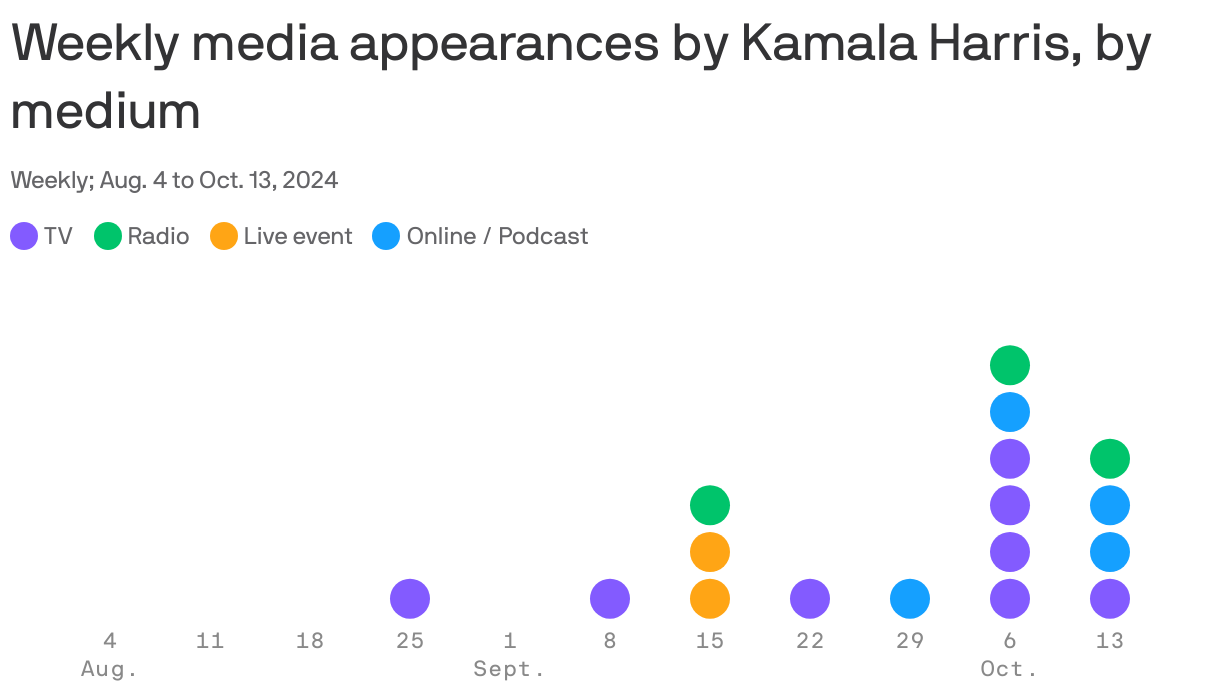
Vice President Kamala Harris has aggressively ramped up her media appearances in the past few weeks in an attempt to reach undecided voters, although polling suggests her efforts haven't moved the needle significantly.
Why it matters: Compared to Trump, Harris has made a larger point to participate in hard-hitting interviews with major TV networks across the aisle.
- In fact, most of Harris' interviews have been with major broadcast or cable TV news outlets, not podcasts, which tend to get a lot of attention.
What we're watching: Harris will continue her media blitz this week, with an interview today with Hallie Jackson for NBC Nightly News and a Wednesday town hall with CNN in Pennsylvania moderated by Anderson Cooper.
5. Scoop: NewsGuild files labor claim against NYT

The NewsGuild of New York has filed an unfair labor practice charge with the National Labor Relations Board against the New York Times, claiming management violated the National Labor Relations Act by interrogating employees about their strike sentiments within the past six months.
Why it matters: The complaint adds to growing tensions between the unions the NewsGuild represents and the Times' management as the Tech Guild threatens to strike, possibly around the election.
Catch up quick: The New York Times Tech Guild, which represents more than 600 staffers across engineering, product and tech, voted to unionize in March 2022. Contract negotiations with management began in July 2022.
- Last month, guild workers authorized a strike to protest stalled contract negotiations with the Times' management.
Of note: The guild has been ramping up support from its colleagues in other Times unions.
- On Monday, nearly 750 Times journalists who are part of a separate Times union signed a pledge of support for the Tech Guild.
- On Tuesday, leaders from the union representing the Times' consumer reviews site Wirecutter sent a letter to the Times' management also pledging support to the Tech Guild workers.
State of play: The complaint, according to a copy seen by Axios, alleges the Times violated section 8(a) of the National Labor Relations Act that prohibits employers from interfering with, restraining or coercing employees in the exercise of their union rights.
- The NewsGuild claims, according to a spokesperson, that at least 20 Tech Guild members have been pulled into one-on-one interrogation meetings with their managers over the past few weeks to ask if they supported a strike.
- Those managers, the spokesperson said, were asked to tell employees that if they chose to work during the strike, they would be connected with HR for a sign-up form to keep working in a discrete fashion, the spokesperson added.
6. Scoop: Morning Brew rebrand
Morning Brew, the decade-old newsletter company, is rebranding its corporate name to Morning Brew Inc., a reflection of its growth outside of its core daily email newsletter and most popular product, Morning Brew.
Why it matters: The rebrand further distinguishes Morning Brew's consumer brands from its professional brands, which today drive $25 million in annual revenue for the company, according to an internal note from CEO and co-founder Austin Rief.
- Subscribers to the outlet's seven professional newsletters have doubled since 2022, he noted. (Axios reported in 2022 that it surpassed 1 million subscribers to its B2B newsletters.)
Zoom out: It also reflects the company's push to diversify away from email newsletters as its sole source of income and audience engagement.
- Today, Rief says, Morning Brew's multimedia products are on pace to do "well over" $10 million in top-line revenue for 2025.
- Over 60% of Morning Brew's engagement with its audience happens on platforms other than email, per Rief's note.
Catch up quick: Morning Brew launched in 2015 as a single email newsletter catered to business-minded millennials.
- It is owned by German media giant Axel Springer, which also owns Business Insider. Business Insider bought a majority stake in Morning Brew in 2018.
What to watch: Rief expects revenue from Morning Brew Inc.'s B2B division to surpass the revenue from the company's flagship daily newsletter for the first time next year.
7. G/O shrinks
G/O Media has agreed to sell Jalopnik, a news and opinion site about car culture, to Static Media as it continues to shed its portfolio, according to people familiar with the matter.
- Indianapolis-based Static Media manages a portfolio of digital sites across categories, including auto, food, travel and health. It acquired food site The Takeout from G/O Media back in March. Private equity firm Novacap acquired Static in 2023.
Why it matters: The brand was one of the few remaining sites in the digital media company's dwindling portfolio, owned by private equity firm Great Hill Partners.
- Back in March, CEO Jim Spanfeller said in a staff memo that the company was undergoing an "extensive review of our portfolio."
- At that time, Static Media agreed to acquire The Takeout. Paste Media, which previously bought Jezebel and Splinter, acquired The A.V. Club.
- The Onion sold to Global Tetrahedron, a new firm backed by former Twilio CEO Jeff Lawson. Ziff Davis acquired Lifehacker. G/O Media sold Deadspin to Lineup Publishing and Gizmodo to Keleops.
What we're watching: G/O Media's remaining brands are Kotaku, Quartz, The Root and The Inventory.
- Share this story ... Sign up for Axios Pro Media Deals authored by Kerry Flynn and Tim Baysinger.
8. 📺 1 fun thing: Hope for Hollywood

Netflix on Thursday said it added more subscribers than expected, thanks to a 35% growth in membership to its ad-supported tier quarter over quarter between July and September.
Why it matters: Netflix's earnings report typically serves as a bellwether for the rest of the streaming industry. Rivals are also trying to ramp up their ad-supported offerings to become more profitable.
The big picture: Hollywood's momentum has been stalled thanks to the previous year's dual writers and actors strikes that delayed production and content schedules.
- The Los Angeles film and TV production industry plummeted last quarter.
- But Netflix said Thursday that it expects production to return to normal levels next year, providing a glimmer of hope for the rest of the industry, which will report earnings over the next few weeks.
Go deeper. Netflix's movie strategy, via Bloomberg.
Sign up for Axios Media Trends