Axios Media Trends

May 05, 2026

Good afternoon from Los Angeles. Today's Media Trends, edited by Christine Wang and copy edited by Sheryl Miller, is 2,184 words, an 8-minute read. Sign up.
๐ Situational awareness: The 2026 Pulitzer Prize winners were announced Monday, with more than one-third of the prizes being awarded to local news outlets. List of journalism winners.
- Double win: Hannah Natanson, the reporter whose home and devices were searched by the FBI in January, was part of the Washington Post team that won a Pulitzer for Public Service. On Monday, a federal judge ruled that the Justice Department cannot search the seized devices, affirming an earlier decision that any review must be conducted by the court.
1 big thing: ๐ Ad market shrugs at chaos
Even with rising inflation, uncertainty around the war in Iran and surging oil prices, advertising-based companies continue to forecast strong growth, thanks to broad optimism in the markets fueled by AI.
- ๐ค Kate Scott-Dawkins, WPP Media global president of business intelligence, said she expects to increase projected ad growth for the year, as technology-driven tailwinds are currently "proving to be the more dominant factor in the data" than macroeconomic risks.
State of play: For now, forecasters aren't baking macroeconomic chaos โ including possible constraints on the supply chain โ into their projections, but that could change if the Strait of Hormuz remains blocked.


How it works: Advertising tends to grow at roughly the same rate as nominal GDP, because revenue drives marketing expenditure.
- The only real exception to that in recent memory was the 2008 financial crisis and the COVID-19 pandemic.
- As long as macroeconomic forecasts remain high, so will ad optimism.
- "It's no different than the stock market," said Rich Greenfield, partner and analyst at LightShed Partners. "AI excitement is trumping (pun intended) everything else."
Yes, but: Some experts warn that optimism could be short-lived, given the uncertainty around the war and the Trump administration's economic policies, including tariffs.
- "Depending on how far out one is looking, I would characterize someone expressing positivity as 'willfully optimistic,'" said ad industry analyst and Madison and Wall CEO Brian Wieser.
- While the ad market remains resilient, Wieser argues the low double-digit growth we're seeing now "is not sustainable" and "current economic policies have negative consequences for the industry," including supply chain risks.
๐ด Zoom out: Axios asked more than a dozen advertising executives last week at Possible, an annual marketing conference in Miami, why the industry continues to project optimism despite anticipated headwinds. Here's what we heard:
- Fickle economic policies: "I think one of the things that has to be built into every model is that this administration will change its mind," said The Trade Desk CEO Jeff Green, referencing volatile tariff policies.
- Supply chain lag: "The longer this drags on, I do think the more severe the consequences are going to be for the broader economy," said Sean Buckley, president of revenue and market strategy at Magnite.
- Businesses are compartmentalizing: "We're able to separate geopolitical issues and still know what we need to do to drive sales and marketing, and sell goods and services," 3C Ventures CEO Michael Kassan said.
๐ป The big picture: Some ad executives suggested analysts are scared of being too bearish because they overestimated the impact of tariffs on the economy last year.
- Others say companies are worried about pegging weak forecasts to the Iran war out of fear they'll get dinged by the president.
The bottom line: Optimism is a winning strategy, for now.
2. ๐ James Murdoch circles Vox assets
Vox Media is in late discussions with James Murdoch's investment firm, Lupa Systems, to sell its podcast network and part of its publishing business, a source confirmed to Axios.
๐งฉ Why it matters: Vox Media has been eyeing opportunities for months to sell its business in pieces, with the hope of reaping greater shareholder value than trying to sell it as a whole.
- Axios reported in November that its board had discussed possibly spinning out the podcast network after receiving active interest from strategic and financial sponsors.
- Vox Media's largest shareholder, Penske Media Corporation, was possibly interested in the company's digital publishing assets, Axios reported at the time.
- Versant, the cable spinout from Comcast/NBCUniversal, was reportedly eyeing the podcast network.
๐๏ธ State of play: Lupa Systems is interested in buying Vox Media's podcast network as well as New York Magazine and the publishing assets associated with it, such as Grub Street, Intelligencer, The Cut and Vulture, a source confirmed to Axios.
- Vox Media acquired New York Magazine and its publishing assets in 2019. It also owns its own digital publishing brands, such as The Verge, Eater and SB Nation.
- The Wall Street Journal was the first to report on the Lupa Systems discussions.
- Vox Media did not comment.
Zoom out: Murdoch founded Lupa Systems after stepping down as CEO of 21st Century Fox. He later resigned from the board of News Corp., citing disagreements with the editorial content published by the company, which is home to the Wall Street Journal and other publications.
- Over the past few years, Lupa Systems has invested in a few media brands and experiential companies, such as Tribeca Enterprises and Vice Media.
- Vox Media's podcast network could serve as a marketing and distribution channel for some of Murdoch's experiential investments.
The big picture: Vox Media is the latest in a string of big publishing brands that have tried to narrow their focus.
- G/O Media sold off virtually all of its websites over the past few years, including The Root, Jezebel, Quartz and Kotaku.
- BuzzFeed sold Complex and First We Feast.
3. ๐คย OpenAI ads open for biz
OpenAI has launched a self-serve advertising platform, executives said, marking a significant step in its goal of generating $2.5 billion in ad revenue this year and $100 billion by 2030.
Why it matters: The new platform makes it easier for a broader set of advertisers to buy ads on ChatGPT.
- That's especially true for smaller businesses that can't afford to outsource their ad-buying capabilities to big agencies.
Zoom in: A beta version of the new Ads Manager tool is beginning to roll out to advertisers in the U.S., OpenAI's head of monetization Asad Awan told reporters Monday.
- Businesses can register as advertisers on the platform to launch and manage their campaigns in real time through ChatGPT.
How it works: Advertisers can create ads through the tool directly or through agency partners such as Dentsu, Omnicom, Publicis and WPP.
- The Ads Manager will also be available to several ad tech companies, such as Adobe, Criteo, Kargo, Pacvue and StackAdapt.
- With the new platform, OpenAI also announced new measurement tools to make it easier for advertisers to analyze and optimize their campaigns.
Between the lines: OpenAI has been piloting the new Ads Manager product for months, but it's now expanding it after improving its capacities.
- During the pilot phase, advertisers could only buy ads on a cost-per-impression basis.
- Now, they can buy ads on a cost-per-click basis, allowing them to align their investments with a more direct performance indicator.
- Advertisers previously were required to spend at least $50,000 to test campaigns in the platform. Now that threshold is being removed, per Awan.
๐ธ Zoom out: AI companies are leaning into advertising as rising infrastructure costs demand more revenue diversification.
- Firms like OpenAI will rely on ads to keep their consumer products affordable and widely accessible.
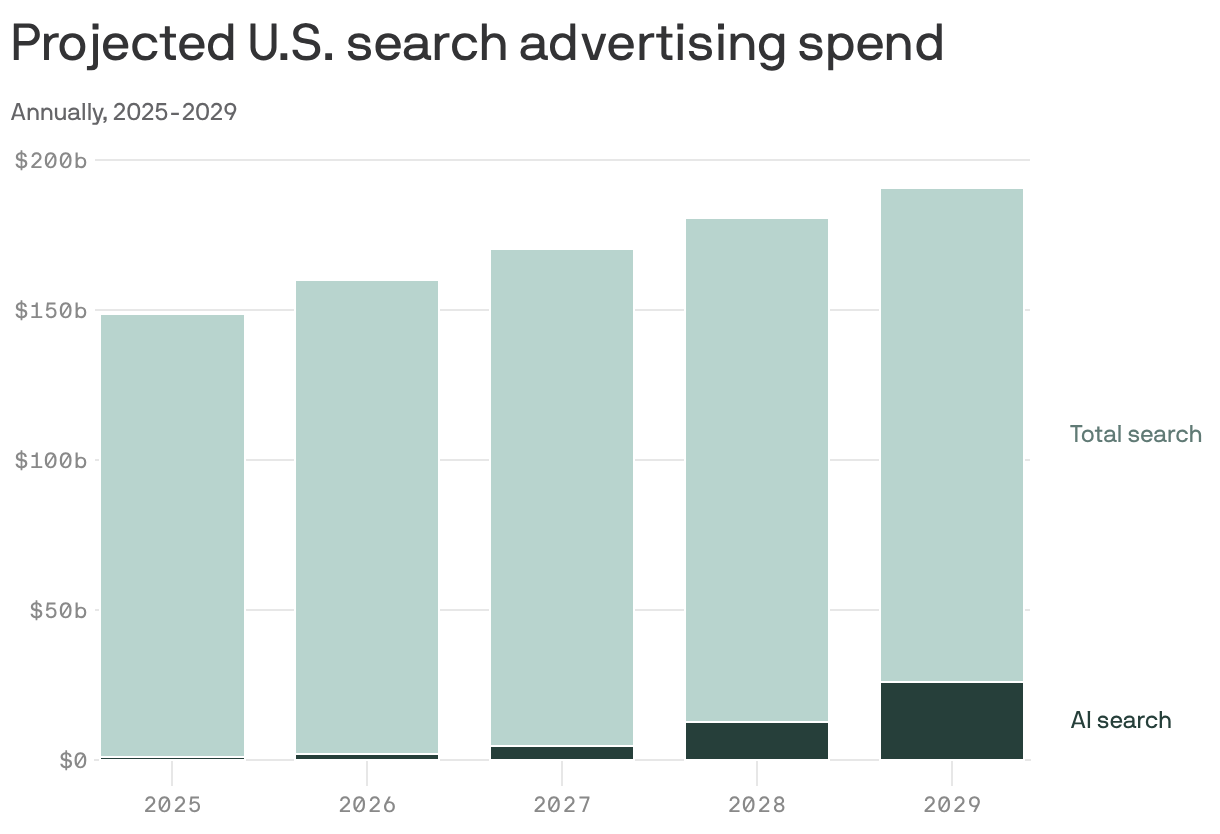
๐ Yes, but: AI search advertising is still relatively nascent, and it isn't expected to overcome traditional search advertising anytime soon.
- U.S. AI search ad spend is expected to grow from 0.7% of all search ad revenue to 13.6% in 2029, per eMarketer.
๐ฆพ Reality check: A lot of that growth is expected to come from OpenAI, as well as traditional search companies like Microsoft and Google, which are investing in AI-powered search experiences.
- A Reuters report in March suggested OpenAI banked over $100 million in revenue for its U.S. ad pilot after just six weeks.
The big picture: In order for the ad marketplace to grow meaningfully in the agentic era, AI platforms need to convince advertisers and users that their ad marketplaces will remain unbiased.
- Awan told reporters that ads "do not influence the core organic model" of ChatGPT and that the company holds a high bar on user privacy.
4. ๐ค Scoop: Netflix taps Nielsen as it hunts for hits

Netflix has inked a new expansive deal with Nielsen to license data that shows how well content is performing across the entire streaming landscape, not just on Netflix properties, Axios has learned.
Why it matters: Most major streamers have licensed Nielsen's Streaming Content Ratings for years, but Netflix has held out, opting instead to rely mostly on its own data to make strategic decisions.
โฎ๏ธ Flashback: Nielsen became the first third-party measurement provider for streaming program viewership when it introduced SCR in 2017.
- At the time, Netflix famously said the data "is not accurate, not even close, and does not reflect the viewing of these shows on Netflix."
Today, the landscape is quite different.
- Nielsen has introduced Big Data to its panel, modernizing the way it measures streaming. Netflix now faces much steeper competition.
๐ Zoom in: The new multiyear deal will give Netflix access to a full-market view of the top streaming shows, movies and events in the U.S.
- The data goes beyond traditional viewership and provides more context for specific titles, such as genre performance and audience composition.
Context: Nielsen's SCR data is what's used to power the measurement giant's weekly Streaming Top 10 rankings.
- Netflix has referenced how well it performs in that ranking in its pitch to advertisers and investors.
What to watch: The new deal sheds light on Netflix's programming strategy now that it's removed itself from the Warner Bros. Discovery bidding war.
- SCR ratings are often used by streamers to inform licensing decisions, as well as product and advertising moves.
5. ๐ฃ Tabloid takeover
TMZ's push into D.C. reporting is the latest move by a tabloid to expand into serious reporting with real-world impact.
Why it matters: As politics and entertainment blend, so too has journalism and gossip.
๐ธ TMZ's photos of lawmakers on vacation during a government shutdown quickly went viral last month.
- The tabloid also played a key role in the Nancy Guthrie disappearance earlier this year, publishing ransom notes it claimed were connected to the case.
The Daily Mail, which brought FBI director Kash Patel as its guest to the White House Correspondents' Dinner last month, broke the story about Kristi Noem's husband's secret online life.
- It also broke a huge story last year about an affair between Rep. Tony Gonzales and an aide, which led to his resignation from Congress last month.
The New York Post's Page Six team published photographs showing New England Patriots coach Mike Vrabel and The Athletic reporter Dianna Russini at a hotel together in Arizona.
- Those photos eventually led to an investigation of Russini's work at The Athletic and, ultimately, her resignation.
๐ Zoom out: Most major U.S. print tabloids have seen their audiences age in the digital era. As a result, several titles have sold for a fraction of their former values.
- Not all of those deals have panned out. Gawker was suspended by its parent BDG following financial struggles that plagued the outlet since it relaunched in 2021.
- The legal drama around The National Enquirer's "catch and kill" scandal during the first Trump administration showed the risks tabloids face accepting payments for killing stories.
Yes, but: The success of The Daily Mail, TMZ, the New York Post and others proves tabloids can still be relevant, if the proper owners invest.
6. ๐ BookTok takes Hollywood
Nearly half of the original drama series that premiered on Netflix, Disney+ and Amazon Prime Video from January 2024 to June 2025 were book adaptations, according to a March report by the Publishers Association.
- Among the top 50 highest-grossing films from 2020 to 2024, adaptations earned 57% more at the box office than non-adaptations.
๐คณ Why it matters: The BookTok community โ ravenous readers who share reviews of their latest reads โ is reshaping the streaming wars.
๐ฌ State of play: Production studios are tuning in to influential creators and built-in fanbases, placing their bets on book adaptations to win viewers.
- Production houses don't really "have to spend any money marketing these shows, because TikTok is going to do it for them," said Hannah Griffiths, head of adaptations at independent production house Banijay.
๐ฐ The intrigue: Built-in fan bases can translate into major payouts. While studios rarely disclose deal prices, leaks show popular titles can command multimillion-dollar deals.
- After an intense bidding war, Amazon MGM snapped up the movie rights to "The Last Letter," a novel by romantasy heavyweight Rebecca Yarros, for a reported $2 million in 2025.
- And more than 50 million BookTok-recommended books were sold in European book markets in 2025, bringing in more than โฌ800 million in revenue, per data from NielsenIQ BookData.
๐ Worth noting: Most adaptations so far have focused on contemporary romance, even as romantasy โ a fast-growing genre that blends romance and fantasy โ gains popularity.
- Fantasy concepts require more movie magic to bring them to life, and the biggest titles have yet to premiere.
Sign up for Axios Media Trends