Axios Media Trends

August 06, 2024

✏️ Today's Media Trends, copy edited by Sheryl Miller, is 2,156 words, an 8-minute read. Sign up.
⚖️ Situational awareness: Google violated federal antitrust laws to maintain a monopoly in the online search market, a federal judge ruled Monday. The ruling will have major implications as we enter the AI-driven search era.
- Meanwhile, a slew of new media cuts were announced today.
1 big thing: Exclusive... Media giants strike new AI deals
The Financial Times, Axel Springer, The Atlantic, Fortune and Universal Music Group agreed to license their content to ProRata.ai, a generative AI startup that claims it can accurately attribute and share revenues with content owners from AI chatbot subscriptions on a per-user basis.
Why it matters: Media partners hope ProRata.ai's business model will pave the way for a new AI economy that honors the value of premium content.
How it works: ProRata.ai is building its own, yet-to-be-named subscription AI chatbot that it plans to debut this fall.
- It plans to evenly split revenues from subscriptions to the forthcoming chatbot search engine with its content licensing partners.
- It aims to strike deals with a wide array of premium content owners, including publishers, authors, music labels, poets, artists and more, to feed its large language model that will power its chatbot.
- In addition to the publishing partners announced today, the firm has also struck deals with individual authors such as Adam Grant, Seth Godin and Tony Robbins, tech entrepreneur Bill Gross, who will serve as CEO, told Axios in an interview.
Zoom in: Half of ProRata.ai's monthly subscription revenue from its search chatbot app upon launch will be divided among all of its media partners, Gross said.
- ProRata.ai will use an already-patented algorithm to attribute every individual output from its chatbot to a content owner's work.
- The attribution algorithm considers a unique set of qualifications, such as the novelty of a claim or fact made in a report.
- Content partners are compensated based on the percentage of outputs attributed to their work.
The big picture: Gross eventually plans to license ProRata.ai's large language model to bigger AI firms, such as OpenAI or Anthropic, that don't currently have a system to attribute the contribution of a particular content owner to its bottom line.
- ProRata.ai could also license the technology to third-party marketplaces, such as Tollbit, that can use that attribution to help broker deals between AI companies and content publishers.
2. Scoop: X sues major brands, ad industry group for antitrust
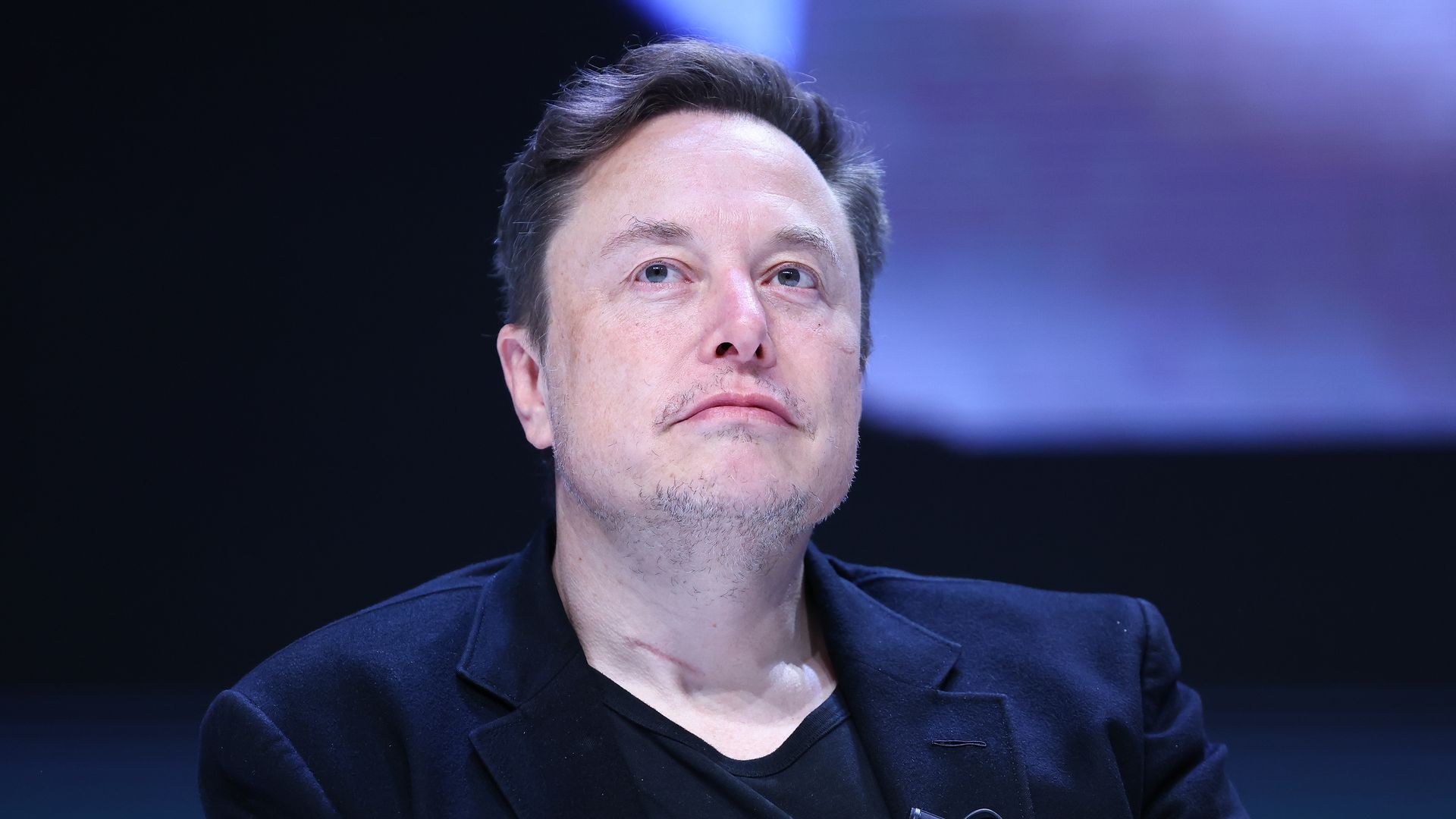
X filed a federal antitrust lawsuit today against an advertising industry coalition and its members — including CVS Health, Mars, Orsted and Unilever — alleging the group abused its influence over marketers and ad agencies to discriminate unfairly against X, prompting an ad boycott.
Why it matters: The lawsuit is part of a broader effort by conservative lawmakers and media companies to go after GARM, the Global Alliance for Responsible Media.
- GARM was created by members of the World Federation of Advertisers (WFA) in 2019 to set standards around brand safety for digital advertisers. Members include major tech companies, advertisers, agencies, ad tech firms and advertising coalitions.
- Last month, conservatives on Capitol Hill held a hearing to address complaints from conservative media firms, mainly the Daily Wire, that GARM was colluding with ad-buying giant GroupM to discourage clients from buying ads on their sites because of conservative politics.
State of play: Rumble said today that it would join X in its lawsuit against WFA, GARM's parent, but added that it would also be suing WPP and its subsidiary GroupM. WPP is one of the world's largest ad agencies.
Zoom in: The lawsuit, which was filed in the U.S. District Court for the Northern District of Texas, argues GARM "conspired, along with dozens of non-defendant co-conspirators, to collectively withhold billions of dollars in advertising revenue from Twitter, Inc. ("Twitter," now X Corp.)."
- A copy of the lawsuit obtained by Axios alleges GARM triggered "a massive advertiser boycott" when it conveyed to its members concerns about compliance from Twitter, now X, with its standards, after Musk acquired the platform in 2022.
By the numbers: X's advertising business has taken a significant hit since Musk purchased it in 2022.
- The company is expecting to earn roughly $2 billion in advertising revenue this year, a source told Axios.
- That's down from the $4.5 billion in ad revenue that the company earned in 2021, the last full year that X, formerly Twitter, was publicly traded.
The big picture: The lawsuit is part of a broader effort by X to litigate its way through advertising challenges.
- X last year sued the progressive watchdog group Media Matters for defamation. That lawsuit has been scheduled for trial next year.
- X also sued the consumer advocacy group Center for Countering Digital Hate, but a judge tossed that case.
3. Red Ventures offloads CNET to Ziff Davis
Red Ventures, the digital media and marketing juggernaut based in Fort Mill, South Carolina, is selling tech news and reviews site CNET to Ziff Davis, the publicly traded digital marketing behemoth, in a deal valued at over $100 million, sources confirmed to Axios.
Why it matters: It's a stunning turn of events for CNET, which bought Ziff Davis — then a tech magazine firm — and its online services company ZDNet, in deal worth roughly $1.6 billion more than two decades ago.
Zoom out: Ziff Davis today trades publicly with a market value of $1.94 billion and is one of the few healthy digital media and services conglomerates that trades publicly in the U.S.
Ziff Davis CEO Vivek Shah told Axios he believes in content businesses, despite market fears around AI and the ad market shifts.
- "I think in the end, content and context do matter to advertisers," he said. Offering premium content at scale for advertisers "is a great value proposition and business," he added.
By the numbers: Red Ventures acquired CNET, along with a few smaller websites, from ViacomCBS, now Paramount Global, in 2020 for $500 million.
- Axios reported in January that Red Ventures was trying to offload the asset for around $250 million. Sources Axios spoke with who were approached about the deal noted that the valuation was far too high for what they would be willing to pay.
- A source confirmed that the Ziff Davis deal is valued at over $100 million.
The big picture: Red Ventures' business model never made sense for CNET and the timing was off.
- Red Ventures took on debt to fund the deal, and it hoped to grow CNET's business by integrating it into the revenue engine that it uses to fuel its other assets, including Bankrate, The Points Guy, and more.
- But CNET made most of its money from direct sales, not affiliate commerce, and the integration didn't work.
What to watch: Ziff Davis appears poised to continue its deal streak.
- "I think of this as buyers' market," Shah said. With a solid balance sheet, the firm has "lot of dry powder to do a lot of deals."
- Last year, Ziff Davis acquired Lifehacker, a website that focuses on tips and tricks for living a better life, from G/O Media.
4. Dems outspending GOP nearly 2x on pres race
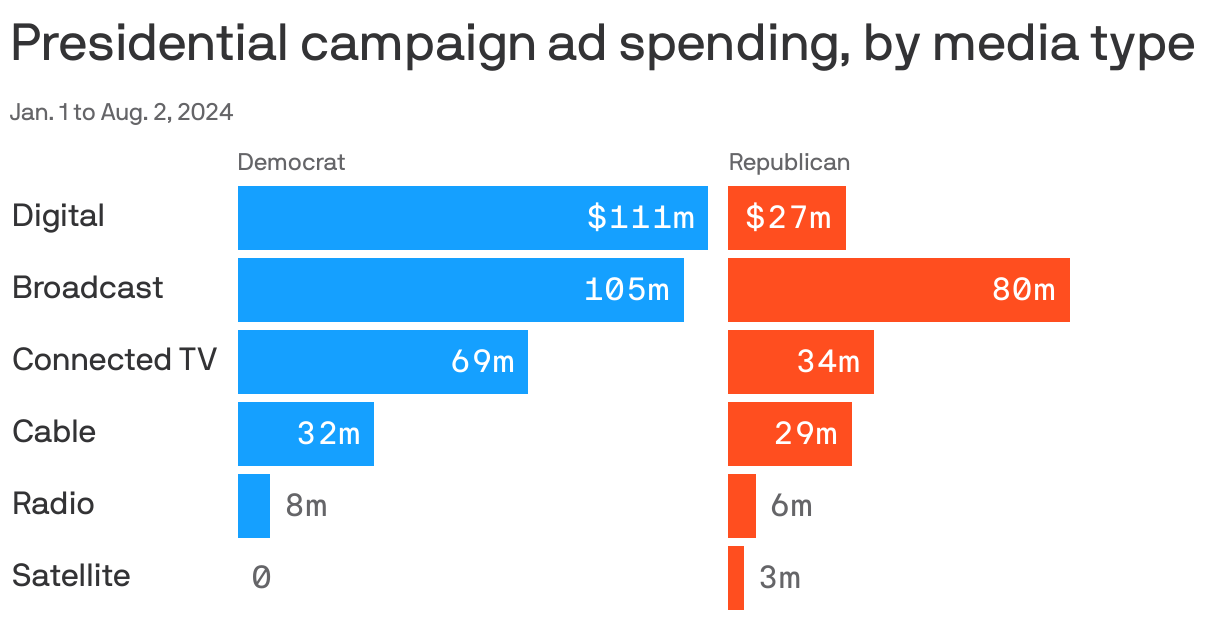
Democrats have poured nearly twice as much cash into political ads this cycle ($325 million) compared to Republicans ($181 million), according to the latest projections from AdImpact, a political advertising analysis firm.
Why it matters: Democrats' fundraising lead faced pressure amid party division over President Biden's viability as the party's nominee. But Vice President Kamala Harris' rapid rise and subsequent momentum suggest the party could maintain its advertising edge heading into the general election.
By the numbers: Democrats so far have spent the bulk of its advertising dollars on digital properties, such as Google and Facebook.
- That's notable given that campaigns have historically poured most of their dollars into local broadcasts.
- TV ads, which tend to be longer and viewed on a big screen, are good for persuading voters. Digital ads are typically used for fundraising and list-building, but they help candidates target certain populations, such as younger or minority voters.
Zoom in: Both campaigns are spending record amounts on CTV advertising, or streaming. While not all streaming platforms accept political ads, those that do offer campaigns the opportunity to target TV-like ads to narrower groups of people based on their interests.
The big picture: The political ad market is expected to reach record spend levels this year.
- Total spending on the presidential election alone is expected to reach $10.69 billion, a 19% growth rate over the 2019-2020 presidential cycle, per AdImpact.
- All political advertising, including issue ads and down-ballot campaign ads, is expected to surpass more than $16 billion this year, per GroupM.
5. Elusive hedge fund backs away from tabloid roots

Accelerate360, the parent of the National Enquirer and celebrity magazines like Us Weekly, is quietly planting seeds for a loud expansion.
Why it matters: The pending deals are backed by Chatham Asset Management, a secretive hedge fund with links to Donald Trump.
- The deals suggest that Chatham is trying to move away from its tabloid era following its involvement in the "catch and kill" scandal.
Driving the news: On Friday afternoon, accelerate360 announced plans to merge with local newspaper chain McClatchy — also owned by Chatham.
- McClatchy CEO and chair Tony Hunter is expected to serve as CEO of the combined company.
- The firm plans to divide the new enterprise into three divisions, separating the local news divisions from its celebrity titles and its distribution arm, Hunter told McClatchy.
- Back-office layoffs are likely following the merger.
- Hunter told McClatchy that the merger frees up cash to allow the business to pursue more acquisitions.
Catch up quick: McClatchy operates 30 newsrooms, including the Kansas City Star, the Sacramento Bee and the Fort Worth Star-Telegram. Chatham acquired McClatchy in 2020 through a bankruptcy auction.
- Accelerate360 is a sales, distribution and logistics company. American Media, the parent company to the National Inquirer, merged with accelerate360 in 2020 and launched the media arm as a360media.
The intrigue: McClatchy executives said its tabloid publications would be excluded from the merger of McClatchy and accelerate360.
- David Pecker, former National Enquirer publisher who consults for the company, also would not be associated.
- Accelerate360 has tried and failed numerous times to sell the National Enquirer, following its involvement in the "catch and kill" scandal linked to Donald Trump's hush money payments.
- a360media's website does not mention any of its tabloids, which also includes Star, National Examiner and Globe. It does tout its celebrity titles like Us Weekly and InTouch and special interest brands like Denise Austin's Fit Over 50.
What we're watching: a360media recently announced plans to expand Us Weekly's print product and grow new video offerings.
- Chatham is also a majority owner of the Canadian newspaper chain Postmedia, which agreed to acquire SaltWire — Atlantic Canada's largest newspaper chain — last month.
6. 🏅 1 Olympics thing: Today in Paris

I caught up with the anchors and producers at NBC's "Today Show" while in Paris this week. While the show has seen a huge ratings bump over the past two weeks, it's the digital audience growth that makes Paris stand out from previous Games.
Why it matters: Digital used to be an afterthought for the show, said the program's longtime host Savannah Guthrie. Now, "it's an absolute priority."
- "We were trying to get Peacock (NBC's streaming services) to be a thing at the last Olympics in Tokyo. Remember how hard we tried?" said Hoda Kotb. "This is the first year we're totally free. Everything's out there. It's all available."
By the numbers: The program had 65 million and 54 million video views of Olympics content on Instagram and TikTok, respectively, during the first three days of the Games, executive producer Libby Leist said in an interview.
- It added over 140,000 new followers to its accounts on this platforms during that period.
- In addition to social, the team has zeroed in on optimizing its content for search results.
- "We really want to capitalize on what people are thinking about while they're watching in real-time," Leist said.
Zoom in: Key to "Today's" success has been its newfound focus on digital coverage of what's happening behind the scenes.
- "People are eating up the extra look at what's going on behind the scenes here," Leist said.
- The show brought dedicated social media and radio producers with it for the first time to capture that content.
- Al Roker and Craig Melvin had their croissant crawl documented. A dedicated "Hoda cam" was set up to capture Hoda Kotb's reactions to the U.S. Women's gymnastics team competitions.
- I watched as one of the biggest stars of NBC's behind-the-scenes coverage, Snoop Dogg, presented a cake on set to his partner-in-crime Martha Stewart for her 83rd birthday.
The big picture: The Olympics offers NBC News, which houses the "Today Show," a chance to draw new viewers. "We think this is a good time to sort of reintroduce ourselves to maybe people who've been looking at other channels," Kotb said.
- But for those who are loyal "Today Show" watchers, the show has been careful not to drift from its core mission of covering the news.
- Guthrie opened last Friday's show with an interview with national security adviser Jake Sullivan about the prisoner swap that saw the return of Wall Street Journal reporter Evan Gershkovich and others return back home to the U.S.
- "The news will always lead our show, and it has led the show every single day we've been here, no matter what's happened in the Olympics," Guthrie said.
Sign up for Axios Media Trends