Axios Media Trends

November 11, 2026

Good afternoon. Today's Media Trends, edited by Christine Wang, is 2,096 words, an 8-minute read. Sign up.
🏎️ Situational awareness: Formula 1's parent company, Liberty Media, is buying back shares that gave John Malone extra voting power, which could make a future sale of F1 easier, per Bloomberg. Malone is also stepping down from his leadership role and becoming a senior adviser.
- Join us live: F1 president and CEO Stefano Domenicali will join Axios and The Race on stage for an interview during an event we are hosting at the Las Vegas Grand Prix on Nov. 20. Request a spot.
- 🎲 Email me if you'll be on the ground in Vegas.
1 big thing: 🎙️ Exclusive... Winners dominated pods
Winning congressional candidates made nearly three times as many podcast appearances as their losing opponents, according to Spotify data shared exclusively with Axios.
Why it matters: Podcasts have become a baseline for congressional campaigns, especially competitive races.
By the numbers: The vast majority (82.6%) of House and Senate candidates made at least one podcast appearance during the 2026 midterm cycle.
- Winners were much more likely to show up. Most winning House candidates (96%) appeared on at least one podcast, compared to just 67% of runners-up.
- Yes, but: In the Senate, the difference wasn't as jarring. Every winning Senate candidate appeared on at least one podcast, as did 97% of runners-up.
- The fine print: Those figures include appearances on stand-alone podcasts but not TV news programs distributed as podcasts. Inclusive of TV news program podcasts, 83.1% of House and Senate candidates appeared as guests at least once during the 2026 midterm cycle.
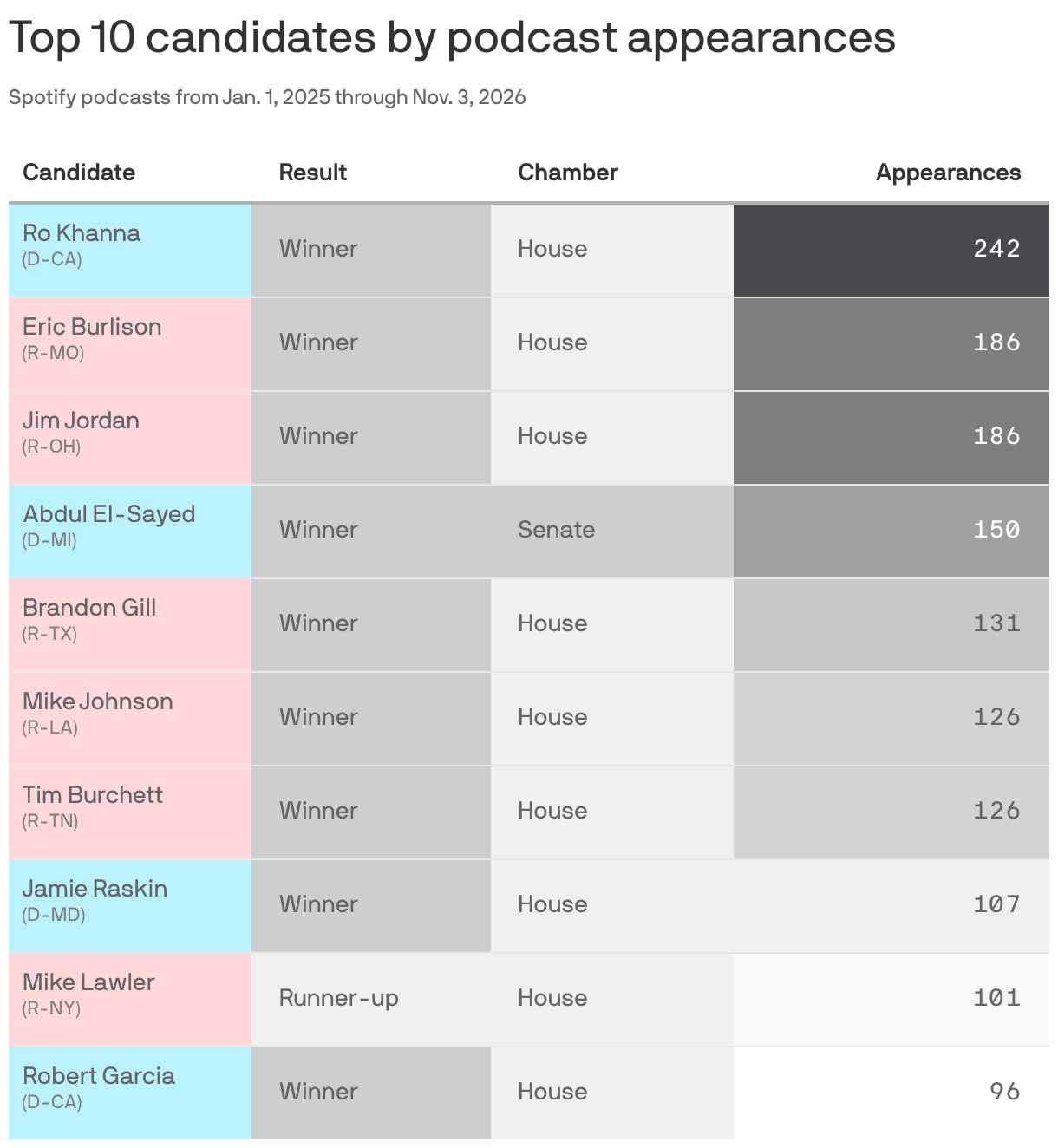
State of play: The vast majority of candidates with the most appearances were winners.
- Across both chambers, Rep. Ro Khanna (D-Calif.) made the most appearances of any candidate, with 242 appearances across 175 shows.
- Among Senate candidates, Sen.-elect Abdul El-Sayed (D-Mich.) made the most podcast appearances, with 150 appearances across 119 shows.
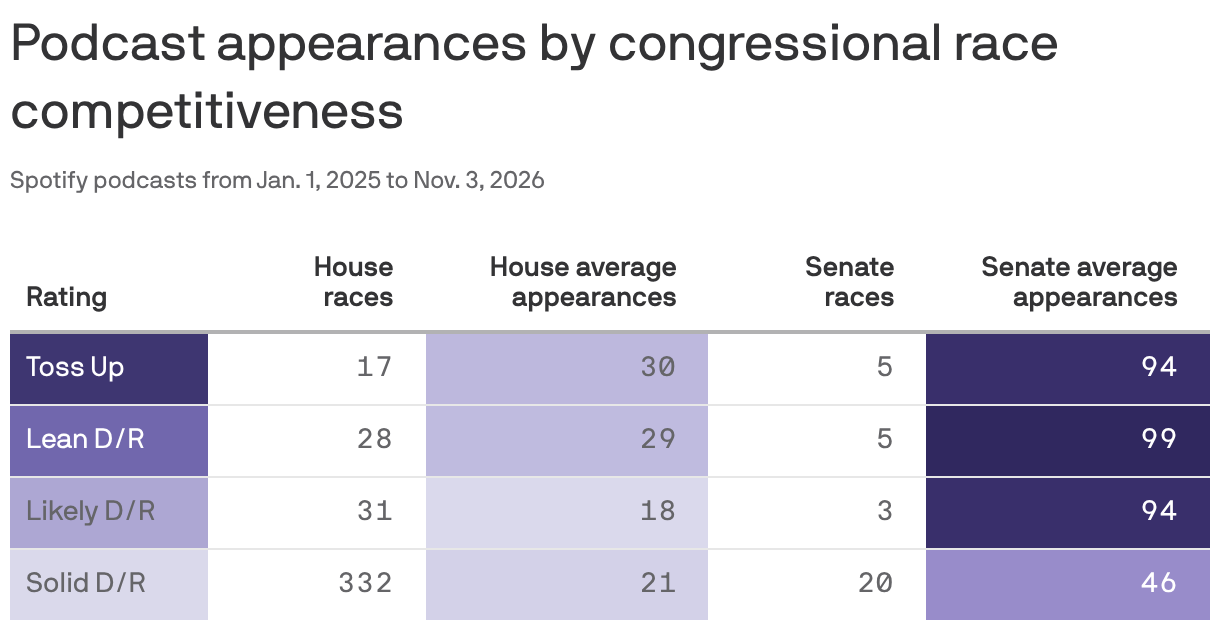
Zoom in: Competitive races yielded far more podcast appearances, according to an Axios analysis of Spotify appearance data mapped against competitive race ratings by Cook Political Report.
- In the Senate, candidates in toss-up elections averaged roughly 94 podcast appearances per race, more than double the 46 appearances in races considered safely Democratic or Republican.
- In the House, toss-up races averaged 30 appearances, compared with roughly 21 in safely Democratic or Republican districts.
The intrigue: Incumbents dominated podcasts, even when they lost.
- Incumbents who lost reelection averaged the most podcast appearances (24.1), while winning incumbents averaged 20.2 appearances. Winning nonincumbents averaged 14.1 appearances compared to losing nonincumbents, who averaged 4.8.
- In open-seat races where neither candidate was an incumbent, winning candidates made about 50% more appearances on podcasts compared to losing candidates.
The big picture: Democrats and Republicans appeared on podcasts at roughly the same rate.
- Overall, Democratic candidates had a median of six appearances, compared with five for Republicans. Among winning candidates, Republicans had a slightly higher median of 12 appearances versus 10 for Democrats.
- The top podcast by candidate appearances by far was "John Solomon Reports," according to an Axios analysis of the Spotify data.
The bottom line: Podcasts gained momentum in 2024 as a tool for presidential candidates. Now, they are critical campaign stops downballot.
2. 🤝 Exclusive: Vox to sell ads for The Bulwark
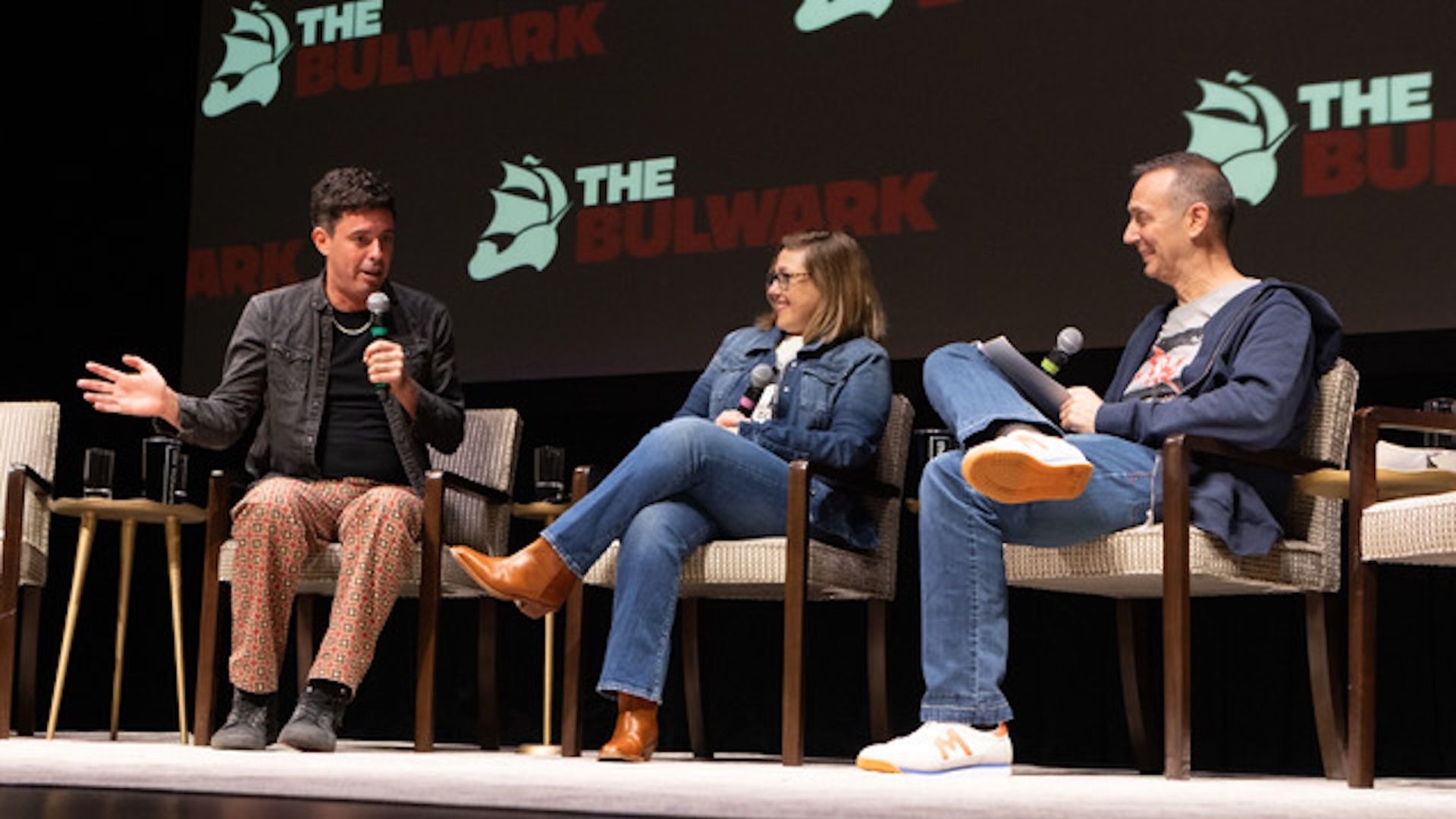
Vox Media has struck an exclusive three-year advertising sales and marketing deal with The Bulwark, executives told Axios.
Why it matters: The Bulwark has seen explosive audience growth in recent years, but its inventory is undermonetized, CEO and publisher Sarah Longwell told Axios.
- A more sophisticated advertising strategy will help ensure much of its content remains free. "You can't save democracy from behind a paywall," she said.
How it works: Vox Media will become the exclusive advertising seller for The Bulwark's inventory across podcasts, video, newsletters and live events, chair and CEO Jim Bankoff said.
- It will host The Bulwark's podcasts on its ad platform and support the company's business growth with additional tools, such as analytics, cross-promotion and marketing across its network. The Bulwark will continue doing its own production.
- The companies also plan to expand live event sponsorship opportunities for The Bulwark next year, building on Vox Media's experience with podcast tours.
- Vox Media will get a cut of advertising revenue, Bankoff confirmed.
Zoom out: Launched in 2019, The Bulwark has evolved from a scrappy startup to a multimillion-dollar business with a sprawling portfolio.
- The company is on track to exceed $30 million in revenue this year, with about an even split across advertising and subscriptions, Longwell said.
- It now has roughly 167,000 paid subscriptions across Substack (147,000), YouTube (~15,000) and Apple (~5,000), in addition to over 1 million free Substack newsletter subscribers and nearly 2 million free YouTube subscribers.
Of note: Vox Media sold its podcast network and several of its publishing assets, including New York Magazine, to James Murdoch's investment firm Lupa Systems in July.
- The Bulwark is also backed by Murdoch through his and his wife Kathryn's family foundation Quadrivium.
- Longwell said The Bulwark's investors are a "super small part of our portfolio," adding, "We are not an investor-owned company."
- Longwell said she has no current plans to sell the company.
What's next: The Bulwark deal will give Vox Media's advertising partners access to a combined network of nearly 200 hours of original current affairs programming per month, beginning in 2027.
3. ⏱️ "60 Minutes" ratings down 17% YOY
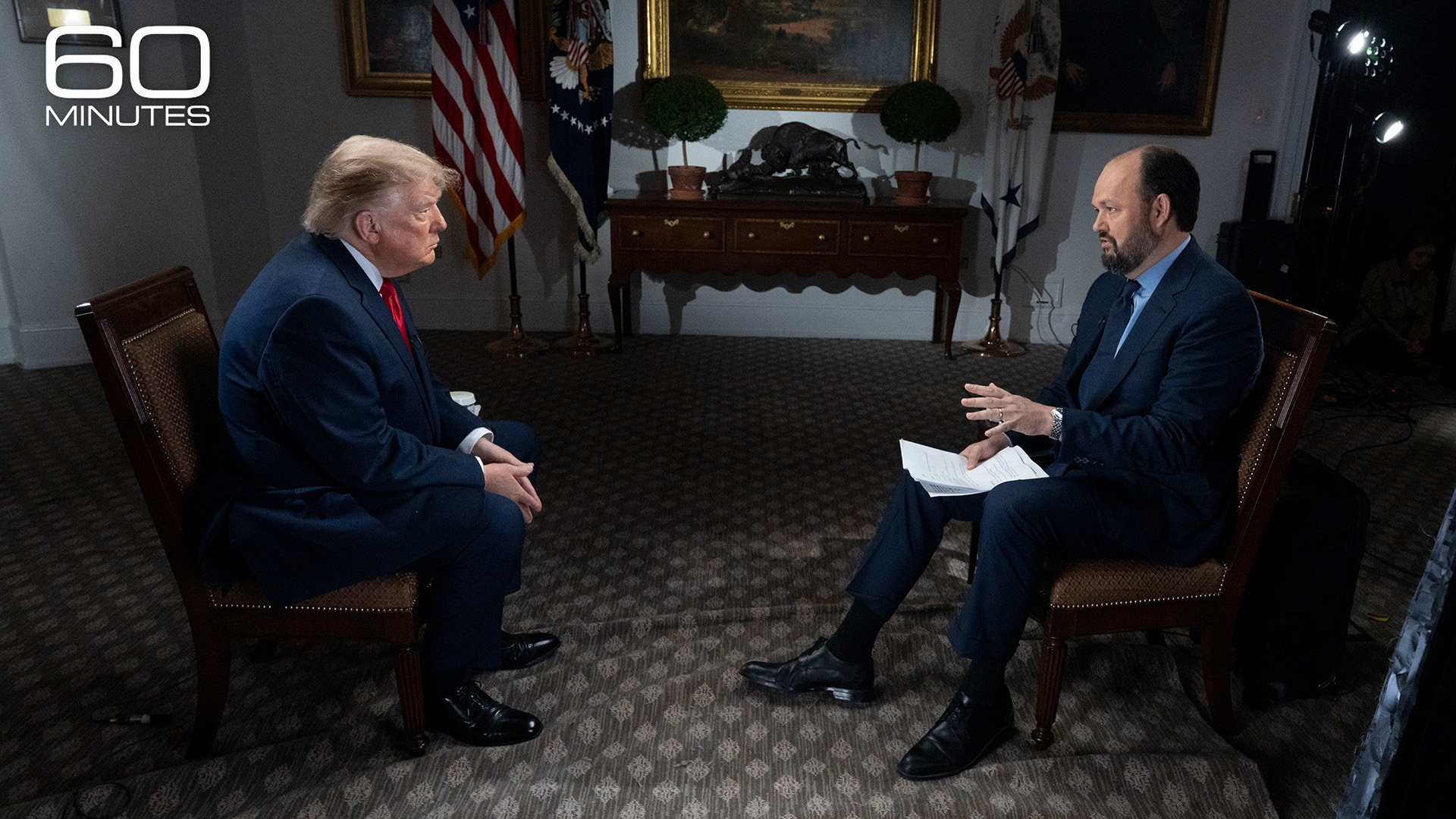
"60 Minutes" viewership is down 17% year over year, according to an analysis of Nielsen's Live+7 ratings across the first eight episodes of the season.
Why it matters: The data doesn't suggest a mass audience exodus, but it does paint a picture of a program that has struggled to find its footing under new leadership.
Reality check: It's hard to compare ratings year over year in a completely apples-to-apples fashion at this point in the season, but a double-digit decline so far suggests the show would need to post big numbers in subsequent episodes to make up the gap.
- A "60 Minutes" season has about 32 episodes on average, which means around a quarter of the season has aired.
- Last season, five episodes were preceded by NFL games, compared with just four this season.
Between the lines: President Trump appeared on "60 Minutes" last season in its sixth episode and this season in its eighth — his first sit-down interview after the midterms.
- The episode with Trump's interview drew 7.8 million viewers this year, compared to 14.9 million last year.
- Last year's interview was preceded by an NFL game, while this year's was not.
Context: The show has landed several other big interviews, including the first television interview with Patrick Clancy and the first network interview with San Antonio Spurs star center Victor Wembanyama after his team lost in the NBA Finals to the Knicks.
- Episodes featuring those two interviews are the only ones so far to pull in ratings increases compared with last year.
The big picture: A weak ratings stretch has worried talent, but leadership has put up a strong front.
- Last week, longtime "60 Minutes" correspondent Lesley Stahl urged viewers who stopped watching to return.
- Many loyal viewers "tuned us out, we presume, in protest," she said at a Women in Media "Power Lunch" attended by Axios and hosted by The Daily Beast.
Meanwhile, CBS News editor-in-chief Bari Weiss said in an interview with The Information's Jessica Lessin last month that she's not focused on ratings, but rather "transforming the business."
- Weiss and the show's new executive producer, Nick Bilton, have said they are prioritizing the show's growth beyond linear television.
- A CBS spokesperson said the show's interview with President Trump generated the highest social media viewership in the days following an episode in the show's history.
The bottom line: It's too early to say that "60 Minutes" under new leadership is flailing in the ratings, but if the trends continue, it will become harder for CBS to argue the numbers are just noise.
4. 🎬 Hollywood executive purge
Pressure on Hollywood to consolidate and adapt to the AI future has driven a slew of high-profile exits and trades across the industry.
Why it matters: Rank-and-file employees aren't the only ones in Tinseltown hammered by cuts.
Driving the news: James Gunn and Peter Safran are out as co-heads of DC Studios and will be replaced by former Marvel executive Jeremy Latcham.
- The shake-up comes amid tensions over creative control and reporting structures, along with concerns about DC's financial performance, per The Hollywood Reporter.
- Gunn said he had disliked the "corporate nature of the job" in an Instagram post.
Flashback: Skydance's acquisition of Warner Bros. Discovery has led to other leadership changes. Most notably, Mattel CEO Ynon Kreiz joined Skydance as co-CEO.
- As part of the deal close, former WBD CEO David Zaslav, CFO Gunnar Wiedenfels, chief revenue and strategy officer Bruce Campbell and film chiefs Mike De Luca and Pam Abdy have all departed.
- Other departing executives include WBD international president Gerhard Zeiler, distribution president Scott Miller, technology chief Avi Saxena and global streaming and digital studios chief Michael Bishara.
- Several senior Paramount executives are exiting, including international networks chief Pank Patel and Paramount+ international general manager Marco Nobili.
Zoom out: The leadership shuffle extends beyond Skydance.
- Fox: The completed acquisition of Roku this week ushered a reorganization of Fox's streaming businesses.
- Roku's president of media Charlie Collier and Tubi CEO Anjali Sud are departing. Fox direct-to-consumer chief Pete Distad will oversee Tubi and Frndly TV. Roku executive Mustafa Ozgen will succeed Anthony Wood as CEO of Roku.
- SiriusXM: Sud is moving from Tubi to become CEO of SiriusXM, starting Jan. 1. She replaces Jennifer Witz who has spent about 25 years at the company.
- Netflix: The streamer hired Mattel executive Roberto Stanichi as vice president of consumer products and experiences, including its Netflix House activations. It also named former Google executive Darshan Kantak as vice president of its ads platform.
- Those additions come shortly after Netflix fired its chief content officer Bela Bajaria and brought in Fox executive Peter Rice in her stead. It also let go of its head of film Dan Lin.
- Mattel: Condé Nast CEO Roger Lynch joined Mattel as CEO after his predecessor left for Skydance. Steve Totzke was promoted to president and COO after Stanichi's departure.
5. 🤑 NYT has cash for movie night
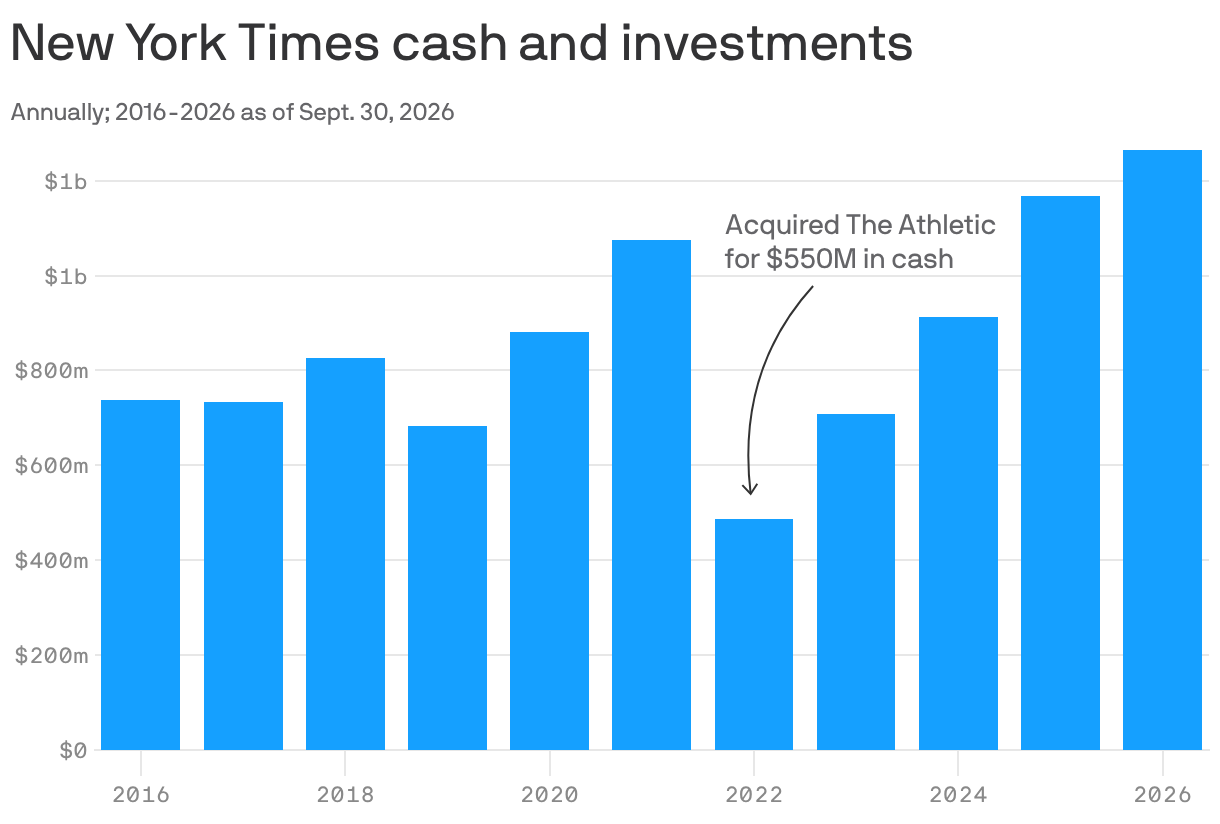
The New York Times is sitting on its biggest pile of cash and investments in years as it eyes a potential acquisition of Letterboxd, a social platform for movie buffs.
Why it matters: At a time when borrowing costs remain high, the Times is among a handful of publishers with the financial flexibility to be able to buy a coveted digital media asset outright.
Zoom in: The Times is in exclusive talks to acquire Letterboxd for roughly $330 million, the company's own reporters Benjamin Mullin and Lauren Hirsch reported last week.
- That price represents roughly 22 times Letterboxd's projected 2026 EBITDA.
- The company has more than 30 million users, many of whom are younger film fans.
- Letterboxd could be added to the Times' sprawling portfolio of digital consumer products designed to bolster its subscription business, including games, cooking, sports and shopping recommendations.
Reality check: A source who eyed the asset told Axios that Letterboxd's purchase price drew skepticism.
- But for the Times, which has a track record of buying undermonetized assets and building advertising businesses around them, the opportunity to grow its portfolio could be worth the markup.
By the numbers: The Times held roughly $1.26 billion in cash and investments as of Sept. 30, per its most recent Q3 financial filings.
- That's more than 2.5 times the amount it held at the end of 2022, following its $550 million cash purchase of The Athletic.
- Letterboxd would cost the Times roughly a quarter of its reserves, if sold at the reported deal price.
The big picture: The Times has a long history of using acquisitions to grow its business, although its track record is mixed.
- It bought the Boston Globe for $1.1 billion in 1993, only to sell it for around $70 million in 2013.
- The Times bought About.com in 2005 for $410 million in cash, only to sell it to Barry Diller's IAC for about $300 million in cash seven years later.
- In 2016, the Times acquired two marketing agencies, HelloSociety and Fake Love. Both folded.
- It also bought Wirecutter in 2016, reportedly for more than $30 million. That deal has been a success.
- Its more recent acquisitions of Wordle, Audm and Serial Productions were much smaller in scope than something like The Athletic.
Go deeper: Axios Media Trends Executive will publish a deep dive on the current state of media deals this Saturday for members. Subscribe.
Sign up for Axios Media Trends