Exclusive: Winning candidates appeared on more podcasts

Add Axios as your preferred source to
see more of our stories on Google.
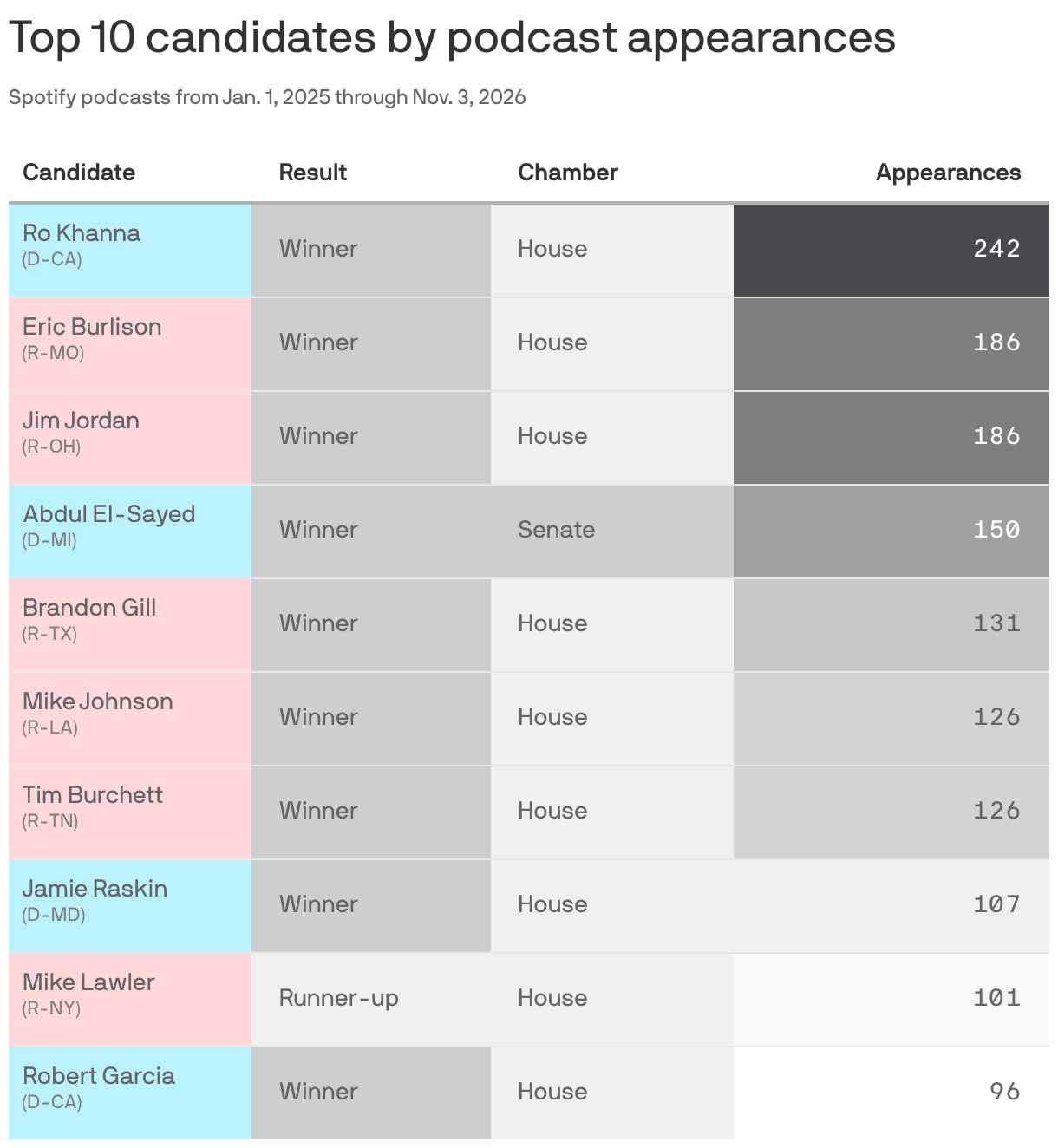
Winning congressional candidates made nearly three times as many podcast appearances as their losing opponents, according to Spotify data shared exclusively with Axios.
Why it matters: Podcasts have become a baseline for congressional campaigns, especially competitive races.
By the numbers: The vast majority (82.6%) of House and Senate candidates made at least one podcast appearance during the 2026 midterm cycle.
- Winners were much more likely to show up. Most winning House candidates (96%) appeared on at least one podcast, compared to just 67% of runners-up.
- Yes, but: In the Senate, the difference wasn't as jarring. Every winning Senate candidate appeared on at least one podcast, as did 97% of runners-up.
- The fine print: Those figures include appearances on stand-alone podcasts but not TV news programs distributed as podcasts. Inclusive of TV news program podcasts, 83.1% of House and Senate candidates appeared as guests at least once during the 2026 midterm cycle.
State of play: The vast majority of candidates with the most appearances were winners.
- Across both chambers, Rep. Ro Khanna (D-Calif.) made the most appearances of any candidate, with 242 appearances across 175 shows.
- Among Senate candidates, Sen.-elect Abdul El-Sayed (D-Mich.) made the most podcast appearances, with 150 appearances across 119 shows.
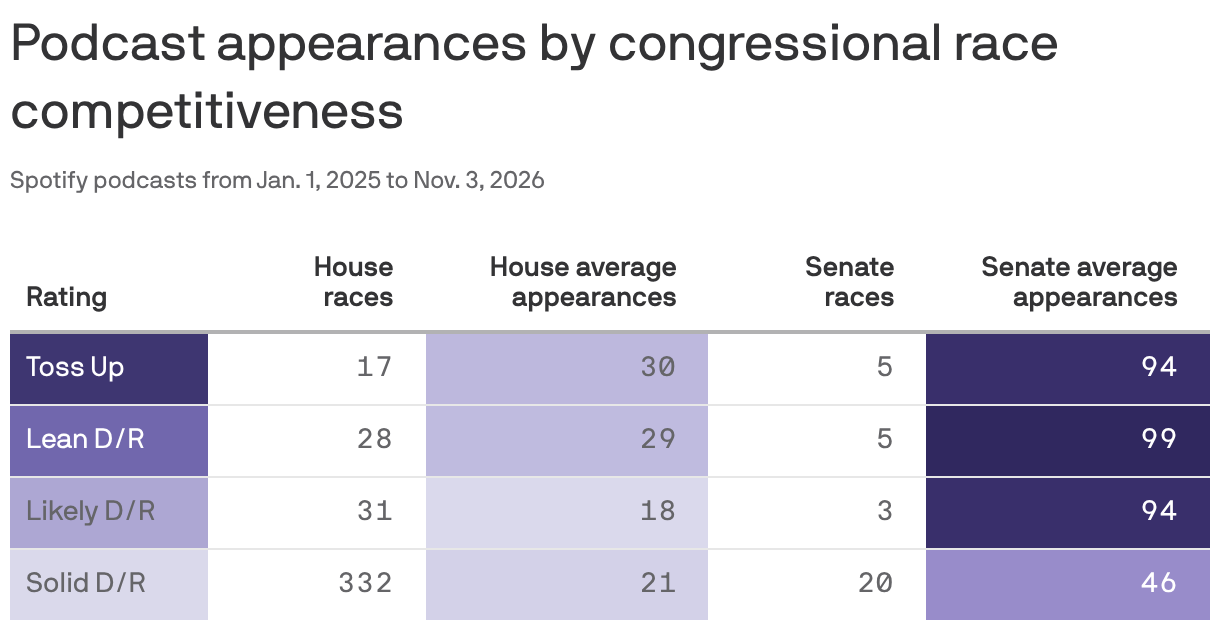
Zoom in: Competitive races yielded far more podcast appearances, according to an Axios analysis of Spotify appearance data mapped against competitive race ratings by Cook Political Report.
- In the Senate, candidates in toss-up elections averaged roughly 94 podcast appearances per race, more than double the 46 appearances in races considered safely Democratic or Republican.
- In the House, toss-up races averaged 30 appearances, compared with roughly 21 in safely Democratic or Republican districts.
The intrigue: Incumbents dominated podcasts, even when they lost.
- Incumbents who lost reelection averaged the most podcast appearances (24.1), while winning incumbents averaged 20.2 appearances. Winning nonincumbents averaged 14.1 appearances compared to losing nonincumbents, who averaged 4.8.
- In open-seat races where neither candidate was an incumbent, winning candidates made about 50% more appearances on podcasts compared to losing candidates.
The big picture: Democrats and Republicans appeared on podcasts at roughly the same rate.
- Overall, Democratic candidates had a median of six appearances, compared with five for Republicans. Among winning candidates, Republicans had a slightly higher median of 12 appearances versus 10 for Democrats.
- The top podcast by candidate appearances by far was "John Solomon Reports," according to an Axios analysis of the Spotify data.
The bottom line: Podcasts gained momentum in 2024 as a tool for presidential candidates. Now, they are critical campaign stops downballot.
Methodology: The dataset, provided by Spotify exclusively to Axios, tracks podcast appearances by U.S. House and Senate candidates during the 2026 midterm election cycle, from Jan. 1, 2025, through Election Day on Nov. 3, 2026.
- It tracks appearances from 893 candidates total, including 449 winners and 444 runners-up across 446 congressional races and three nonvoting House delegate contests that have been called as of 9am ET on Nov. 9.
- An appearance is counted only when a candidate personally participated in a podcast episode, such as through an interview, conversation, panel discussion or call-in. Clips, soundbites, speeches, press conferences and episodes that merely discussed a candidate were excluded.
- Appearances on candidates' own shows were also excluded. If the same interview was published multiple times on the same show's feeds, it was counted only once per candidate.
- Spotify provided two sets of figures to Axios: one counting stand-alone podcasts only, and another that also includes TV news programs distributed as podcasts, such as NBC's "Meet the Press." Axios' analysis mostly evaluates stand-alone podcast data.
- Spotify grouped shows based on how they are distributed, rather than where they originated.
- Only TV news programs published as podcasts, such as "Meet the Press," "Balance of Power" and "The Last Word," were classified as TV news programs.
- If multiple candidates appeared on the same episode, each received credit for an appearance.
- The data reflects when episodes were published on Spotify, which may differ from when interviews were recorded. It measures how frequently candidates appeared on podcasts, not how many people listened to them.
