Axios Media Trends

July 22, 2025

Good afternoon. Today's Media Trends, edited by Christine Wang and copy edited by Sheryl Miller, is 2,052 words, an 8-minute read. Sign up.
📅 Mark your calendars: We're bringing Media Trends to life with Axios' inaugural Media Trends Live event in NYC on Sept. 18.
- Axios' Kerry Flynn and I will be joined on stage by Paramount's Shari Redstone, ESPN chair Jimmy Pitaro, Snap CEO Evan Spiegel, and PBS CEO Paula Kerger, as well as more guests to be announced soon.
- Reserve your spot here.
1 big thing: Scoop... WaPo opinion exodus
A slew of Washington Post opinion columnists and journalists are taking buyouts, as the company weighs changes to the section under new management.
Why it matters: Opinion staffers told Axios the lucrative buyouts appear designed, in part, to help the Post cut down on the number of columnists it employs full time in favor of more audio and video talent.
- CEO Will Lewis earlier this month encouraged staffers "who do not feel aligned with the company's plan" to reflect on the buyout offer.
⏳State of play: Journalists have until July 31 to accept the voluntary separation offer at the Post, sources told Axios.
- Columnists David Von Drehle, Molly Roberts and Jonathan Capehart are taking buyouts, Axios confirmed.
- Drew Goins, newsletter writer and editor for the section, is also planning to depart, Axios confirmed.
- Longtime columnist Philip Bump said last week that he accepted a buyout.
- Monica Hesse hasn't signed buyout papers but doesn't plan to remain in the opinion section, a source told Axios.
👀 Some opinion staffers are also considering shifts into the Post's main newsroom, sources told Axios.
The big picture: The Post last month named Adam O'Neal, a Washington correspondent at The Economist and former executive editor of The Dispatch, as its new opinion editor.
- He replaced David Shipley, who resigned after owner Jeff Bezos mandated the section prioritize two topics, personal liberties and free markets, and not publish dissenting views in those areas.
2. 🔄 Meanwhile, another strategy pivot
The Post today announced sweeping changes to its "third newsroom," called WP Ventures, that puts the unit under a commercial leader and separates it from its core news brand.
Why it matters: The shake-up represents a big shift in the Post's editorial strategy as it looks to overcome revenue challenges.
📰 Catch up quick: Last year, CEO Will Lewis announced an overhaul of the Post's editorial strategy that was meant to broaden the outlet's coverage and reach a wider audience.
- Those changes included the creation of a "third newsroom" that focused on video, audio, newsletters and social engagement.
- The Post named longtime editor Krissah Thompson leader of that division.
State of play: Executive editor Matt Murray announced today that Thompson would be taking a buyout.
- The company subsequently said it's shifting the focus of WP Ventures to operate outside of the Post's newsroom.
Zoom in: Moving forward, WP Ventures will report to the company's chief strategy officer Suzi Watford. It will be led by Samantha Henig, who serves as general manager, not an editor.
- WP Ventures will "focus entirely on building personality-driven content and franchises around personalities" across topics that appeal to new audiences and "with strong commercial opportunities," Henig wrote in a memo to staff explaining the changes. (The memo was co-signed by Thompson.)
📉 The big picture: The Post lost $77 million in 2023, executives said last year. The new editorial vision is meant, in part, to help bring the paper back to profitability.
3. ⚖️ Trump media lawsuits this year tie record

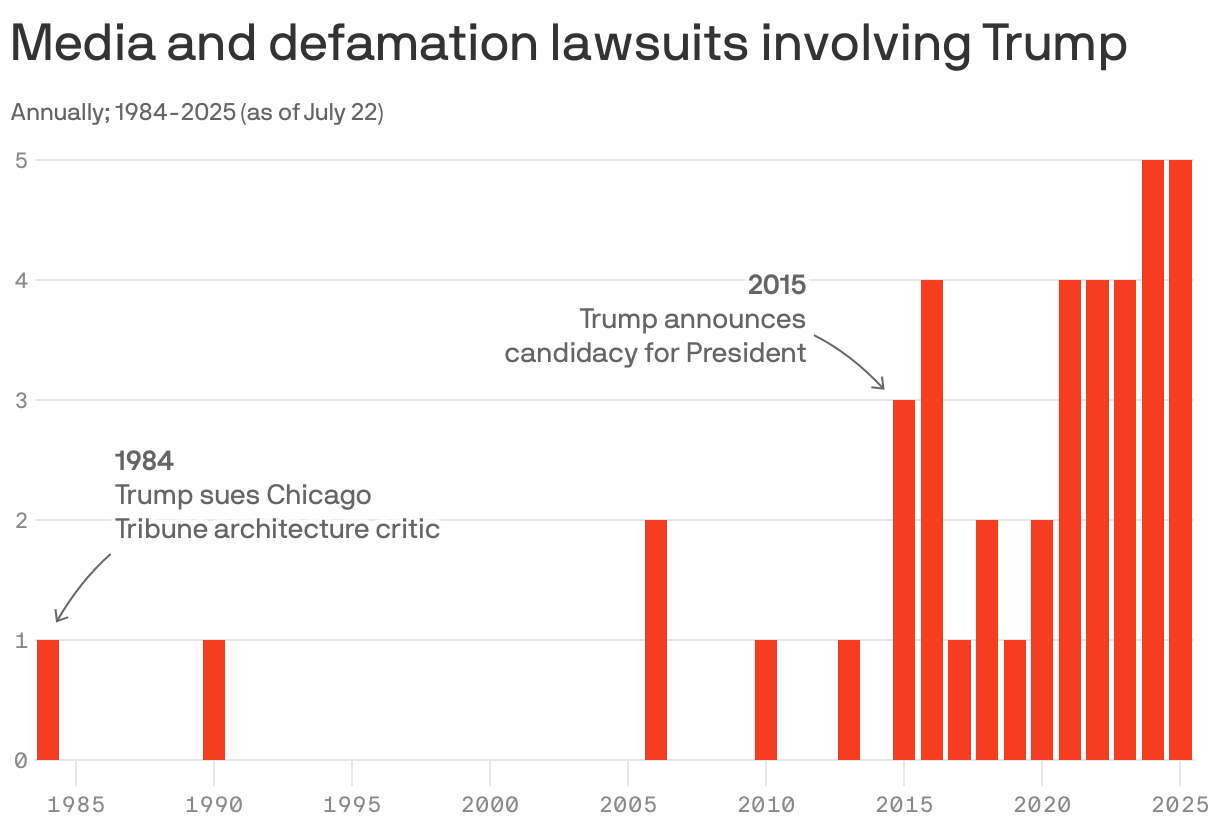
President Trump is already embroiled in as many new media and defamation lawsuits halfway through 2025 as he was in lawsuits that were initiated — by or against him — during all of last year.
🏛️ Why it matters: The record wave of litigation reflects how Trump's clashes with the media have escalated from public criticism to courtroom showdowns with major news organizations increasingly fighting back.
State of play: So far this year, Trump has been sued by the Associated Press, NPR, PBS and the Corporation for Public Broadcasting. He also filed a lawsuit against the Wall Street Journal and Rupert Murdoch.
- On Monday, White House press secretary Karoline Leavitt said the White House had removed the Journal from the press pool covering the president's upcoming weekend trip to Scotland.
- The decision came after Trump sued the news outlet over a story describing a letter bearing his name that the WSJ says was given to Jeffrey Epstein.
- The president has maintained the letter is "fake." Dow Jones, which owns WSJ, told Axios that they have "full confidence in the rigor and accuracy" of their reporting and will vigorously defend against any lawsuit, according to a spokesperson.
📈 By the numbers: These 2025 cases add to a growing list of Trump's media-related legal battles, which spiked dramatically after he launched his political career.
- According to Axios' analysis, Trump and his businesses have been involved in 34 media or defamation lawsuits since 2015, compared to just seven in the three decades prior to announcing his presidential bid.
📊 Zoom in: The lawsuits shown in the chart involve Trump as either the plaintiff or defendant and include Trump-affiliated businesses, like Miss Universe and Trump Media & Technology Group, and his campaign.
- In 2023, TMTG sued 20 media organizations, including Axios, for defamation. That suit in Florida is ongoing.
- Trump or his business served as the plaintiff in 59% of the cases — four before announcing his presidential run and 20 afterward. He or his business was the defendant in three cases before and 14 afterward.
- The analysis includes defamation cases from non-media entities and individuals like E. Jean Carroll.

4. 💸 Inflated IPOs
Los Angeles Times owner Patrick Soon-Shiong said he wants to take the newspaper public in a Monday appearance on "The Daily Show."
- Soon-Shiong said the timeline was over the next year and that he was working with an organization to put the deal together.
Why it matters: It's part of a wider trend of media companies eyeing public markets to raise capital, despite flimsy financials.
- The LA Times reportedly lost $50 million in 2024. Last year, it cut 115 newsroom employees, more than 20% of its newsroom. The company laid off more than a dozen staffers in May.
Zoom out: Newsmax, a conservative media company that lost $55 million in the first half of 2024 on revenue of $80 million, was valued at $16.1 billion at market open on its second day as a public company.
- Its stock has since fallen significantly. It now trades with a market value of $1.8 billion, which is still very high considering its financials.
- Trump Media & Technology Group, the parent company of Truth Social, brought in just $3.6 million in sales for all of 2024 and an operating loss of $186 million. It currently has a market cap value of over $5.4 billion.
🗞️ The big picture: Soon-Shiong's announcement comes after years of newsroom turmoil as the biotech billionaire tries to reshape the legacy paper.
- The owner has repeatedly faced staff backlash over his decisions. He blocked the paper's planned presidential endorsement for Vice President Harris, prompting its editorial editor to resign and a reported 20,000 subscription cancellations.
5. 🙋♂️Silicon Valley leans out
With the exception of Bluesky CEO Jay Graber and Signal CEO Meredith Whittaker, there are hardly any women leading major social media or messaging companies anymore.
Why it matters: Women and underrepresented groups are some of the internet's most active and engaged users, but they also tend to be the biggest targets of online abuse.
Zoom in: The resignation of X CEO Linda Yaccarino has left a void among Silicon Valley's leadership that doesn't seem likely to be filled anytime soon.
- Meta last week named longtime executive Connor Hayes as its new head of the Threads app. Instagram is led by Adam Mosseri. WhatsApp is led by Will Cathcart. The parent company is led by founder Mark Zuckerberg.
- YouTube tapped Neal Mohan as its new CEO in 2023, succeeding Susan Wojcicki, who led the platform for nearly a decade before her passing.
- Nirav Tolia replaced Sarah Friar as CEO of Nextdoor in 2024.
- TikTok, Twitch, Spotify, Apple, Snapchat, Pinterest, Reddit, LinkedIn, Telegram, Substack and Patreon are all led by men, although many of those companies feature women prominently elsewhere in the C-suite.
By the numbers: Big Tech's women leadership gap isn't as pronounced overall as it is within social media and messaging.
- This year, 11% of Fortune 500 CEOs are women. Within the 52 tech companies, six — or 11.5% — are women.
- But there are no women CEOs at social media and messaging companies on the Fortune 500 list.
6. NPR news chief quits following cuts

NPR editor-in-chief Edith Chapin informed staff today that she will be stepping down.
Why it matters: The resignation comes days after Congress voted to strip public media of federal funding.
- NPR reported that Chapin said the decision was not driven by Congress' actions and that she informed CEO Katherine Maher of her decision two weeks ago.
❌ The big picture: The gutting of federal funding for public broadcasters is expected to cause hundreds of local station groups across the country to significantly scale back operations or shutter.
- Those stations are often in rural places where there isn't any other local news source.
- Public broadcasters don't just provide news, but also critical public safety warnings, including Amber Alerts and Silver Alerts.
- "The interconnected public broadcasting system is the only system capable of broadcasting these alerts to every corner of our nation — and at the county and state levels, we rely upon it frequently throughout the year," dozens of local public safety and emergency management officials wrote in a recent letter to Congress.
While the cuts are meant to target NPR and PBS, the national organizations won't feel much of the impact.
- NPR and PBS nationally are mostly funded by nongovernment sources, such as corporate sponsorships or viewer/listener donations.
- Only around 1% and 15% of NPR's and PBS' national revenue comes through the Corporation for Public Broadcasting, whose funding was slashed by Congress.
But local member stations depend on CPB funding, and they're the ones that will be most heavily impacted.
7. 📺 Late night reckoning
"The Late Show" host Stephen Colbert responded to President Trump's post that celebrated the cancellation of the program, telling Trump to "go f**k yourself" in his opening monologue yesterday.
🌙 The big picture: Late-night shows used to be the crown jewel of big broadcast. Now, in a hyper-partisan streaming era, they present more risks.
- The late-night comedy show format, split between an opening monologue, short interviews and comedic bits, is hard to preserve for an on-demand audience in streaming, as most clips air nearly instantaneously on social media.
- Late-night shows, like the rest of linear television, are struggling from declining ad revenues amid consistent if not higher production costs associated with live daily telecasts. ("The Late Show" was reportedly losing tens of millions of dollars annually.)
- In a hyper-partisan world, political comedy risks alienating sizable audiences or drawing ire from people in power.
📢 Between the lines: Colbert wasn't just a vocal critic of Trump, he also criticized CBS' parent Paramount's decision to settle with him.
- "I believe this kind of complicated financial settlement with a sitting government official has a technical name in legal circles: It's a 'big, fat bribe,'" Colbert said on his show days before CBS announced its cancellation.
🤔 What to watch: CBS said last week it is pulling the show for "financial" reasons, but the timing of the announcement has drawn suspicion from media watchers and Democrats.
- Colbert said Thursday he found out about the program's cancellation the day before.
- David Ellison, CEO of Skydance Media, the company taking over Paramount, met with FCC chair Brendan Carr last Tuesday.
- He urged the FCC's Media Bureau to "promptly grant" Paramount's applications to transfer control of its broadcast licenses to its new owners, after emphasizing "the public interest benefits" of the deal in the meeting.
8. 🦄 New creator unicorn


Substack, the email newsletter platform, has raised $100 million in a Series C round, bringing its total valuation to more than $1.1 billion, a source confirmed to Axios.
Why it matters: The lofty valuation speaks to investor enthusiasm around the creator economy.
- Substack hasn't recently disclosed its revenue, but it made just $12 million in gross revenue in 2021.
💰By the numbers: The company, which launched in 2017, has raised a total of roughly $200 million to date, mostly from venture firms and wealthy investors.
- It's used that capital to expand its product from simply serving emails to becoming a full-stack business and creative platform for writers, journalists, podcasters, video creators and influencers.
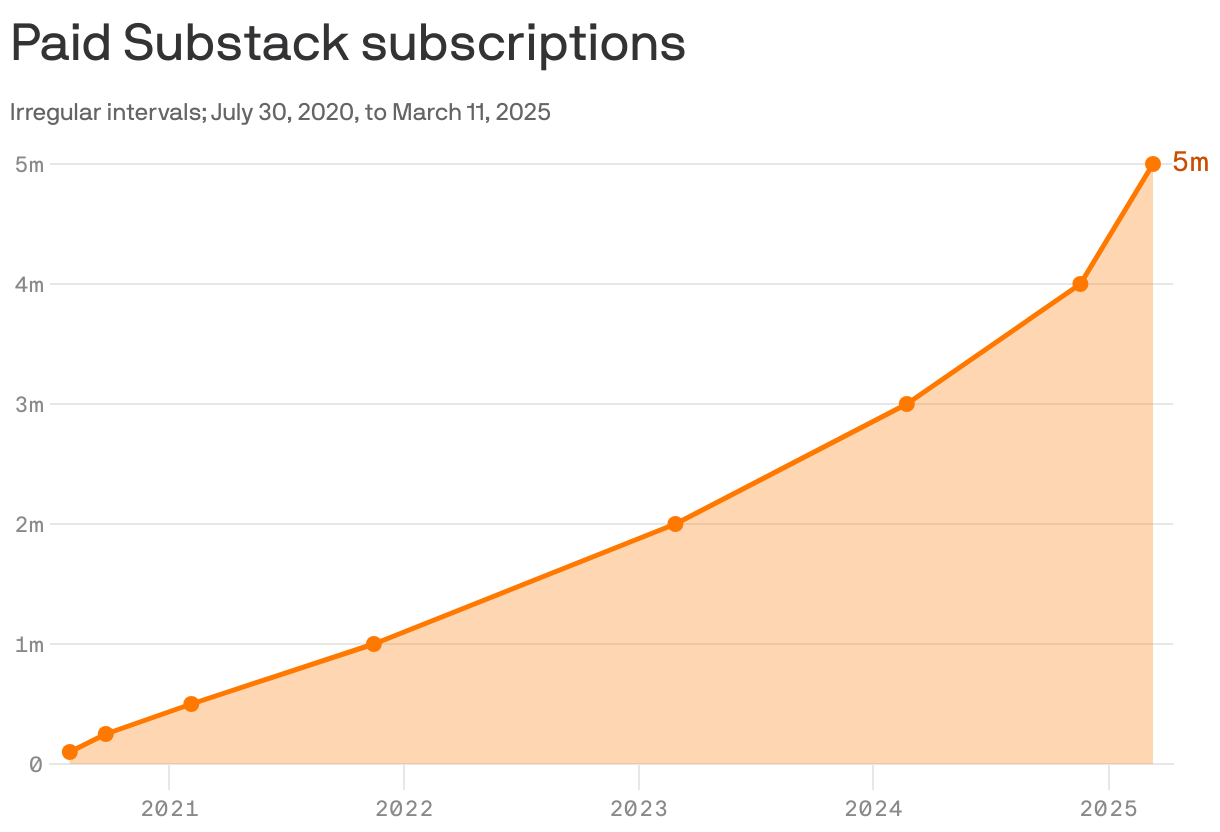
📧 By the numbers: The company said earlier this year that it had surpassed 5 million paid subscriptions on the platform, up from 2 million in 2023.
- More than 50 creators are now making more than $1 million per year on the platform.
Sign up for Axios Media Trends