Axios Markets

March 10, 2025

🌅 Welcome to another week! Today we're looking at eggs: what we're willing to pay for them, and why that's so lucrative for big producers.
- Plus: Where the impacts of DOGE are being felt (hint: it's redder than you think).
 👀 Situational awareness: In interviews Sunday, President Trump didn't rule out the possibility of a recession. Commerce Secretary Howard Lutnick did, while acknowledging prices are likely to rise for imported goods. Go deeper.
All in 1,000 words, a 4-minute read.
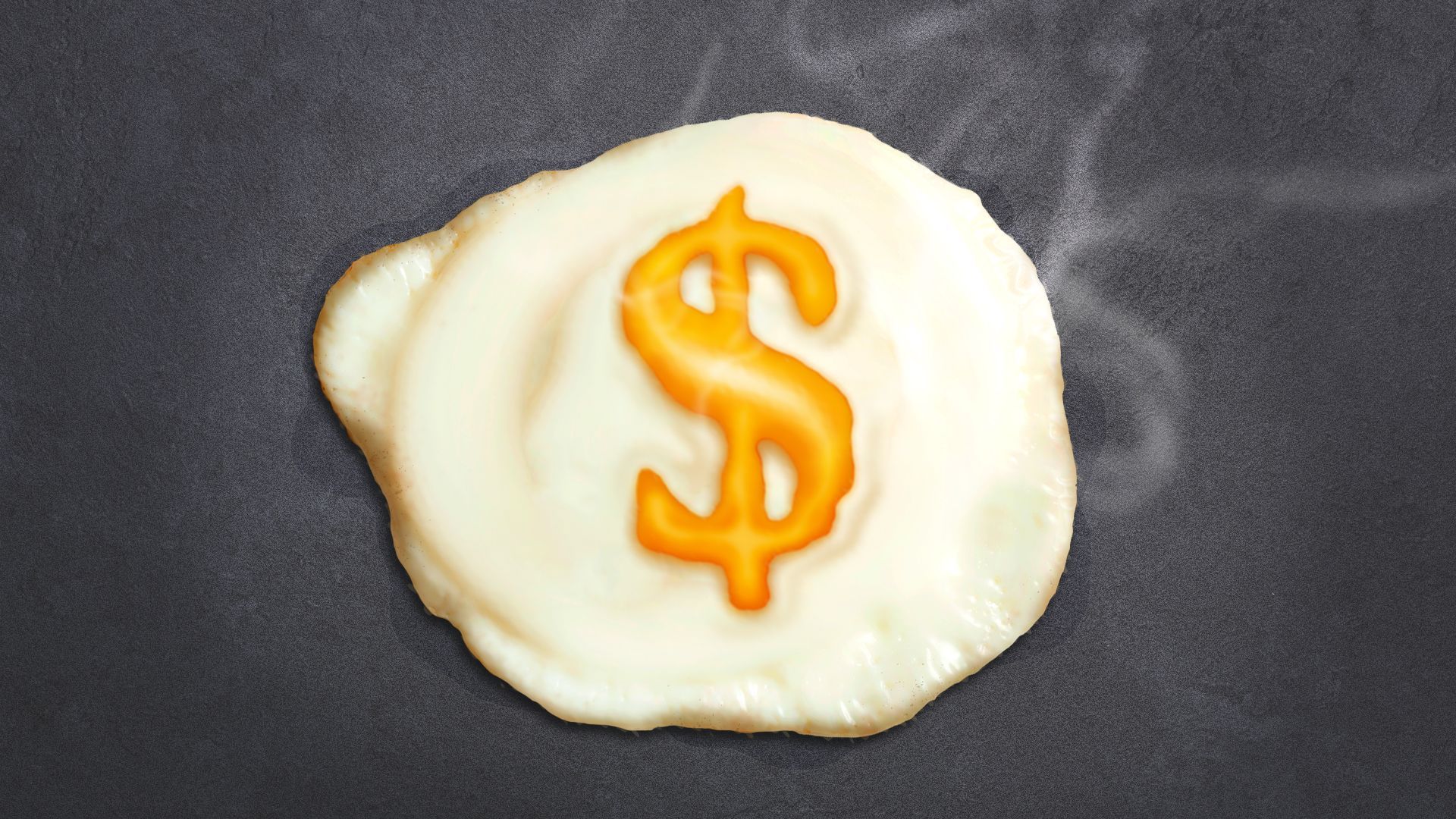
1 big thing: Time for some Eggonomics 101
The Justice Department is reportedly in the early stages of investigating egg producers for antitrust violations, but proving criminal activity won't be easy.
Why it matters: High egg prices alone don't suggest collusion is happening. To understand why, we need to turn to Microeconomics 101, and specifically the question of price elasticity.
The big picture: Price elasticity measures the degree to which consumers are willing, or unwilling, to pay higher prices for certain items.
- Eggs, it turns out, have astonishingly low price elasticity: Demand barely falls as price rises. As a result, even modest reductions in supply are likely to result in huge price increases.
Follow the money: Berkeley economist Aaron Smith has run the numbers on egg price elasticity and found that it took a 228% increase in the price of eggs to reduce the number of eggs purchased by a mere 4%.
- Elasticity is determined by a mathematical formula, where the closer you are to zero, the less elastic the price of a commodity is. Overall, Smith found demand elasticity for eggs to be somewhere between -0.02 and -0.06.
- That's astonishingly low, lower even than the super-low price elasticity for eggs of -0.1 cited in "Microeconomics," the standard textbook by Paul Krugman and Robin Wells.
- By comparison, gasoline has a short-run price elasticity of around -0.3, some 15 times greater than we've recently seen in the egg market. (Over the long run, when consumers can switch to more fuel-efficient vehicles, the price elasticity is closer to -0.5.)
How it works: "Egg demand is inelastic because there are few good substitutes and it doesn't take up a huge portion of most people's budget," Smith wrote. It's not pleasant to pay more for eggs, he noted, but "most people are willing and able to do it."
Where it stands: Wholesale egg prices have finally started to fall, but that's more because there have been no significant outbreaks of the avian flu over the past couple of weeks, per the USDA, than because demand is fallen in response to high prices.
- The respite, USDA staff wrote, "has provided an opportunity for production to make progress in reducing recent egg shortages."
- And as Karyn Rispoli, managing editor for eggs in the Americas for price-reporting service Expana, told Axios' Kelly Tyko, "the market is suddenly faced with a surplus of eggs" and therefore a potential decrease in prices.
Between the lines: It's great to be in a business where price elasticities are low and supply is shrinking, because whatever you lose in volume, you more than make up for in higher prices.
- Normally, those excess profits get competed away: Your competitors will invest in new supply and undercut you unless you lower your prices. But that takes time.
The bottom line: When shrinking supply is the result of a shock like bird flu, it can take a full year for the industry as a whole to rebuild supply, during which time it may make very fat profits.
2. Canada's new leader is a central banker

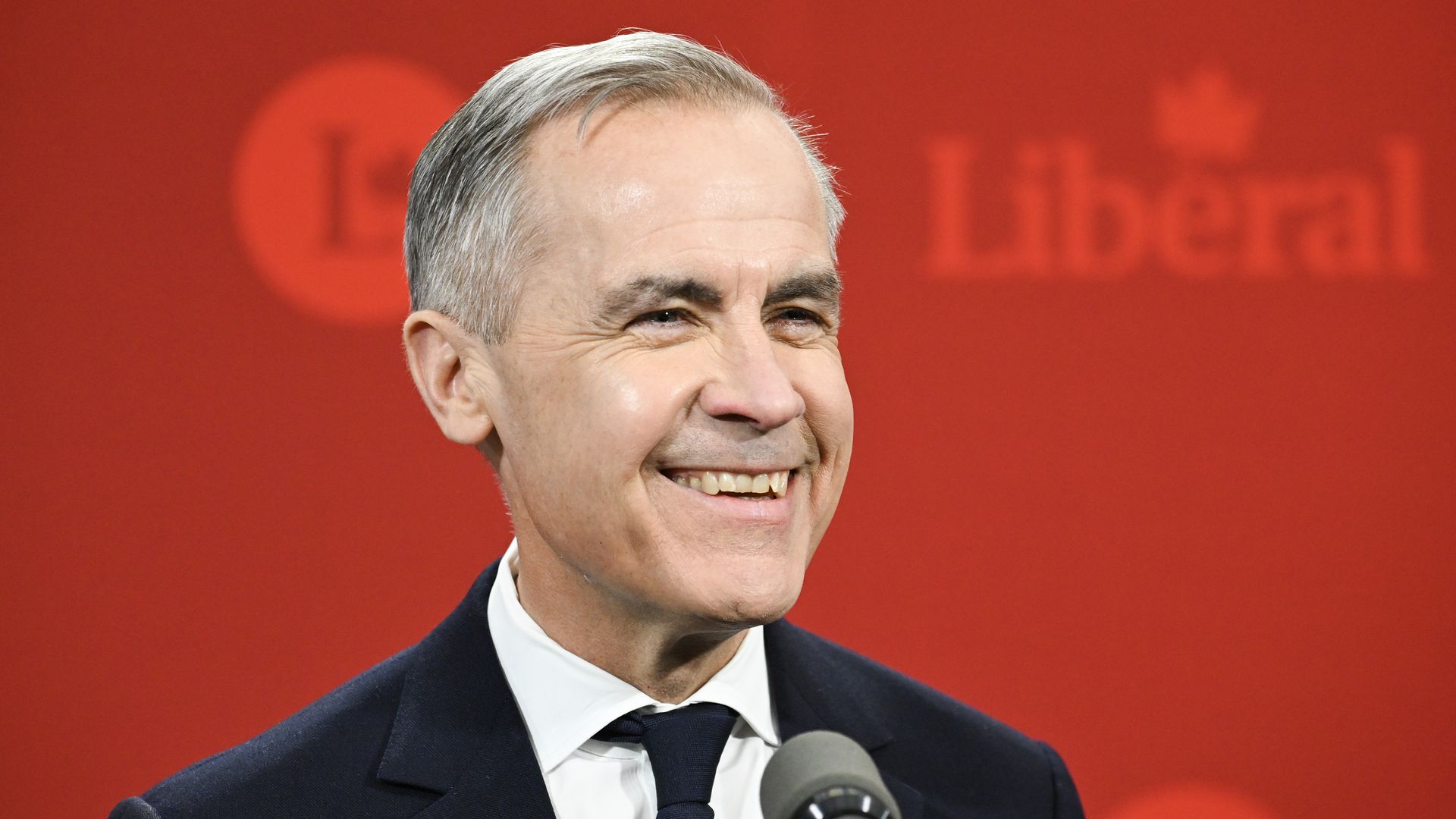
Canada's ruling Liberal Party elected a new party leader yesterday, former central bank governor Mark Carney, who will serve as the nation's next prime minister.
Why it matters: The vote for Carney, former governor of the Banks of Canada and England, comes as the Liberal Party is experiencing a polling boost amid widespread opposition to Trump's policies.
What they're saying: "These are dark days brought on by a country we can no longer trust," Carney said yesterday, in reference to U.S. tariffs, after the 59-year-old won 86% of the vote to be elected Liberal Party leader.
- "Donald Trump is trying to weaken our economy," he said.
- Carney said the plan floated by Conservative Party leader Pierre Poilievre "will leave us divided and ready to be conquered because a person who worships at the altar of Donald Trump will kneel before him, not stand up."
The big picture: Justin Trudeau resigned as Liberal Party leader in January amid deep unpopularity, as polls showed the Conservative Party was set to trounce his party in the upcoming national elections.
- Yet anti-Trump sentiment, spurred by the U.S. president's latest tariffs and boasts about making Canada the 51st state, have raised the Liberal Party's fortunes, with one poll giving it its first lead since 2021.
💠Felix's thought bubble: It's vanishingly rare for central bankers to enter electoral politics, but Carney's thumping party win shows that in Canada, at least, there's a real desire for competence rather than rhetoric.
3. The districts most vulnerable to DOGE cuts

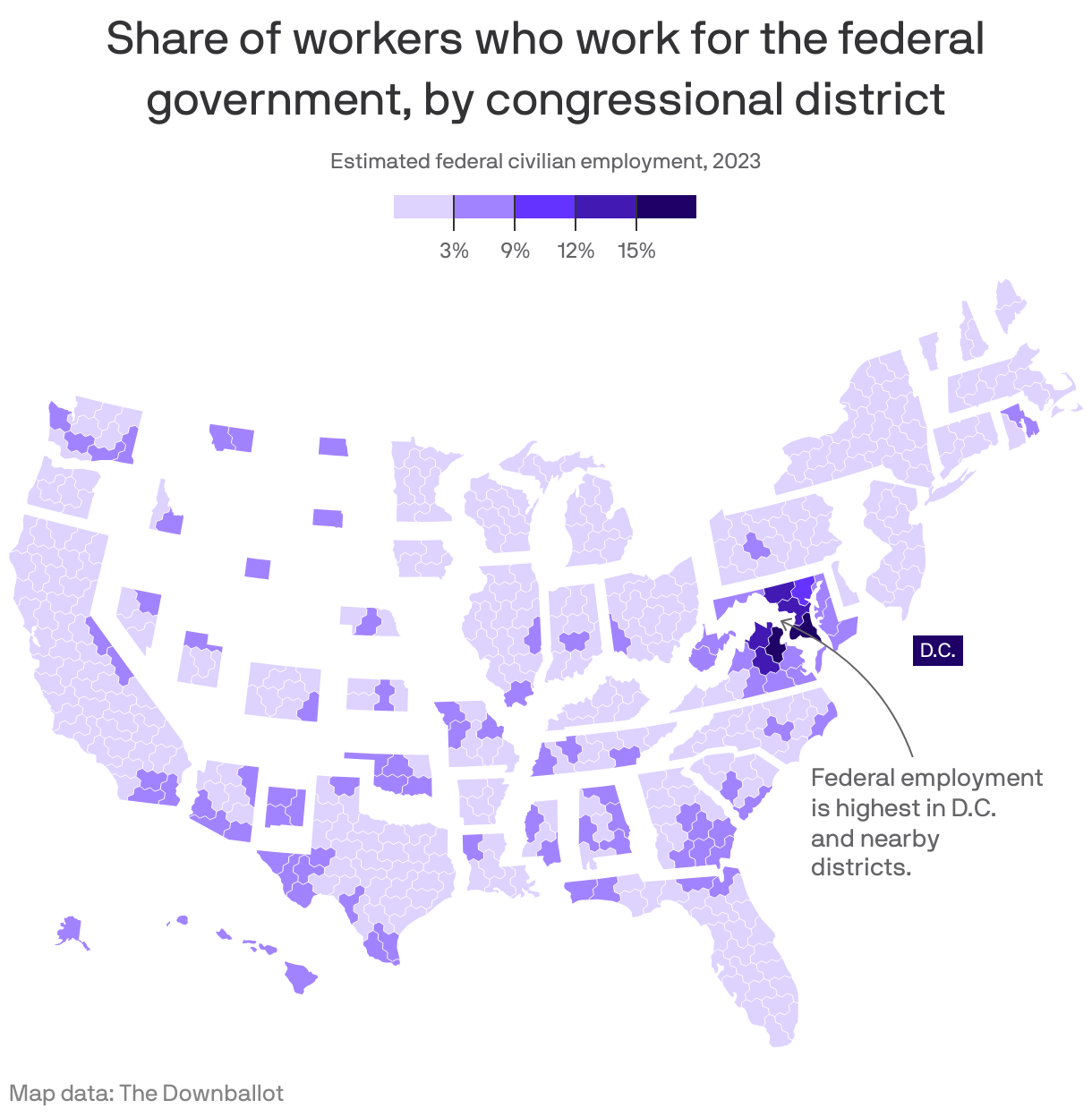
At first glance, it seems like the DOGE efforts to slash the federal workforce mainly affects the solidly Democratic districts in the D.C. metro area. Then you dig a little deeper.
Why it matters: Of the 60 congressional districts that have the most federal workers, a slight majority are actually represented by Republicans, many of whom are publicly cheering on Elon Musk's hack-and-slash efforts.
- House Speaker Mike Johnson (R-La.) is on the list. So is Rep. Andy Harris (R-Md.), who leads the ultra-conservative Freedom Caucus, and Rep. Tom Cole (R-Okla.), chair of the House Appropriations Committee.
- Several of their endangered GOP incumbents — including Reps. Jen Kiggans (R-Va.) and Juan Ciscomani (R-Ariz.) — are on there as well.
By the numbers: According to a 2024 Congressional Research Service report, nearly all of the 10 districts with highest proportions of federal workers are in D.C., Virginia or Maryland.
- As Axios' Cuneyt Dil recently noted, D.C. is essentially a company town where the factory is the vast federal government bureaucracy. Many of its workers live in the surrounding suburbs and exurbs.
- Once you get past the top 10, ruby red states such as Oklahoma, Alabama and Texas start to show up more.
Between the lines: Even as they have applauded DOGE's cuts publicly, some Republicans have privately expressed pause at Musk's ruthless tactics.
- "It would be more helpful if some of those DOGE folks showed more sensitivity to the people who are being terminated this way...who didn't do anything wrong," one House Republican told Axios last month.
Thanks to Ben Berkowitz for editing and Anjelica Tan for copy editing. See you tomorrow!
Sign up for Axios Markets